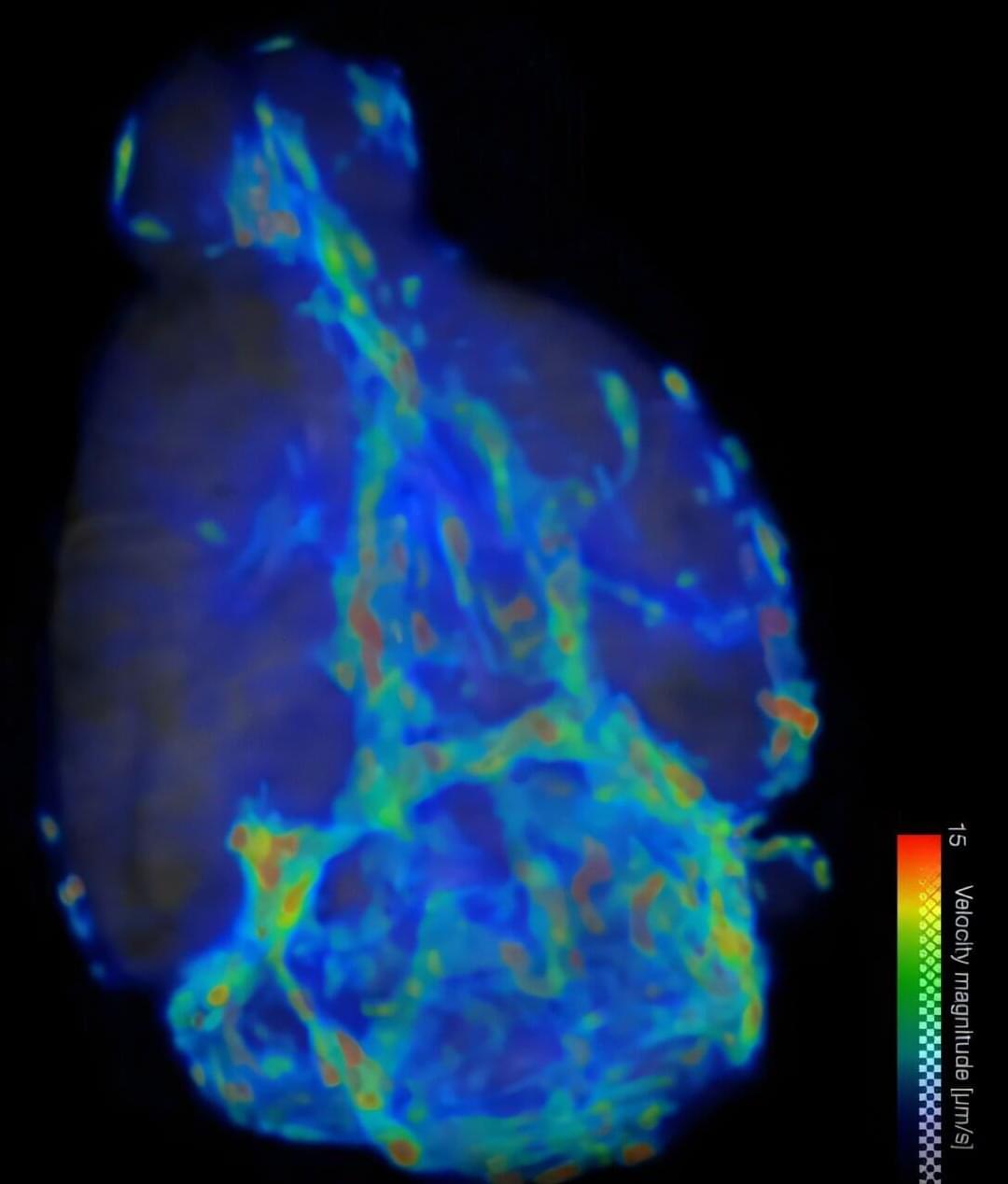
When a person goes into deep sleep, waterlike fluid circulates around the brain, washing away metabolic waste that is linked to diseases such as Alzheimer’s. This process, known as the glymphatic system, was first described in 2012 by Maiken Nedergaard, a pioneering neuroscientist and co-director of the University of Rochester Center for Translational Neuromedicine.
But questions remain about the system’s mechanics—notably, how quickly the fluid circulates around the brain. Studying the circulation within a living brain is difficult to do without causing irreparable harm to a subject.
“You can put a microscope on a small patch of the brain and watch what’s happening there with a lot of detail, and we’ve worked with that type of data in the past, but it’s only a tiny view of the overall process,” says Professor Douglas Kelley from the University of Rochester’s Department of Mechanical Engineering.