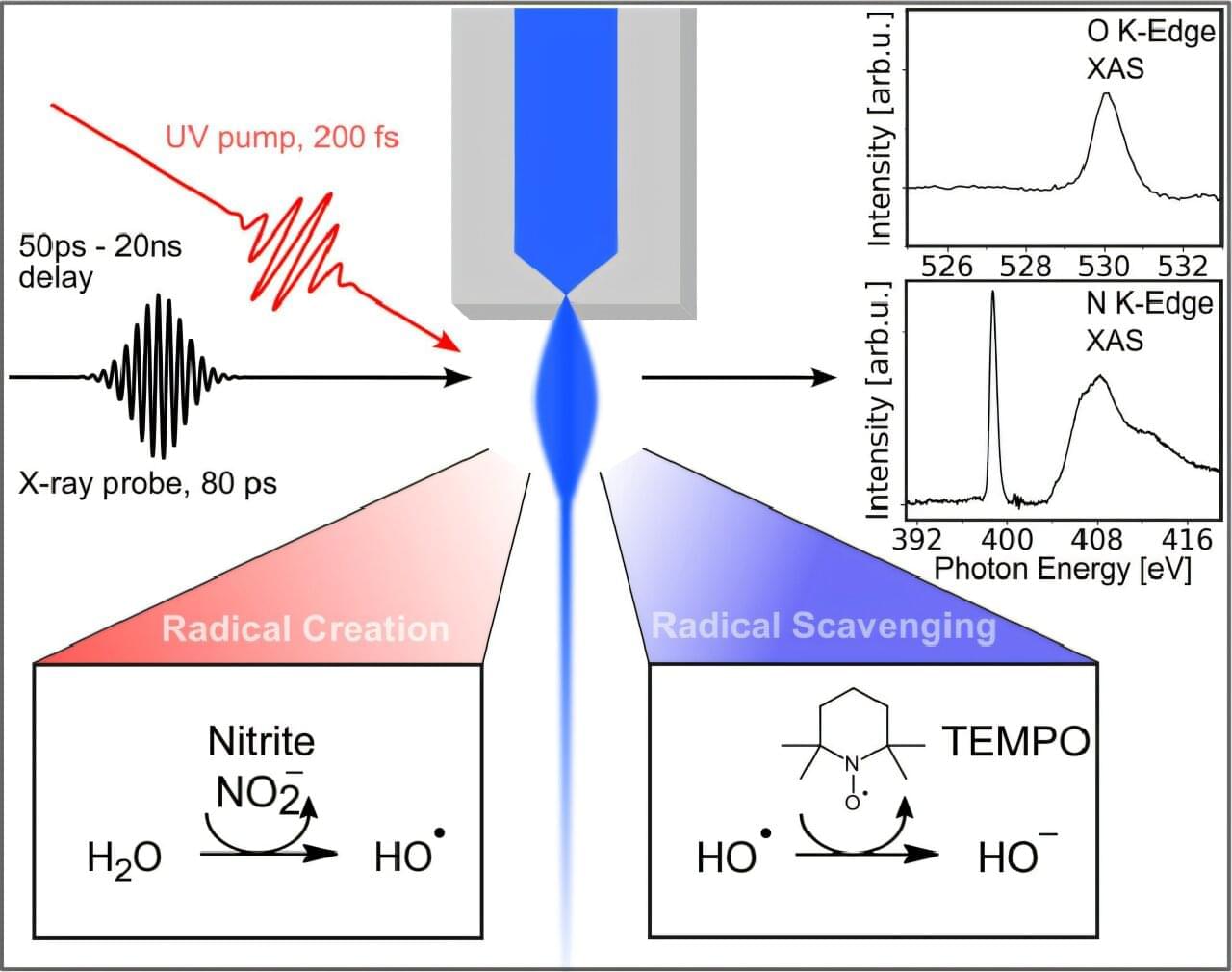
How do radicals form in aqueous solutions when exposed to UV light? This question is important for health research and environmental protection. For example, with regard to the overfertilization of water bodies by intensive agriculture. A team at BESSY II has now developed a new method of investigating hydroxyl radicals in solution. By using a clever trick, the scientists gained surprising insights into the reaction pathway. The findings are published in the Journal of the American Chemical Society.
Hydroxyl radicals (OH·) are found everywhere, from the troposphere to the cells of the human body. There, they cause oxidative stress and accelerate the aging process. They are also increasingly present in rivers and lakes, where they are formed by the photolysis of nitrogen oxides that have entered the water from over-fertilized soils. When UV radiation from sunlight strikes nitrogen oxides, hydroxyl radicals and a range of other radicals are generated. The chemistry of these radicals is extremely difficult to characterize accurately, as they react very quickly.
A team led by Professor Alexander Föhlisch of the HZB has investigated the chemistry of hydroxyl radicals formed from nitrogen oxides in water using X-ray absorption spectroscopy at the BESSY II X-ray source.