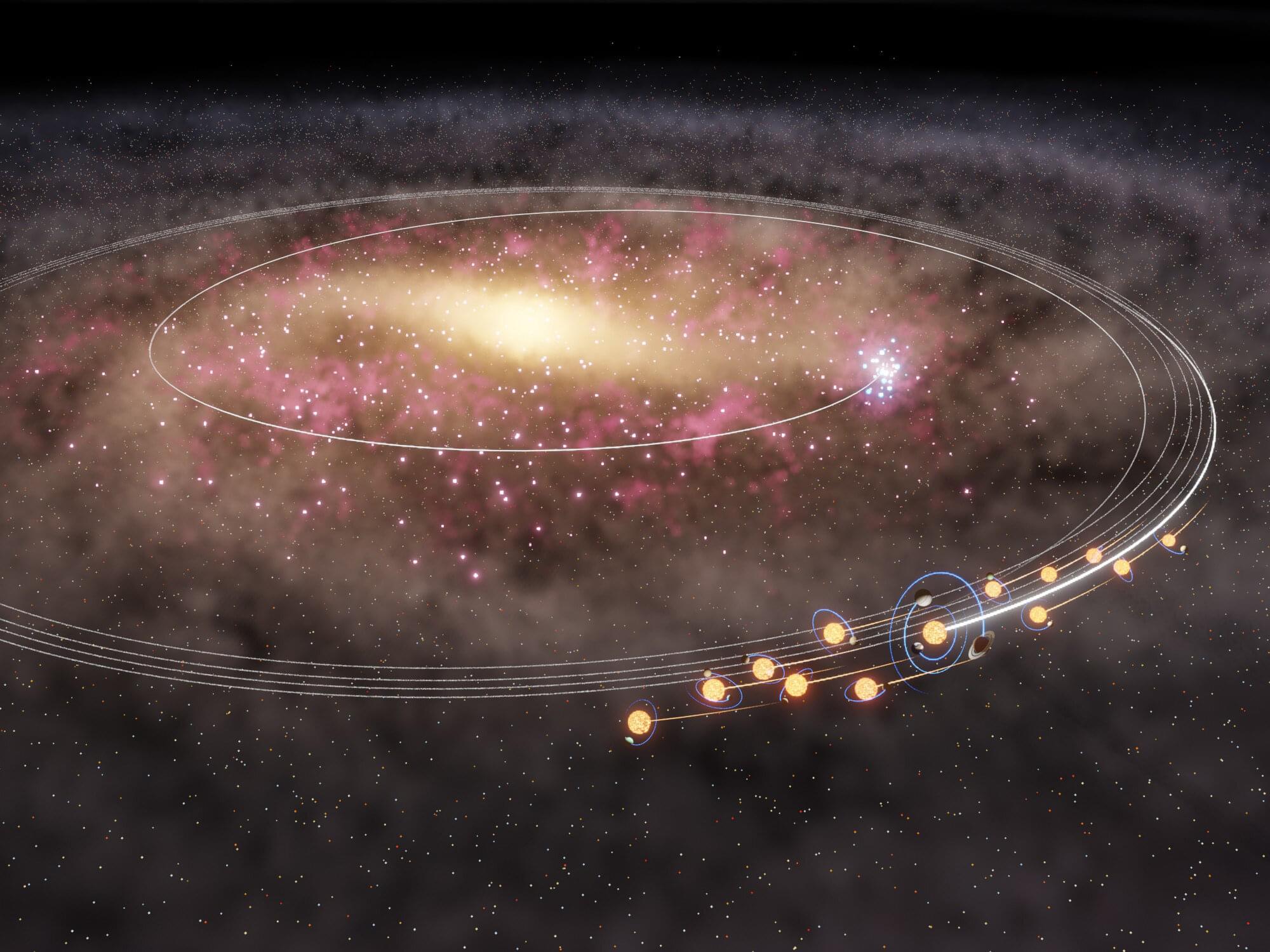
Researchers have uncovered evidence for our sun joining a mass migration of similar “twins” leaving the core regions of our galaxy, 4 to 6 billion years ago. The team created and studied an unprecedentedly accurate catalog of stars and their properties using data from the European Space Agency’s Gaia satellite. Their discovery sheds light on the evolution of our galaxy, particularly the development of the rotating bar-like structure at its center.
While archaeology on Earth studies the human past, galactic archaeology traces the vast journey of stars and galaxies. For example, scientists know that our sun was born around 4.6 billion years ago, more than 10,000 light years closer to the center of the Milky Way than we are today.
While studies of the composition of stars support this theory, this has long proven a conundrum for scientists. Observations reveal an enormous bar-like structure at our galactic center which creates a “corotation barrier,” which makes it difficult for stars to escape so far from the center.