Monash University researchers have captured the exact atomic movements that write data to next-generation memory devices, which could pave the way for smaller, faster and more energy-efficient electronics. Published in Nature Communications, the study was led by Dr. Kousuke Ooe, a Japan Society for the Promotion of Science (JSPS) postdoctoral fellow in the School of Physics and Astronomy at Monash University who is first author of the paper, in collaboration with Australian Laureate Professor Joanne Etheridge and researchers from the Japan Fine Ceramics Center, Kyoto University, and the University of Osaka.
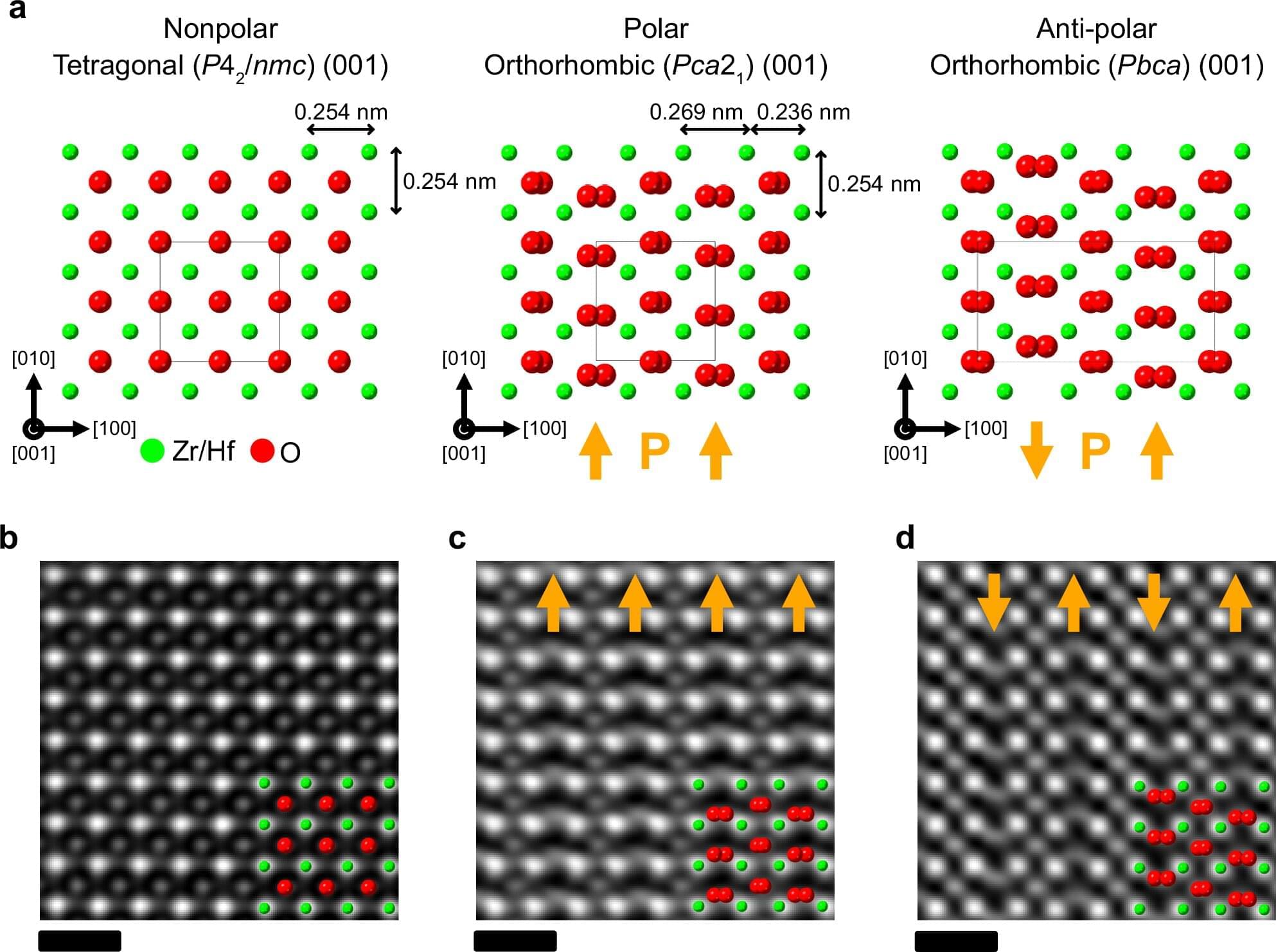
Using advanced electron microscopy at the Monash Center for Electron Microscopy (MCEM), the team captured atomic-scale movements inside promising memory materials, known as fluorite-type ferroelectrics, that could overcome current limits to how small and efficient memory devices can become.
Everyday technologies, such as smartphones, medical devices, wearable electronics and contactless IC cards used in public transport, store data as billions of digital 1s and 0s. In these materials, the physical position of an atom acts like a “switch”—and moving an atom just a fraction of a nanometer is what flips a data bit from a 0 to a 1.