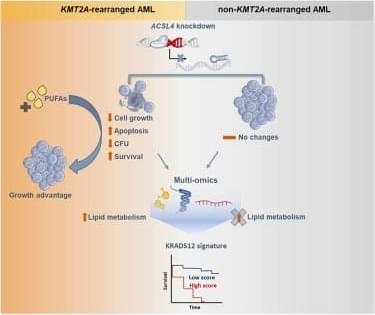
Schäfer et al. identify ACSL4 as a selective vulnerability in KMT2A-rearranged AML. ACSL4 knockdown impairs leukemic growth in vitro and in vivo by reprogramming lipid metabolism, which can be rescued by polyunsaturated fatty acids (PUFAs). A KRADS12 signature derived from ACSL4-dependent cells is associated with poor patient survival.