🔥 New and HOT in Chemical Science!
“” by Kai Mundsinger (Queensland University of Technology, Australia), Christopher Barner-Kowollik (Queensland University of Technology, Australia and Karlsruhe Institute of Technology, Germany), et al.
Read it for free.
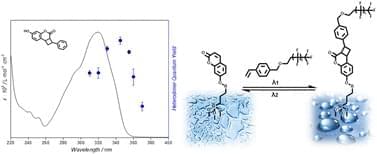
We report the first wavelength-dependent quantum yields of a [2 + 2] photocycloaddition generating the heterodimers of 7-hydroxycoumarin (7HCou) and styrene via a photochemical action plot. The wavelength-dependent heterodimer quantum yields are quantified at a constant number of photons at each wavelength between 310 and 370 nm. The resulting wavelength-dependent quantum yields demonstrate that the heterodimer is most efficiently generated at 345 nm, red-shifted by close to 25 nm compared to the absorption maximum of 7HCou at 320 nm. We subsequently translate these findings to photochemical surface functionalization by exploiting heterodimer formation between a surface bound coumarin derivative and para-styrene perfluoroalkyl ether (StyPFA) on surfaces under 345 nm irradiation to reversibly modulate surface hydrophobicity. The reversibility of the surface heterodimerization is demonstrated by removing StyPFA under UVC irradiation, and re-functionalization on the same surface. Functional heterodimer formation and the reversibility of the reaction on surface are followed via surface-sensitive X-ray photoelectron spectroscopy (XPS) and contact angle measurements. We subsequently apply our photochemical surface functionalization strategy to a dual cure photoresin based on a polyurethane-acrylate interpenetrating network, without deterioration of its mechanical properties, thereby confirming the feasibility of a photocycloaddition-based functionalization strategy for photoresins.