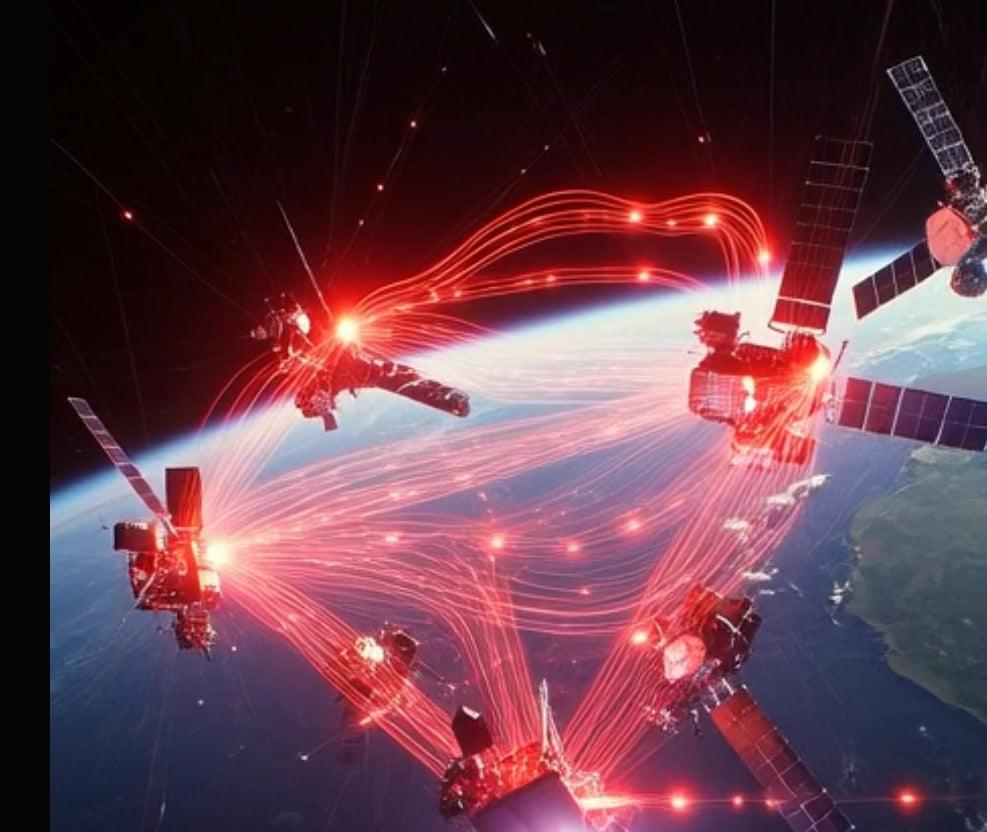
In a bold fusion of SpaceX’s satellite expertise and Tesla’s AI prowess, the Starthink Synthetic Brain emerges as a revolutionary orbital data center.
Proposed in Digital Habitats February 2026 document, this next-gen satellite leverages the Starlink V3 platform to create a distributed synthetic intelligence wrapping the planet.
Following SpaceX’s FCC filing for up to one million orbital data centers and its acquisition of xAI, Starthink signals humanity’s leap toward a Kardashev II civilization.
As Elon Musk noted in February 2026, ]
“In 36 months, but probably closer to 30, the most economically compelling place to put AI will be space.”
## The Biological Analogy.
Starthink draws from neuroscience: * Neural Cluster: A single Tesla AI5 chip, processing AI inference at ~250W, like a neuron group. * Synthetic Brain: One Starthink satellite, a 2.5-tonne self-contained node with 500 neural clusters, solar power, storage, and comms. * Planetary Neocortex: One million interconnected Brains forming a global mesh intelligence, linked by laser and microwave “synapses.”
This hierarchy mimics how human cognition arises from billions of neurons via trillions of synapses. ## ## Architecture of Distributed Intelligence.
*At chip level, AI5 clusters handle inference*
. At satellite level, each Brain integrates V3 bus with enhanced solar (125 kW) and compute.
At constellation scale, Brains connect via 4x 200 Gbps lasers (800 Gbps aggregate) for low-latency sharing, plus Ka-band arrays for ground relay.
The FCC proposes 500–2,000 km orbits: sun-synchronous for steady “deep processing,” lower inclination for burst “attention.”
Expansion to cislunar space could link Earth-Lunar neocortices across 400,000 km. ## ## Why Orbital AI?
Terrestrial data centers strain power grids (sold out to 2030), water, and land. Orbit offers ~1,361 W/m² solar—5x Earth efficiency, no clouds or nights in sun-synchronous paths. Starthink scales V3’s 20 kW to 125 kW with four wings (700 kg).
Economics: Starship’s 200t payload enables 80 Brains per flight, targeting 100 GW annual compute from one million tonnes launched. ## Technical Specifications.
Built on Starlink V3 (~1,500 kg, 20 kW), Starthink adds: * Solar: 4x multi-junction PV wings, 125 kW continuous, 700 kg. * Compute: 500 AI5 chips (400 active, 100 spares) on 50 boards, ~500x NVIDIA H100 equivalent, 125 kW draw, 200 kg total. * Storage: 2x 300 kWh Tesla Megapack Orbital modules (600 kWh, 700 kg), providing 4.8 hrs compute backup or 3.4 hrs full load—essential for demand spikes, eclipses, and radiation events despite Musk’s no-battery claim. * Thermal: Ammonia-loop radiators reject 125 kW, 250 kg. * Comms: 4x laser ISLs, 2x Ka-band arrays, 1x 1 Tbps optical uplink. * Orbital: 500–2,000 km LEO, 5-year life, Hall-effect thrusters. * Mass Breakdown: Power/storage 56.6%, bus 14.1%, thermal 10.1%, compute 8.1%. ## Bill of Materials (Unit 1)
Initial BOM: $3.4M, 2,475 kg. Key costs: AI5 chips ($1.5M), V3 bus ($1.2M). Masses: Solar/energy 1,400 kg combined. ## Wright’s Law Projections.
Using 12% learning rate (SpaceX empirical 5–8% composite with Tesla/semiconductor curves), costs drop from $2.2M (2027) to $263K at 1M Brains (2033).
Forecast: ## By 2040: 204M Brains, 25.5M MW, $100K/unit. At 1M Brains, 500M clusters deliver 132 GW—cheaper than today’s H100 racks. ## Competitive Edge and Outlook.
SpaceX leads over Google’s Suncatcher, Blue Origin’s TeraWave: lowest launch costs, V3 production (6+/day), vertical integration.
Starthink paves the way for solar system-scale intelligence.
For the complete proposal, including detailed production, economic, and scaling forecasts from 2027 to 2040.
Download the full document and Excel model at:
[SpaceX Starthink Synthetic Brain](https://cdn.shopify.com/s/files/1/1295/2229/files/SpaceX_Sta…1770812767)
[Supplementary Content (xls)](https://cdn.shopify.com/s/files/1/1295/2229/files/Starthink_1.xlsx?v=1770812957)
[Starthink Cluster Imagining ](https://grok.com/imagine/post/39164936-4766-4d39-a2d…atform=web)
More: [ https://digitalhabitats.global/blogs/starthink/spacex-starth…orbital-ai](https://digitalhabitats.global/blogs/starthink/spacex-starth…bital-ai)[ ](https://www.facebook.com/sharer.php?u=)