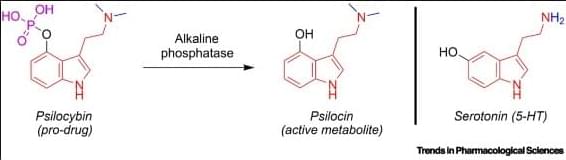
Psilocybin, a serotonergic psychedelic, is gaining attention for its rapid and sustained therapeutic effects in depression and other hard-to-treat neuropsychiatric conditions, potentially through its capacity to enhance neuronal plasticity. While its neuroplastic and therapeutic effects are commonly attributed to serotonin 2A (5-HT2A) receptor activation, emerging evidence reveals a more nuanced pharmacological profile involving multiple serotonin receptor subtypes and nonserotonergic targets such as TrkB. This review integrates current findings on the molecular interactome of psilocin (psilocybin active metabolite), emphasizing receptor selectivity, biased agonism, and intracellular receptor localization.