As organisms develop from embryos, groups of cells migrate and reshape themselves to form all manner of complex tissues. There are no anatomical molds shaped like lungs, livers or other tissues for cells to grow into. Rather, these structures form through the coordinated activity of different types of cells as they move and multiply.
No one is sure exactly how cells manage this collective construction of complex tissue, but a study by Brown University engineers could offer some new insights.
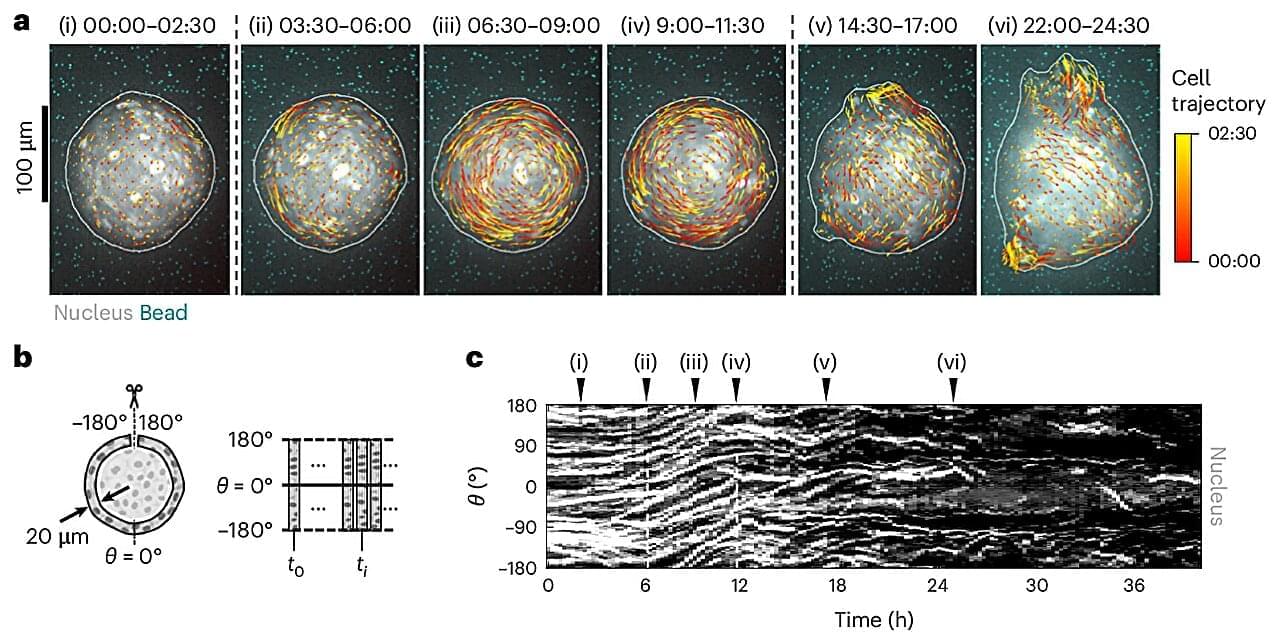
The study, published in Nature Physics, looked at how human epithelial cells behave as spherical aggregates confined inside a collagen matrix. The research revealed surprising ways in which cell clusters first rotate collectively within the confined space, then eventually reconfigure their surroundings to allow individual cells to venture out of the sphere.