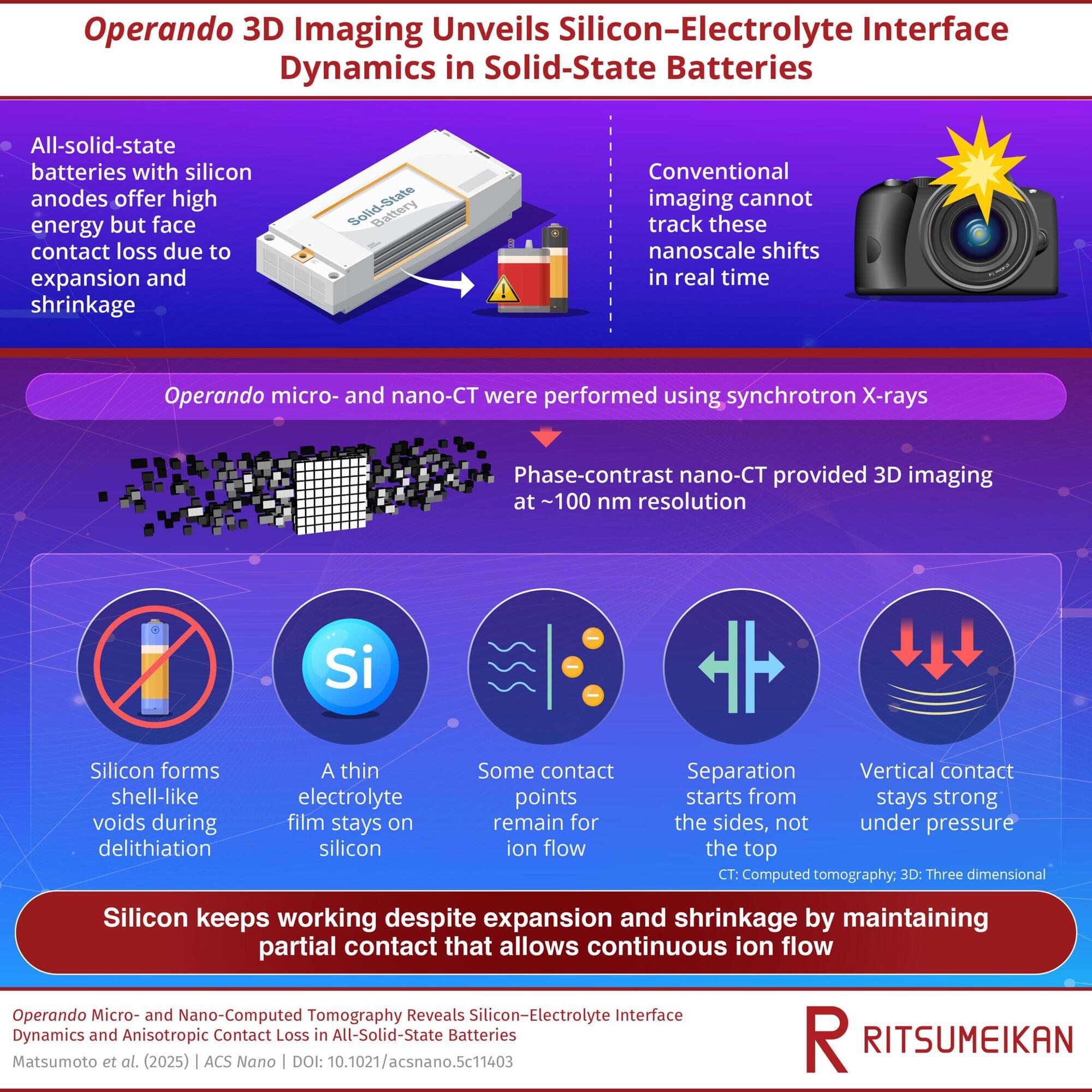
All-solid-state batteries (ASSBs) using silicon (Si) anodes are among the most promising candidates for high-energy and long-lasting power sources, particularly for electric vehicles. Si can store more lithium than conventional graphite, but its volume expands by roughly 410% during charging. This swelling generates mechanical stress that cracks particles and weakens their contact with the solid electrolyte, disrupting the flow of ions and reducing efficiency.
To address this, a research group led by Professor Yuki Orikasa from the College of Life Sciences, Ritsumeikan University, along with Ms. Mao Matsumoto, a graduate student at the Graduate School of Life Sciences, Ritsumeikan University (at the time), and Dr. Akihisa Takeuchi from the Japan Synchrotron Radiation Research Institute, used operando synchrotron X-ray tomography with nanometer resolution to observe what happens inside these batteries as they charge and discharge in real time.
Their paper is published in ACS Nano.