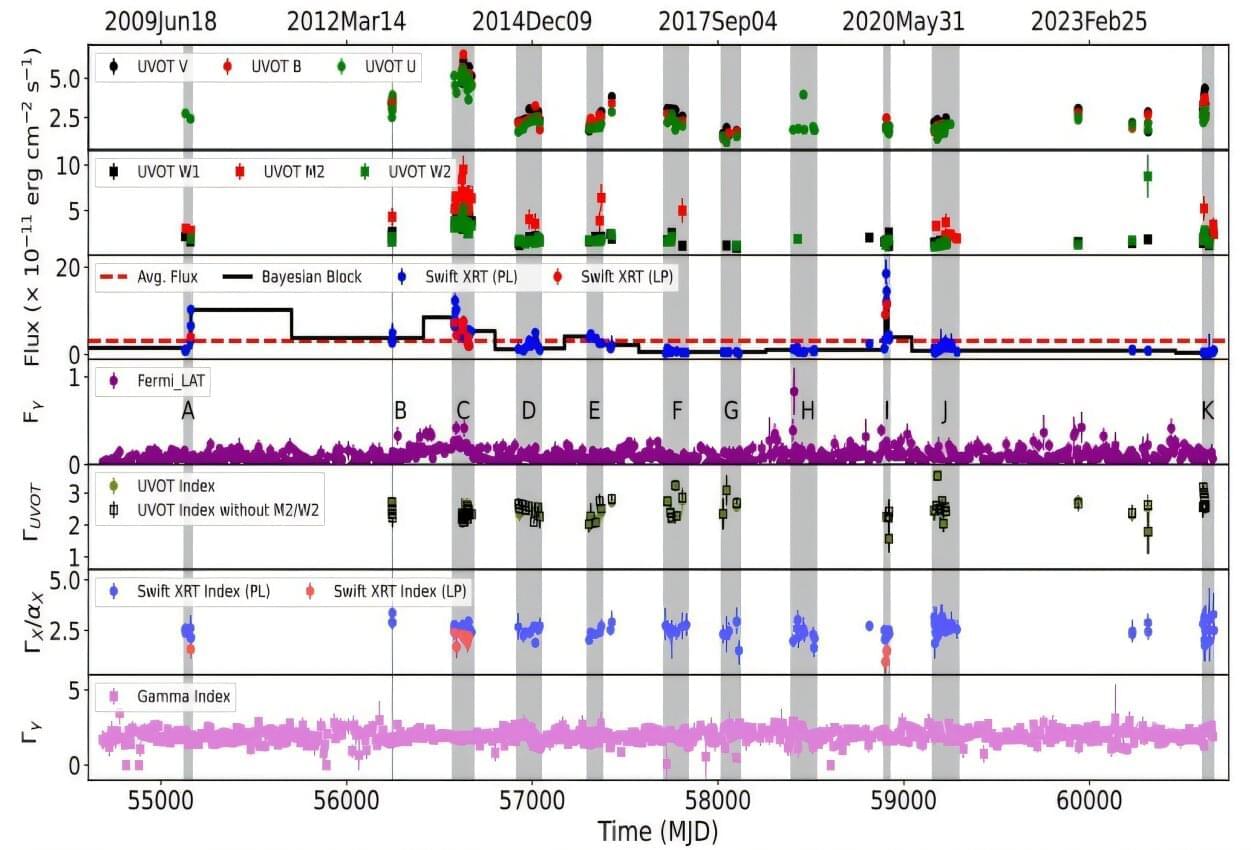
Using NASA’s Swift and Fermi space telescopes, Indian astronomers have conducted a long-term multiwavelength study of a nearby blazar designated TXS 0518+211. Results of the study, published Nov. 26 on the arXiv pre-print server, reveal the complex nature of this object.
Blazars are very compact quasi-stellar objects (quasars) associated with supermassive black holes (SMBHs) at the centers of active, giant elliptical galaxies. They are the most luminous and extreme subclass of active galactic nuclei (AGNs). The characteristic features of blazars are highly collimated relativistic jets pointed almost exactly toward Earth.
Blazars are usually divided by astronomers into two classes, based on their optical emission properties: flat-spectrum radio quasars (FSRQs) that feature prominent and broad optical emission lines, and BL Lacertae objects (BL Lacs), which do not.