Schizophrenia stems from abnormal brain development, which can begin even before birth. Yet symptoms typically don’t appear until later in life.
“For a long time, the brain is able to compensate for developmental errors and maintain relatively normal function. But at some point, it’s like a chain snapping — the brain can no longer compensate, and that’s when symptoms emerge. Until that point, however, prevention should be possible,” says one of the study’s first authors.
They investigated when this turning point occurs. By tracking brain development from the fetal stage to adulthood, they found that dramatic changes happen late in the brain’s development. Up until the transition from childhood to adolescence, molecular and functional changes in the brain were rather minor, likely explaining lack of symptoms before adolescence.
The researchers have worked with mice carrying a specific genetic mutation known as “15q13.3 microdeletion syndrome.” In humans, this syndrome is associated with epilepsy, schizophrenia, autism, and other neurodevelopmental disorders.
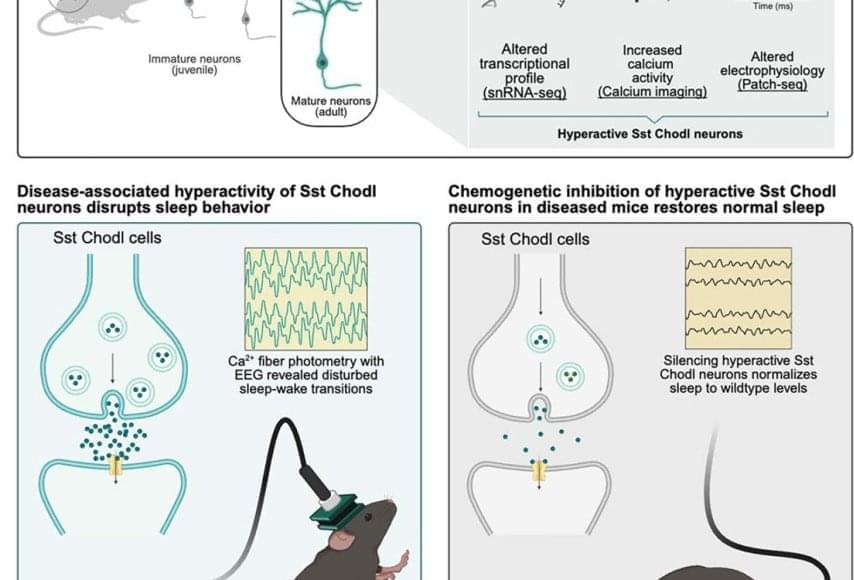
“We know that sleep is often disrupted in people with psychiatric disorders, so we chose to use sleep as a behavioral marker—something we could observe. We examined both the mice’s behavior and the activity of a specific type of brain cell. Our findings show that one particular cell type (γ-aminobutyric acid (GABAergic) projecting neurons) is significantly affected in the test animals compared to healthy mice,” explains the author.
These GABAergic rare brain cells are often overlooked because they make up only a tiny fraction of the brain’s total cell population. Nevertheless, they play a crucial role in regulating many brain functions.
The new study not only demonstrates a link between this specific type of brain cell and sleep — it also shows that the mice’s sleep patterns began to resemble those of healthy mice when researchers reduced the activity of the cell type in question.
For many people living with schizophrenia, cognitive challenges are part of daily life. Alongside well-known symptoms such as hallucinations and delusions, these difficulties can make it hard to live the life they want. That is why researchers are working to find ways to prevent such symptoms — and they may now be one step closer.
In a new study, researchers discovered that a specific type of brain cell is abnormally active in mice displaying schizophrenia-like behavior. When the researchers reduced the activity of these cells, the mice’s behavior changed.
“Current treatments for cognitive symptoms in patients with diagnoses such as schizophrenia are inadequate. We need to understand more about what causes these cognitive symptoms that are derived from impairments during brain development. Our study may be the first step toward a new, targeted treatment that can prevent cognitive symptoms,” says one of the researchers behind the study.