The U.S. Cybersecurity and Infrastructure Security Agency (CISA) is warning that attackers are exploiting vulnerabilities in the iCagenda and Balbooa Forms extensions for Joomla to achieve remote code execution through arbitrary file uploads.
The agency has categorized the flaws as a maximum priority, ordering federal agencies to apply available security updates and/or mitigations within three days, with the deadline set for today.
The first flaw, tracked as CVE-2026–48939, is an arbitrary file upload flaw impacting the iCagenda extension used for registering and scheduling events and creating calendars.
A new version of the RedHook Android malware abuses the Android Wireless Debugging (Wireless ADB) mechanism in a novel way to gain shell-level privileges without requiring a computer connection.
Researchers at cybersecurity company Group-IB analyzed the new release of the mobile malware and say that it significantly expands its capabilities compared to the previous variant documented in 2025.
At the same time, the malware retains its remote access trojan (RAT) features, allowing it to stream the screen, intercept keystrokes, automate UI interactions, and steal credentials.
Darwin spent his life trying to find the law that governs evolution. He knew it existed — he just never found it. Stephen Wolfram thinks he has. And it explains a lot more than evolution.
Stephen Wolfram is a mathematician, complexity theorist, and the mind behind Wolfram Alpha and Mathematica — someone who has spent his career finding the hidden rules underneath reality itself.
The same principle that explains why evolution never gets stuck, why you have free will despite living in a deterministic universe, and why the laws of physics are the way they are turns out to say something profound about what it means to be alive.
0:00 Intro. 1:08 Chapter 1: The limits of theoretical physics. 5:50 Chapter 2: A computational understanding of the world. 12:03 Rule 30: a simple program that outputs pure randomness. 15:48 Evolution and machine learning are the same trick. 18:19 What computational irreducibility means for science. 25:00 Chapter 3: A new kind of theory of everything. 31:36 The ruliad: every possible computation, in one object. 35:03 The second law, explained by the limits of our minds. 38:38 Why the universe exists isn’t the real question — why we do is. 42:53 Chapter 4: If the universe is a program, what is the meaning of life? 44:59 Free will as a side effect of computational irreducibility. 48:06 AI as a civilization we’re learning to coexist with.
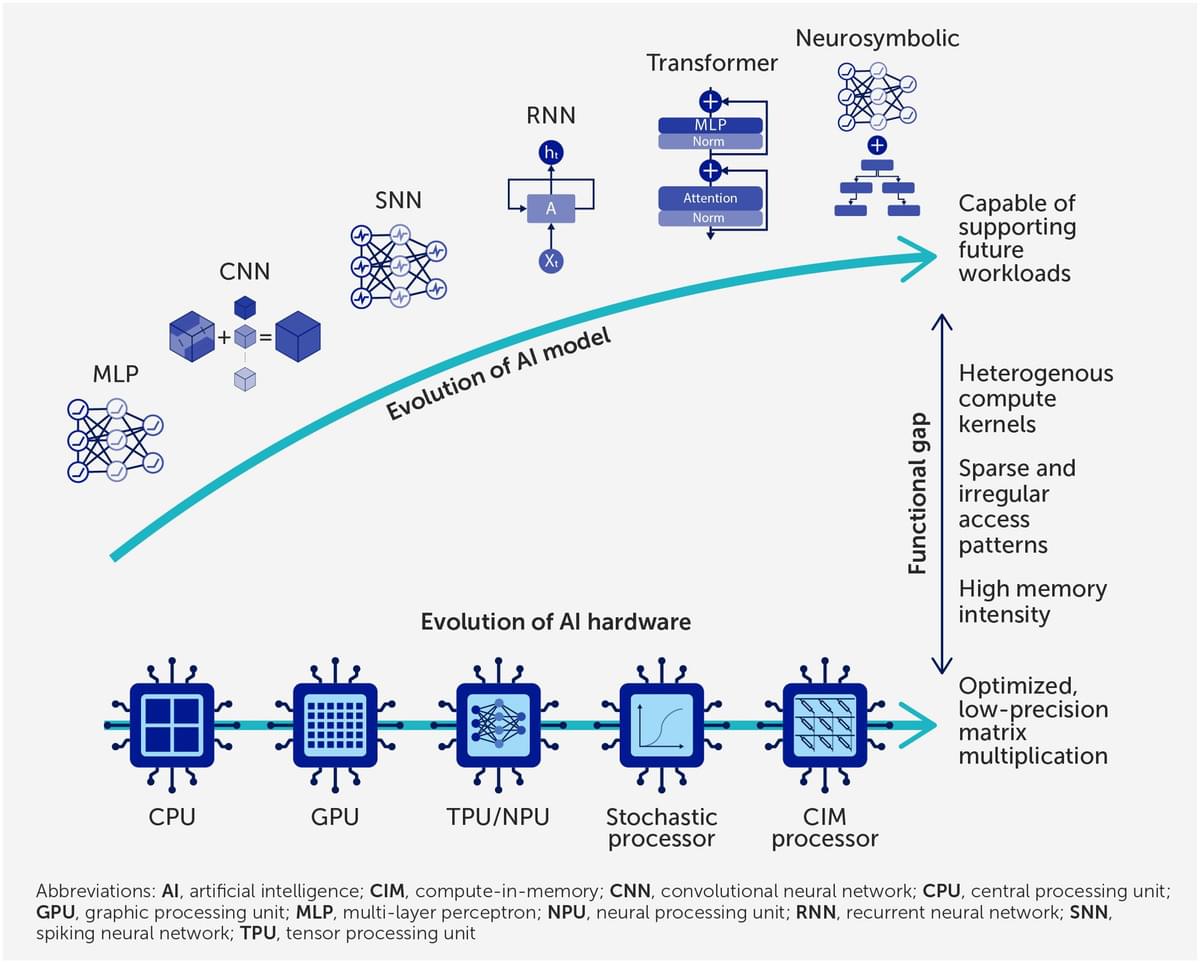
The automotive industry, and social media necessitates the development of more efficient hardware solutions that can implement diverse learning algorithms. This lead article explores the evolution of AI learning algorithms and their computational demands, using autonomous drone navigation as a case study to highlight the limitations of traditional hardware. Traditional hardware, based on the von Neumann architecture, suffers from limited computational efficiency due to the separation of compute units and memory, also known as the “memory wall” problem. To overcome this barrier, this article discusses novel approaches to AI hardware design, focusing on compute-in-memory (CIM) techniques and stochastic hardware.
Two independent groups have demonstrated ways to entangle quantum bits without the need for precisely timed control pulses.
Quantum entanglement describes a link, or correlation, between the states of two or more quantum particles. For example, given a pair of entangled qubits—particles that can be in either a ground state or an excited state—measuring the state of one qubit can inform us about the state of the other. Entanglement is puzzling because it has no analogue in the classical world, where our physical intuition can be relied upon. In particular, entanglement appears to violate the principle of locality: The qubits’ states remain correlated even if we move them far apart before measuring them. But entanglement is more than a curiosity: It is also critical to quantum computing, where it serves as a resource for performing quantum algorithms and remote operations between distant qubits.
For all of medical history, we’ve tried to persuade sick cells to behave better. What if instead we just swapped them out? Can we insert new brain cells grown from your own skin cells? And what does any of this have to do with sending one’s own cells into space, or rescuing animals on the very brink of extinction? Today Eagleman talks with stem cell biologist Jeanne Loring about the exciting next horizons.
Subscribe for new episodes every week. 🛎
INNER COSMOS PODCAST: Stanford neuroscientist David Eagleman tackles wild questions that illuminate new facets of our lives. ❤️ iHeartRadio: ihr.fm/3TxDAqb. 🍎 Apple podcasts: apple.co/3LTxTkH 📢 Amazon Music: amzn.to/3ZxGM6R 🟢 Spotify: spoti.fi/3lOaXZl.
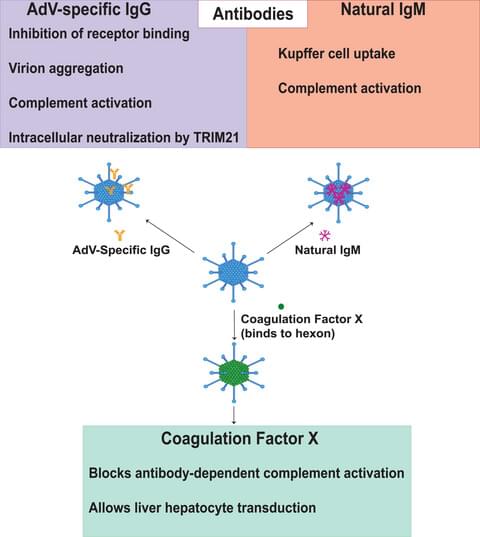
A helpful review on immunological responses to adenoviral vectors, a widely used delivery system for gene therapies, anti-tumor therapies, and vaccines.
Adenovirus (AdV) is one of the most widely used vectors for gene therapy and vaccine studies due to its excellent transduction efficiency, capacity for large transgenes, and high levels of gene expression. When administered intravascularly, the fate of AdV vectors is heavily influenced by interactions with host plasma proteins. Some plasma proteins can neutralize AdV, but AdV can also specifically bind plasma proteins that protect against neutralization and preserve activity. This review summarizes the plasma proteins that interact with AdV, including antibodies, complement, and vitamin K-dependent coagulation factors. We will also review the complex interactions of these plasma proteins with each other and with cellular proteins, as well as strategies for developing better AdV vectors that evade or manipulate plasma proteins.
More than 200 researchers and economists, including 15 Nobel laureates and researchers at OpenAI, Anthropic and Google, have called for governments and technology leaders to urgently create policies and institutions to address the economic impact of AI.
Engineers have developed a new way to pull carbon dioxide directly from the atmosphere using a process similar to charging and discharging a battery—an advance that could help address the planet’s excess CO2 problem.
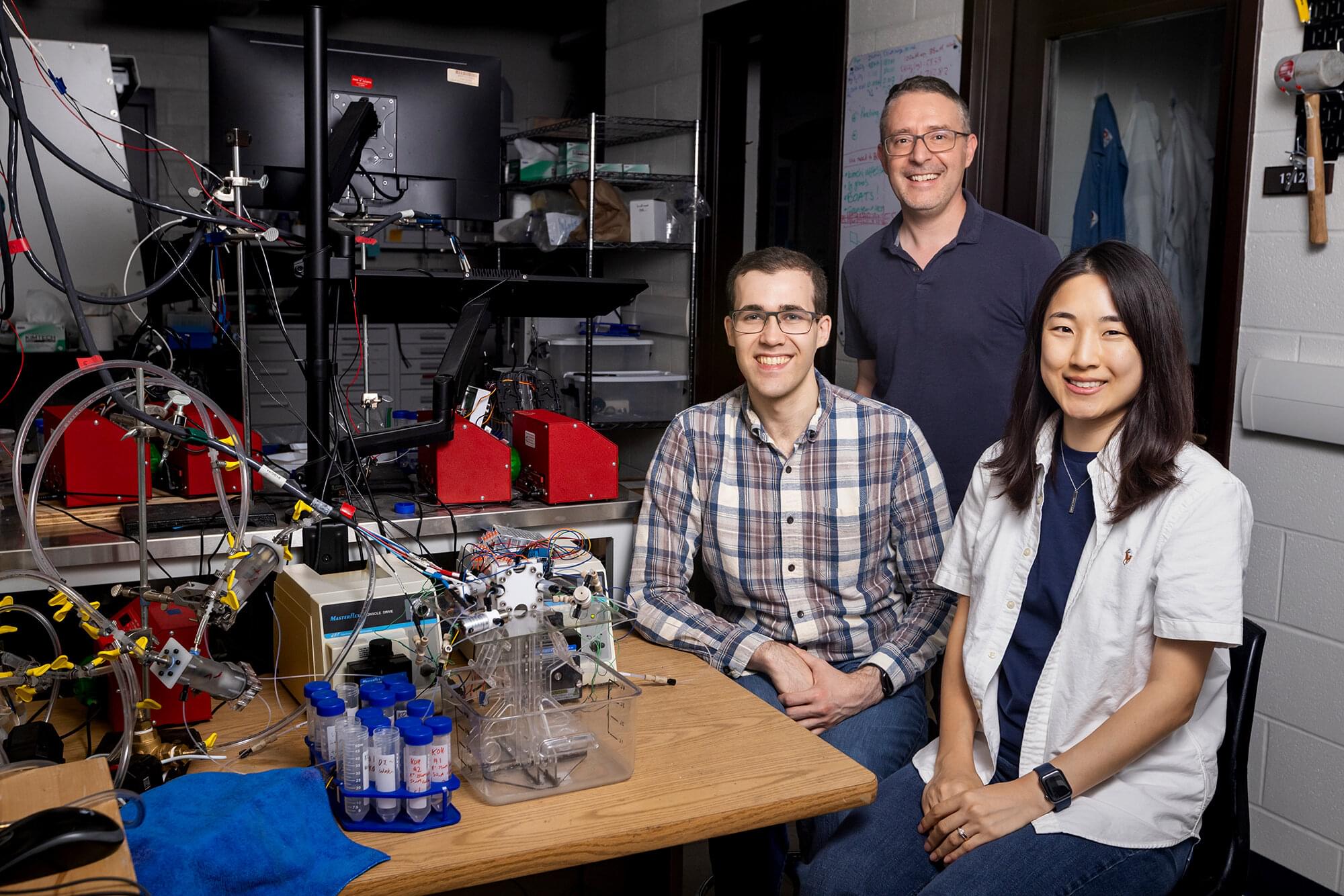
A new collaborative study between scientists at the University of Illinois Urbana-Champaign and Toyota focuses on direct air capture, a technology designed to reduce new emissions and remove CO2 that has already accumulated in the atmosphere. Instead of using heat to absorb and release CO2, as many carbon capture methods do, the new method uses electricity and water-based chemistry within an electrochemical device.
The results of the study by mechanical engineering and science professor Kyle Smith, Illinois graduate students Paul Rozzi and JeongA Lee, and Chip Roberts and Tim Arthur from the Toyota Research Institute of North America are published in the journal Environmental Science & Technology.
Researchers at the University of Warwick and the University of Colorado Boulder have directly observed, for the first time, four white dwarfs in binary star systems in our nearby region of space. These stellar binaries are all within 65 light-years of Earth, and one contains the ninth-closest white dwarf to the sun.
The four systems each include a red dwarf companion—a larger, brighter star—making the systems appear to be single-star systems. The new results, published in MNRAS, show that each of these nearby red dwarfs hosts a hidden white dwarf companion.
First author Dr. Mairi O’Brien, a research fellow at the University of Warwick, said, “Nearby isolated white dwarfs are usually easy to find, but we couldn’t see these four stars directly in visible wavelengths because their red dwarf companions were drowning out their light. It’s a reminder that even in our own cosmic neighborhood, we can still find surprises if we look in the right way, at the right wavelengths.”