Toggle light / dark theme

Get the latest international news and world events from around the world.

Log in for authorized contributors

Hybrid ‘super foam’ uses 3D-printed struts to absorb up to 10 times more energy

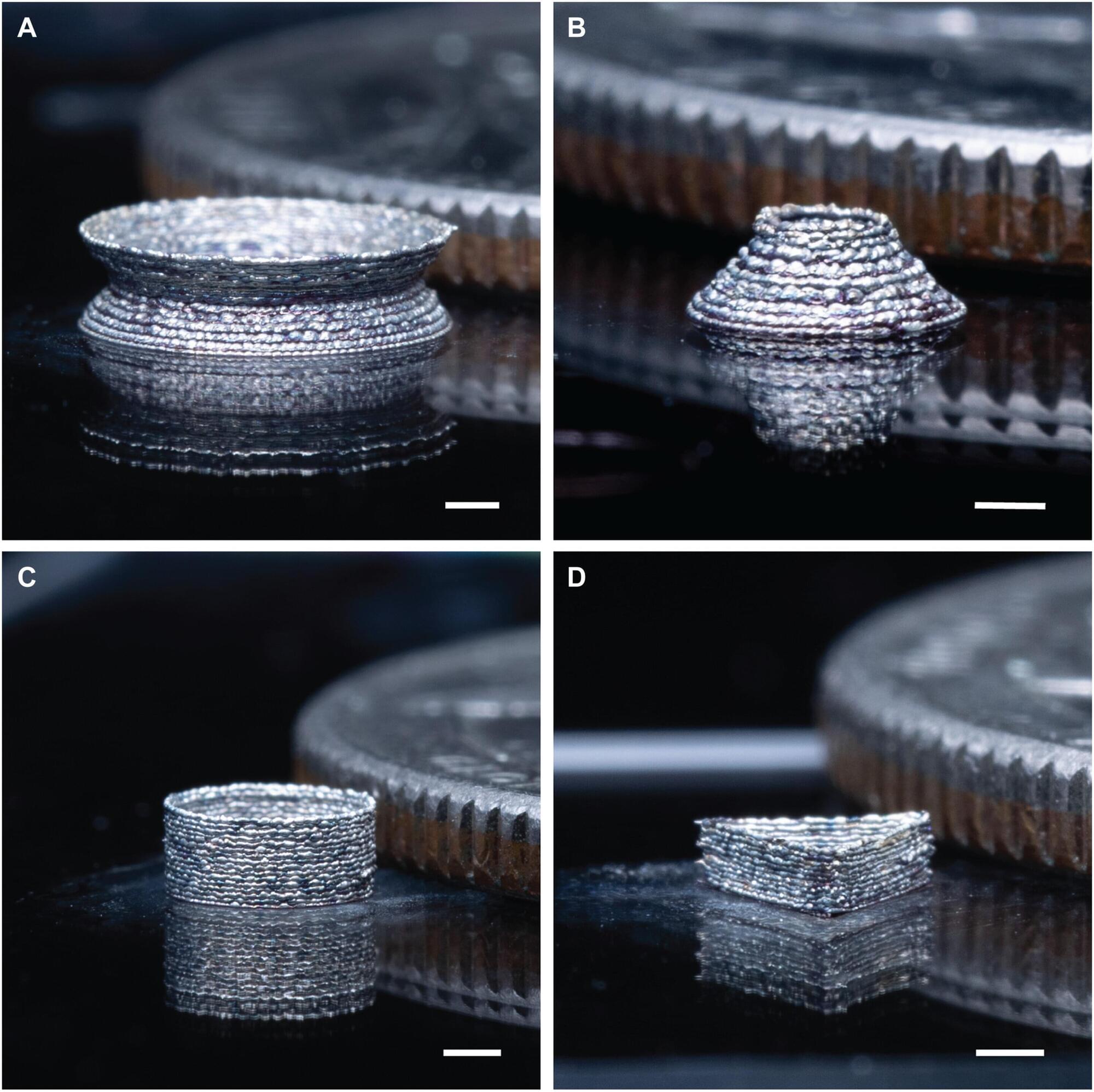
Aerospace engineering and materials science researchers at Texas A&M University and the DEVCOM Army Research Laboratory have developed a “super foam” that can absorb up to 10 times more energy than conventional padding.

The composite, published and described in the journal of Composite Structures, combines an ordinary foam with 3D-printed injections of stretchy, plastic columns known as struts.

The result? An affordable, lightweight and ultra-durable hybrid foam poised to redefine the defense, automotive, aerospace and consumer industries.

Gravitational waves reveal hidden structure of galactic centers

A new study published in Nature Astronomy indicates that the dense, star-and dark-matter–rich environments around supermassive black hole binaries pack on the order of a million solar masses into each cubic parsec. The team used gravitational-wave data from pulsar timing arrays to probe galactic centers that are otherwise impossible to observe directly.

Pulsar timing arrays (PTAs) use precise measurements of timing residuals from millisecond pulsars to detect gravitational waves at nanohertz frequencies. These arrays revealed a stochastic gravitational-wave background, an incoherent hum from countless supermassive black hole binaries spiraling together across the universe.

However, the signal carries a twist. At the lowest frequencies, the spectrum appears to turn over, deviating from predictions for binaries evolving purely under gravitational-wave emission. That bend suggests that something in the environment, or highly eccentric orbits, is reshaping how these massive binaries lose energy and tighten over time.

Cheek cells may provide clues to schizophrenia risk

A simple cheek swab could one day provide a quick and noninvasive diagnostic test for schizophrenia. A new study published in Science Advances has identified higher levels of two biological markers in the cheek swabs of patients with schizophrenia compared with people who don’t have this mental health disorder. Schizophrenia is a long-term condition with a range of symptoms including hallucinations, delusions, muddled thoughts and loss of interest in everyday activities.

There is no single test for the illness, and diagnosis can be challenging because symptoms vary widely between people and typically relies on observing a patient’s behavior. It can, therefore, sometimes take months for a professional to make a diagnosis with any degree of certainty, as they have to rule out other possible causes. That is a lot of time for someone to wait without the right treatment if it is needed.

So researchers led by a team at Rutgers University in New Jersey decided to investigate whether molecular signatures in easy-to-collect buccal (cheek) cells could serve as reliable biomarkers.

Astronomers may have just found one of the missing links in galaxy evolution

A team of 48 astronomers from 14 countries, led by the University of Massachusetts Amherst, has discovered a population of dusty, star-forming galaxies at the far edges of the universe that formed only a billion years after the Big Bang, believed to have occurred 13.7 billion years ago. The galaxies may represent a snapshot in the galactic life cycle, linking recently discovered ultradistant bright galaxies formed 13.3 billion years ago with early “quiescent” (dead) galaxies that stopped forming stars about two billion years after the Big Bang.

Challenging what we know about cosmos The new discovery challenges current models of the universe, making the findings, published in The Astrophysical Journal Letters, a step toward revising cosmic history.

“My research involves trying to identify and understand a population of rare, dusty star-forming galaxies that were only discovered at the end of the 1990s,” says Jorge Zavala, assistant professor of astronomy at UMass Amherst and the paper’s lead author.

This new blood test could detect cancer before it shows up on scans

A new CRISPR-powered light sensor can detect the faintest molecular signs of cancer in a drop of blood. A new light-based sensor can spot incredibly tiny amounts of cancer biomarkers in blood, raising the possibility of earlier and simpler cancer detection. The technology merges DNAnanotechnology, CRISPR, and quantumdots to generate a clear signal from just a few molecules. In lung cancer tests, it worked even in real patient serum samples. Researchers hope it could eventually power portable blood tests for cancer and other diseases.

Scientists have designed a powerful light based sensor capable of detecting extremely small amounts of cancer biomarkers in blood. The innovation could eventually allow doctors to identify early warning signs of cancer and other diseases through a routine blood draw.

Biomarkers such as proteins, fragments of DNA, and other molecules can signal whether cancer is present, how it is progressing, or a person’s risk of developing it. The difficulty is that in the earliest stages of disease, these markers exist in extremely low concentrations, making them hard to measure with conventional tools.

A CRISPR-based mitochondrial gene therapy tool derived by engineering guide RNAs

Wang et al. systematically analyzed mitochondria-localized lncRNAs to reveal that RBP-motif recognition drives RNA mitochondrial translocation, leading to the engineering of an RNA mitochondrial targeting sequence (RMTS). Fusing RMTS with sgRNA promotes sgRNA mitochondrial entry, establishing a CRISPR-based mitochondrial DNA editing system that ameliorates heteroplasmic mtDNA mutation diseases.

The Observer Effect in Everyday Life

Daily reflection is a way to apply this principle in our everyday lives. It shines a spotlight on the behavior itself. And when behavior is observed consistently, it solidifies into neural pathways in the brain. We start behaving differently, not because someone else is judging us, but because we are measuring ourselves. The simple act of asking ourselves reflective questions each day shapes the behaviors in our lives, which, in turn, make us the people who exhibit those behaviors.

Another principle from quantum theory, entanglement, might also be at play when we do daily reflection. Quantum entanglement describes how particles can become linked to one another so that a change in one results in a change in the other. In the same way, the effort we make to change in one part of our lives is rarely confined to that part. Instead, our behaviors extend outward and affect those in relationship to us and around us. For example, your attempt to speak in positive terms, rather than negative ones, can influence your colleagues at work. Your intention to control your emotional outbursts can affect your family. Your efforts to build positive relationships at work or in your community can change the dynamics of those relationships. And when you combine these intentions with daily reflection, you’re not only strengthening a positive personal trait within yourself, but also influencing the bigger, interpersonal systems around you.

Philosophers, physicians, and physicists are forever debating what consciousness is. Is who we are just a byproduct of biology and the brain’s physiology, or is who we are more fundamental and exists irrespective of the brain’s neural firing? We may never know. That said, one thing is true: Conscious awareness shapes who we are. Without reflection, behavior defaults to habit. With reflection, possibility re-enters the system. The practice of asking yourself daily reflective questions puts you in the role of an observer rather than an actor. And from there, you can be intentional about who you choose to be tomorrow.

/* */