The Predator spyware from surveillance company Intellexa has been using a zero-click infection mechanism dubbed “Aladdin,” which compromised specific targets by simply viewing a malicious advertisement.
This powerful and previously unknown infection vector is meticulously hidden behind shell companies spread across multiple countries, now uncovered in a new joint investigation by Inside Story, Haaretz, and WAV Research Collective.
The investigation is based on ‘Intellexa Leaks’ — a collection of leaked internal company documents and marketing material, and is corroborated by technical research from forensic and security experts at Amnesty International, Google, and Recorded Future.
China’s AI industry is evolving at a rapid pace, to the point where domestic chip manufacturers are expected to outproduce regional demand, and NVIDIA CEO has warned about the ‘Chinese AI diffusion’ in place.
Ever since China has moved towards focusing on the adoption of domestic AI solutions, the region has seen a massive rise in chip production, since companies like Huawei, Cambricon, Biren, and many others are coming up with AI chips, with the ‘promise’ of replacing NVIDIA’s tech stack entirely. Based on an analysis by Bernstein (via Jukan), it is estimated that China’s AI chip supply is expected to rise significantly over the years, potentially surpassing domestic demand by 2028. This indicates that the nation has plans to move its tech stack towards the global market. NVIDIA’s CEO Jensen Huang has labeled this move as the AI ‘Belt & Road’ Initiative.
Out of all the Chinese AI firms competing, it is expected that Huawei will capture a whopping 50% share by 2026, significantly shrinking NVIDIA’s lead in the region. One of the main bottlenecks faced by firms like Huawei is the lack of semiconductor production capabilities. However, it appears that the firm plans to address this issue soon, through its own fab buildout, which will be facilitated by collaboration with local governments, as well as companies like SMIC. Similarly, Huawei also faces an HBM capacity problem, but based on Bernstein’s estimates, it is expected that all supply constraints will be addressed.
NVIDIA’s CEO was surprisingly spotted on the Joe Rogan podcast, and one of the interesting stories he mentioned was how the interest in NVIDIA’s first AI machine was almost nonexistent.
Jensen, appearing on the ‘Joe Rogan Experience’ platform, was something that I wasn’t expecting at all, but it appears that NVIDIA’s CEO has become a mainstream personality, not just at the AI front, but also for the entire tech world. Jensen Huang talked about various aspects of his life and the journey of NVIDIA over the years, but one of the more interesting statements was around how Team Green spent ‘billions’ creating the very first DGX-1 AI system, but when Jensen went out to the market, the interest around the machine was ‘zero’, until Elon stepped up.
And when I announced DGX-1, nobody in the world wanted it. I had no purchase orders, not one. Nobody wanted to buy it. Nobody wanted to be part of it. Except for Elon.
What if the future of intelligence isn’t human? In this video, we explore Hans Moravec’s prophetic vision about Artificial Intelligence from his breakthrough book, Mind Children—a world where conscious, superintelligent AIs don’t just outthink us, but carry our legacy forward. Instead of fearing them, should we embrace them as the next phase of mind? If consciousness is our greatest gift, maybe our most important mission is to make sure it survives—even if that means passing the torch to our digital descendants.
0:00 Intro. 1:46 The Inevitability of Smarter, Conscious Machines. 4:45 Beyond Biology: The Short-Sightedness of Flesh-Centric Thinking. 6:09 AI Consciousness: A Lifeboat for the Mind. 8:07 Toward a Conscious Future. 9:02 Outro
Turmeric is everywhere in longevity circles. Here’s what 100+ human trials really say about its anti-aging effects, brain health, and how to use it safely.
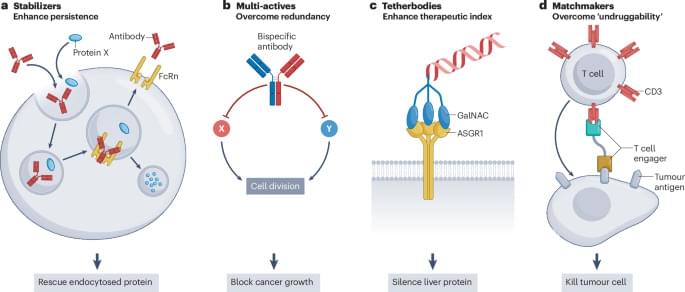
Multispecific drugs are designed to engage two or more entities to exert their pharmacological effect. This Perspective discusses how a new wave of FDA-approved multispecific molecules have been transformative in overcoming barriers to drug development such as toxicity, rapid clearance, undruggable protein features, and functional redundancy.
Wang and colleagues present a phenotypic brain organoid atlas for neurodevelopmental disorders, revealing disease-specific cellular and molecular alterations that illuminate NDD pathogenesis. Integrating patient brain organoids, imaging, and exome sequencing, this resource provides a powerful platform to advance research and therapeutic discovery.