Toggle light / dark theme

Get the latest international news and world events from around the world.

Log in for authorized contributors

Ultra-thin metasurface chip turns invisible infrared light into steerable visible beams

The invention of tiny devices capable of precisely controlling the direction and behavior of light is essential to the development of advanced technologies. Researchers at the Advanced Science Research Center at the CUNY Graduate Center (CUNY ASRC) have taken a significant step forward with the development of a metasurface that can turn invisible infrared light into visible light and aim it in different directions—without any moving parts. The details of their work are explained in a paper published in the journal eLight.

The novel metasurface is constructed of an ultra-thin chip patterned with tiny structures smaller than the wavelength of light. When hit with an infrared laser, the chip converts the incoming light to a higher color (or frequency) and sends the new light out as a narrow beam that can be steered simply by changing how the incoming light is polarized.

In their experiments, the team converted infrared light around 1,530 nanometers—similar to the light used in fiber-optic communications—into visible green light near 510 nanometers and steered it to chosen angles.

Using duality to construct and classify new quantum phases

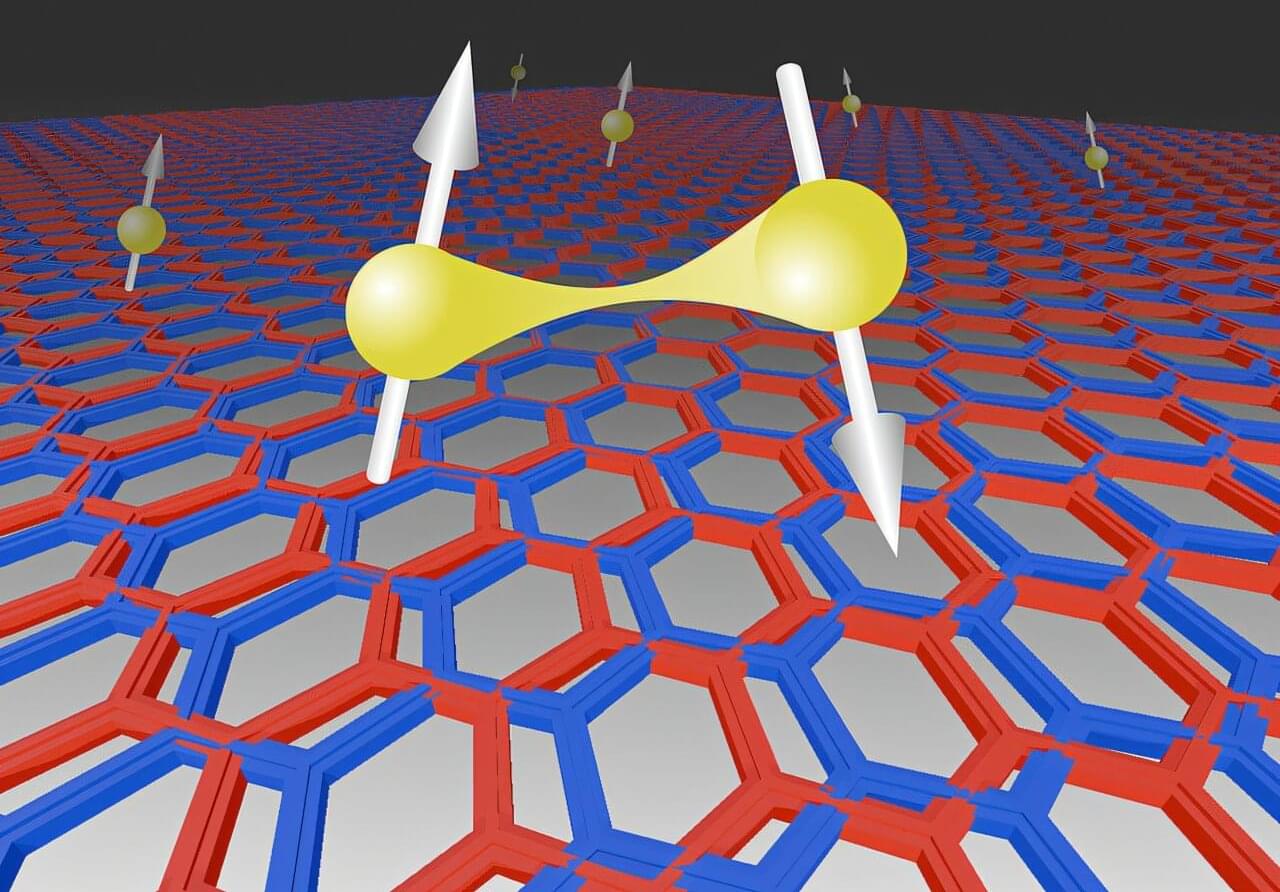
A team of theoretical researchers has found duality can unveil non-invertible symmetry protected topological phases, which can lead to researchers understanding more about the properties of these phases, and uncover new quantum phases. Their study is published in Physical Review Letters.

Symmetry is one of the most fundamental concepts for understanding phases of matter in modern physics—in particular, symmetry-protected topological (SPT) phases, whose quantum mechanical properties are protected by symmetries, with possible applications in quantum computing and other fields.

Over the past few years, non-invertible symmetries, which extend the framework of conventional symmetries, have attracted significant attention in high energy physics and condensed matter physics. However, their complex mathematical structures have made it difficult to understand their corresponding phases of matter, or SPT phases.

Astronomers Reveal the Hidden Magnetic Skeleton of the Milky Way

People have scanned the night sky for ages, but some of the Milky Way’s most important features cannot be seen with ordinary light. Dr. Jo-Anne Brown, PhD, is working to chart one of those hidden ingredients: the galaxy’s magnetic field, a vast structure that can influence how gas moves, where stars form, and how cosmic particles travel.

“Without a magnetic field, the galaxy would collapse in on itself due to gravity,” says Brown, a professor in the Department of Physics and Astronomy at the University of Calgary.

“We need to know what the magnetic field of the galaxy looks like now, so we can create accurate models that predict how it will evolve.”

Researchers Warn: WiFi Could Become an Invisible Mass Surveillance System

Researchers say a new technology can identify individuals even when they are not carrying a WiFi device by passively recording signals in radio networks, raising serious privacy concerns and prompting calls for stronger protections. Walking past a café with an active WiFi network could be enough

Eclipse Foundation Mandates Pre-Publish Security Checks for Open VSX Extensions

The Eclipse Foundation, which maintains the Open VSX Registry, has announced plans to enforce security checks before Microsoft Visual Studio Code (VS Code) extensions are published to the open-source repository to combat supply chain threats.

The move marks a shift from a reactive to a proactive approach to ensure that malicious extensions don’t end up getting published on the Open VSX Registry.

“Up to now, the Open VSX Registry has relied primarily on post-publication response and investigation. When a bad extension is reported, we investigate and remove it,” Christopher Guindon, director of software development at the Eclipse Foundation, said.

/* */