Toggle light / dark theme

Get the latest international news and world events from around the world.

Log in for authorized contributors

New research could improve detection of chiral molecules in pharmaceuticals and biotechnology

Ohio University Distinguished Professor Alexander Govorov of the Department of Physics and Astronomy and the Nanoscale and Quantum Phenomena Institute (NQPI) in the College of Arts and Sciences has co-authored a new study published in Science Advances with collaborators at Wuhan University in China and the Istituto Italiano di Tecnologia in Italy.

The study, “Ultrasensitive Chiral Detection by Nonlinear Chiroptics in Spiral Plasmonic Metastructures Surpasses Linear Limits,” addresses a major challenge in chemical and biological analysis: detecting molecular chirality, or “handedness.” Chirality plays a critical role in biochemical processes and drug function, yet conventional chiroptical measurements often produce weak signals that make sensitive detection difficult.

Most chiral chemicals (enantiomers) are synthesized with both left-and right-handed forms. Often, only one enantiomer is biologically active, while the other may be ineffective or even harmful. A classic example is thalidomide, in which one enantiomer provides sedative and antinausea effects, while the other can cause birth defects.


Malicious Apache Modules Hijack Brazilian Government Site Traffic to Push Betting Pages

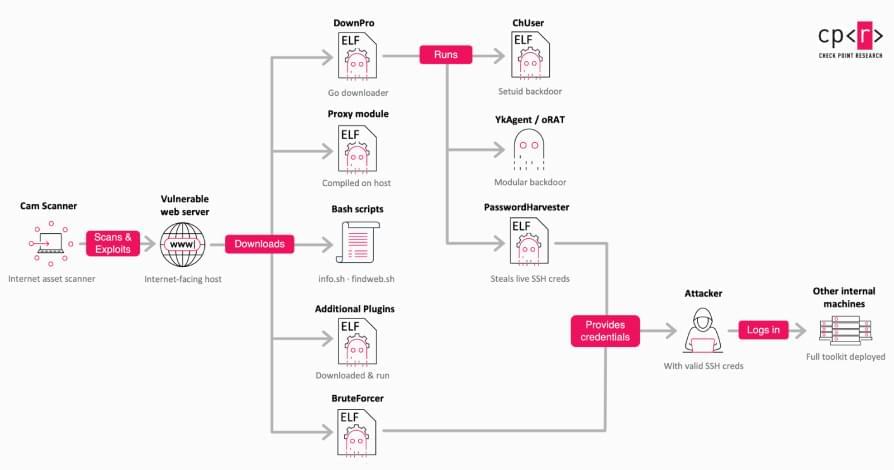
A Chinese-speaking cybercrime cluster known as Gambling Goblin has been observed installing malicious Apache modules on compromised web servers run by Brazilian government and educational institutions, and using them to divert visitors to attacker-controlled pages promoting online gambling and sports betting.

Check Point Research said it has tracked the campaign since mid-2025.

The modules reverse-proxy visitors to a set of phishing pages while the traffic still appears to originate from the legitimate domain. The site’s own security headers are stripped, allowing the injected content to run freely.

Attackers Turn Trusted Node.js Runtime Into Malware Delivery Tool in Targeted Attacks

Threat actors are leveraging the trusted Node.js JavaScript runtime in multiple cyber attacks as a way to deploy malicious payloads.

According to a new report published by the Symantec Threat Hunter Team today, the attack method has been put to use in attacks targeting government departments, technology companies, and hotels since February 2026.

“The technique’s appeal is that node.exe (the binary that runs Node.js) is a legitimate, signed developer tool,” the Broadcom-owned cybersecurity division said in a report shared with The Hacker News. “The attacker’s malicious code lives in interpreted scripts rather than in a binary, making it less likely to trigger signature-based detection, while a registry Run key entry can relaunch the payload at every login.”

Your Employee’s Password Appeared in an Infostealer Log. Now What?

Infostealers can expose far more than passwords, including authenticated sessions that may let attackers bypass MFA. Flare explains how defenders can prioritize compromised identities, determine whether stolen access is still usable, and respond before it leads to account takeover.