
Cells contain a blueprint in the form of DNA that dictates what they can make. This blueprint is converted into a message (mRNA), which is then converted into a protein. Although DNA remains the same in all cells, how it is read depends on specific signals that can change the DNA itself, mRNA or proteins. These signals are often in the form of chemical modifications.
Get the latest international news and world events from around the world.
Study may lead to improved networked quantum sensing
Could global positioning systems become more precise and provide more accurate details on distances for users to get from point A to point B?
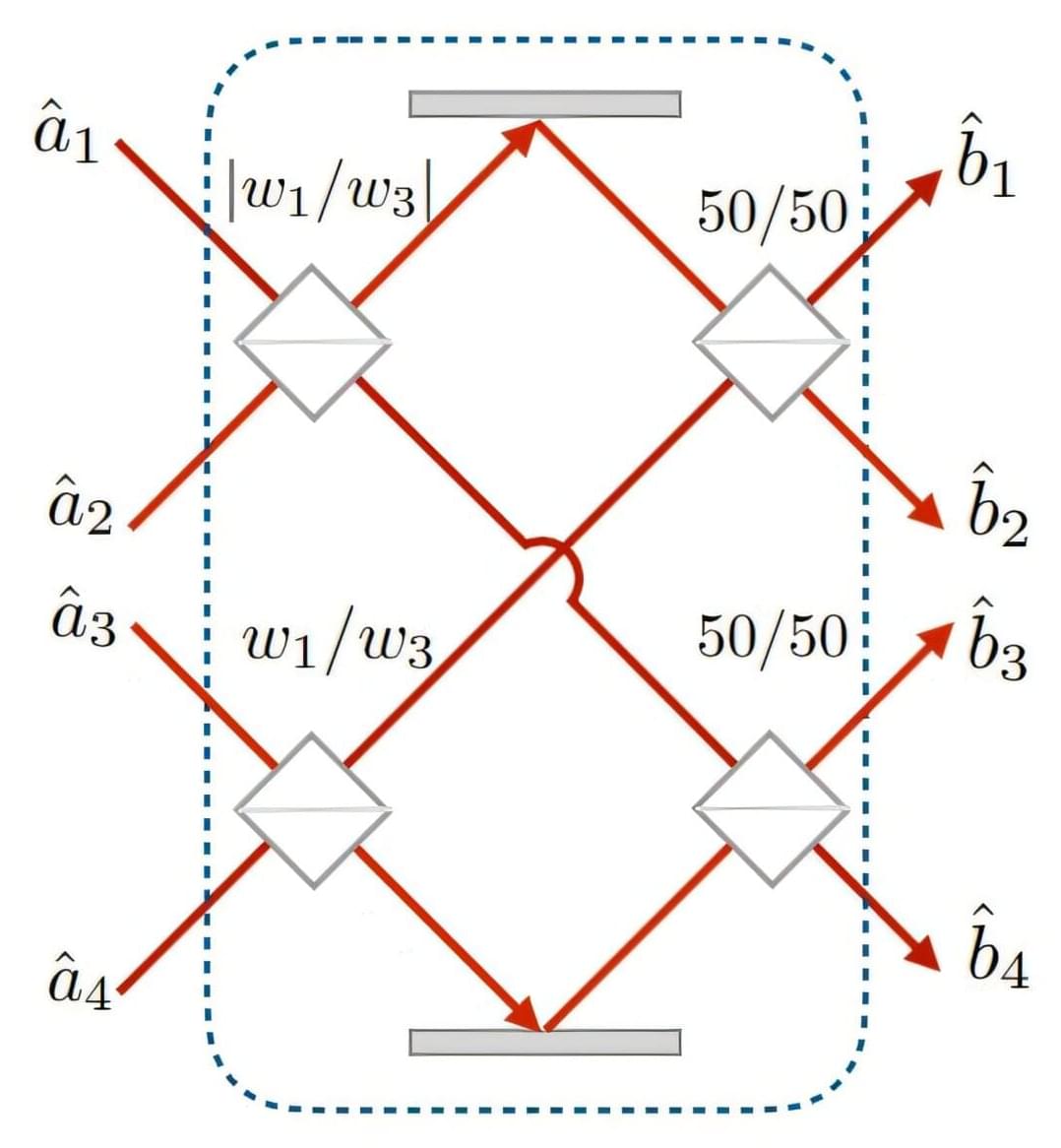
A study by University of Rhode Island assistant physics professor Wenchao Ge in collaboration with Kurt Jacobs, a physicist of quantum tech with the U.S. Army, which was recently published by Physical Review Letters, may lead to more enhanced quantum sensing and make such detection data more definitive.
Ge’s study, “Heisenberg-Limited Continuous-Variable Distributed Quantum Metrology with Arbitrary Weights” published by in September, looked at networked quantum sensing, which explores advanced sensor technology in an entangled network that could improve accuracy on how to measure, navigate and explore the world, such as by sensing changes in motion, and electric or magnetic fields.

Mirrorless laser: Physicists propose a new light source
A team of physicists from the University of Innsbruck and Harvard University has proposed a fundamentally new way to generate laser light: a laser without mirrors. Their study, published in Physical Review Letters, shows that quantum emitters spaced at subwavelength distances can constructively synchronize their photon emission to produce a bright, very narrow-band light beam, even in the absence of any optical cavity.
In conventional lasers, mirrors are essential to bounce light back and forth, stimulating coherent emission from excited atoms or molecules, and thus light amplification. But in the new “mirrorless” concept, the atoms interact directly through their own electromagnetic dipole fields, given that interatomic spacing is smaller than the emitted light’s wavelength. When the system is pumped with enough energy, these interactions cause the emitters to lock together and radiate collectively—a phenomenon called superradiant emission.
The team led by Helmut Ritsch found that this collective emission generates light that is both highly directional and spectrally pure, with a single narrow spectral line, in cases where only a fraction of emitters are excited by a laser and the rest of atoms remain unpumped. Since this passive emitter fraction is not broadened by the driving laser or power broadening, it effectively acts as an optical resonator for the active emitters, in analogy with a conventional laser where the optical resonator and the gain medium are separate physical entities.

Scientists Solve Decades-Old Puzzle of Electron Emission
What occurs when electrons escape from a solid material? Though it may appear straightforward, this process has long resisted accurate theoretical explanation, until now. Researchers have finally uncovered the missing piece that completes the puzzle. Picture a frog inside a box with a high openin

This Chip Computes With Light, Breaking the 10 GHz Barrier for AI
Researchers have developed an optical computing system that performs feature extraction for quantitative trading with unprecedentedly low latency. Many advanced artificial intelligence (AI) systems, including those used in surgical robotics and high-speed financial trading, rely on processing lar

10 npm Packages Caught Stealing Developer Credentials on Windows, macOS, and Linux
Ten typosquatted npm packages (Jul 4, 2025) delivered a 24MB PyInstaller info stealer using 4 obfuscation layers; ~9,900 downloads.

Active Exploits Hit Dassault and XWiki — CISA Confirms Critical Flaws Under Attack
CISA and VulnCheck warn of active exploitation of DELMIA Apriso and XWiki flaws delivering crypto miners.

New TEE.Fail Side-Channel Attack Extracts Secrets from Intel and AMD DDR5 Secure Enclaves
TEE.Fail shows how $1,000 hardware can extract keys from Intel and AMD DDR5 secure enclaves.

New Android Trojan ‘Herodotus’ Outsmarts Anti-Fraud Systems by Typing Like a Human
Herodotus, a new Android trojan, mimics human behavior to bypass biometrics and steal banking data.

Researchers Expose GhostCall and GhostHire: BlueNoroff’s New Malware Chains
BlueNoroff’s GhostCall and GhostHire campaigns target Web3 firms using fake Zoom calls and Telegram job lures