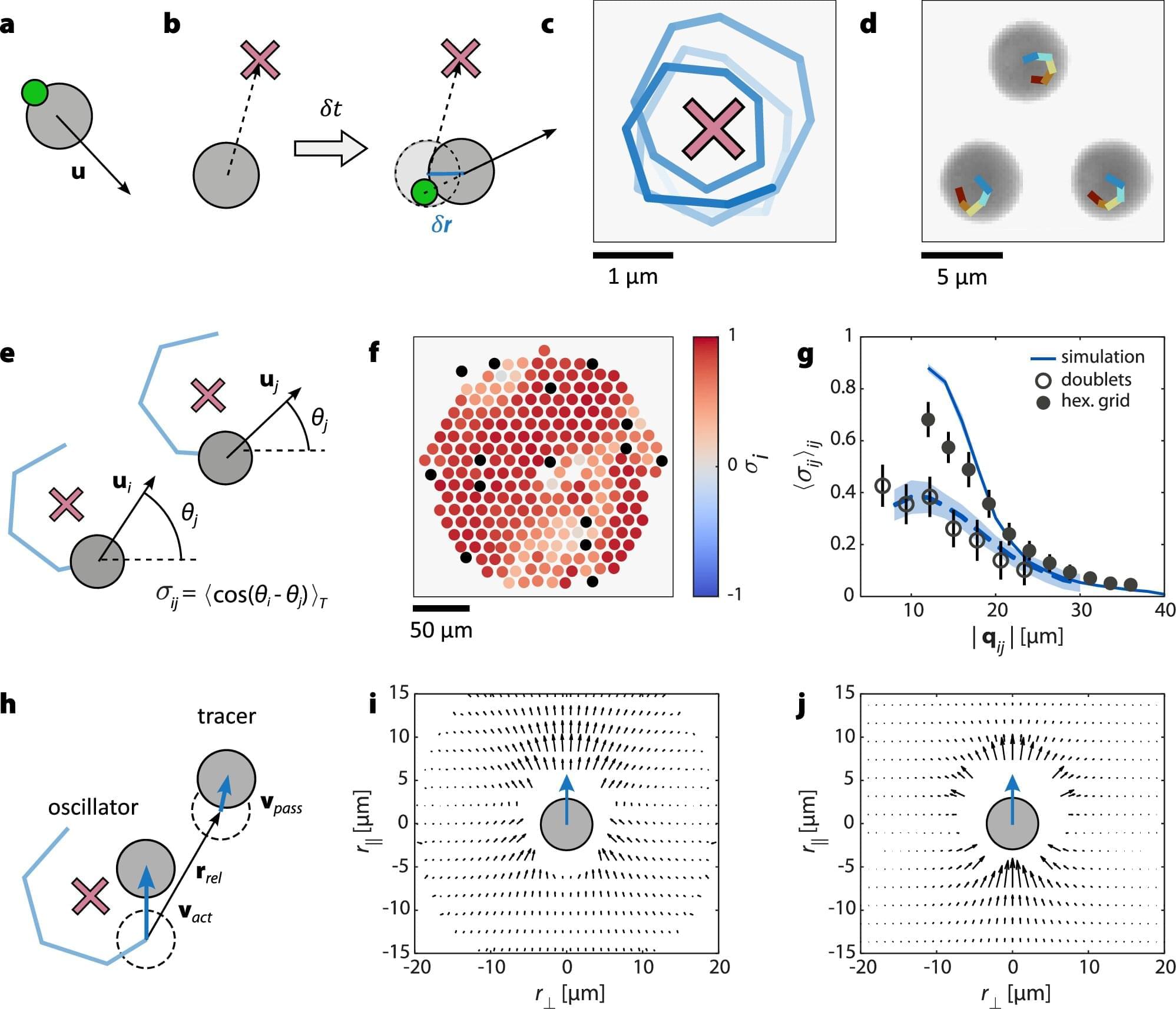
A collaboration between the University of Konstanz and Forschungszentrum Jülich has achieved the first fully tunable experimental realization of a long predicted “swarmalator” system. The study, published in Nature Communications, shows how tiny, self-propelled particles can simultaneously coordinate their motion and synchronize their internal rhythms—a behavior reminiscent of flashing fireflies, Japanese tree frogs or schooling fish.
The results underline how collective dynamics can arise from simple interactions, without overarching leadership or control. Possible applications include autonomous robotic swarms.
Swarmalators—short for swarming oscillators—are systems in which each individual not only moves but also oscillates, with motion and rhythm influencing one another.