All they need to do is also make it capture wind energy…
Porsche defrays its luddite position on driverless vehicles with an impressive solar array that will power the Berlin-Adlershof Porsche center from 2017.
All they need to do is also make it capture wind energy…
Porsche defrays its luddite position on driverless vehicles with an impressive solar array that will power the Berlin-Adlershof Porsche center from 2017.
A British teenager has become the first child in the UK to be cured of epilepsy by a robot that drilled deep into his brain.
Billy Whitaker, 15, had suffered daily seizures for seven years until the operation two weeks ago, which medical experts are convinced has cured him.
The procedure used a £350,000 ($503,455) robot, practically the same as those used on car factory production lines, to drill electrodes into Whitaker’s brain.

The future of transportation looks awesome.

The San Jose Mercury News took a look at SRI’s collaboration with Yamaha to develop Motobot, the first motorcycle-riding humanoid robot. “Consider it a high-tech diagnostic tool for motorcycles that just happens to look like a cyborg.”
Did you know that Quantum Theory does not know how probabilities are implemented in Nature? And for that matter neither does any other physical theory. Why? Or why not? The closest Quantum Theory comes to explaining probabilities, is to guess that a particle’s wave function is related to its probabilities. That’s it!
Why do we need to ask this question? Commercial opportunities. Imagine if you could control where a photon localizes (captured by an atom). Particle detectors become significantly more sensitive. Boring? No, in fact, DARPA aims to precisely spot single photons and explore the Fundamental Limits of Photon Detection. Anti-stealth is one application. Imagine if you didn’t need 1,000,000 radio wave photons to determine an aircraft’s radar signature, but only a 1,000?
Using probabilities to control photon switching “circuits”, probability switches. Imagine an empty box with optical cables entering and exiting. These probability switches cause photons to exit through different optical cables by controlling where they localize within the box. What if we could build computers with materials lighter than a feather to switch photon paths, instead of heavy silicon or gallium arsenide to switch electron paths? Imagine how fast these switches could operate, as no matter is involved.
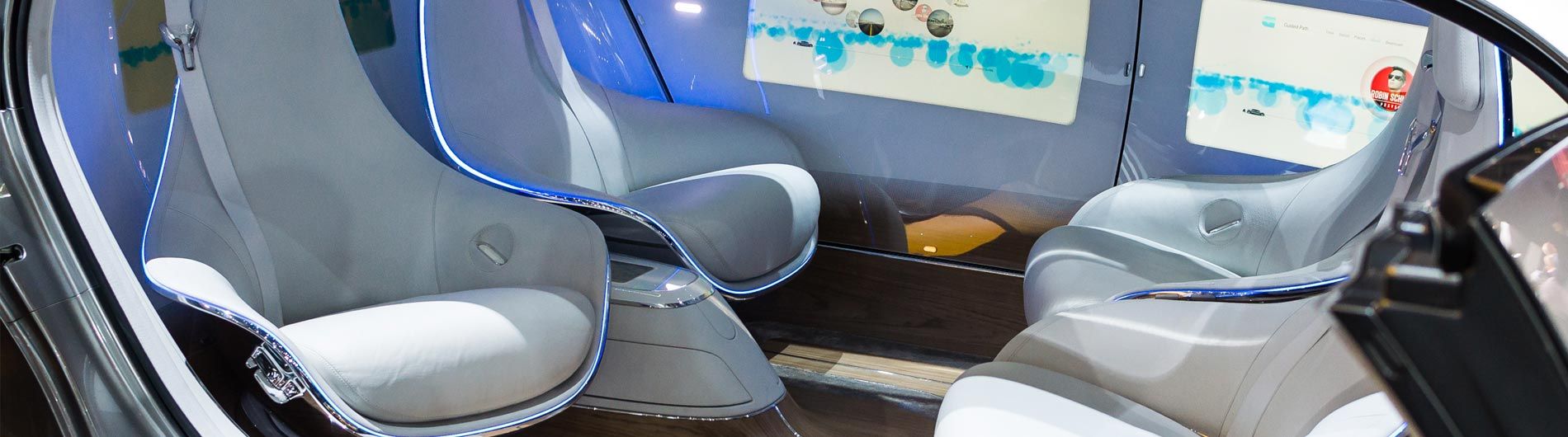
The year is 2021. You’re driving down the highway on your daily commute. You approach a car that’s stubbornly driving at the max speed limit. You decide to pass this overly law-abiding driver, except when you do, you discover there’s no one in the front seat.
As we learned in the first part of our Future of Transportation series, self-driving cars will become publicly available in only a few short years. But due to their component parts, they will likely be far too expensive for the average consumer. Does this mark self-driving cars as an innovation that’s dead in the water? Who’s going to buy these things?
Most articles about autonomous vehicles (AVs) fail to mention that the initial target market for these vehicles won’t be the average consumer—it will be big business. Specifically, taxi and car sharing services. Why? Let’s look at the opportunity self-driving cars represent to one of the biggest taxi/rideshare services on the planet: Uber.

2 trends that is happening now especially with millennials: car ownership is no longer the desire; and home ownership is out of reach. And, this will impact at a minimum 4 industries — financial, real estate, auto, and insurance industries? Something that many in industry will need to get very creative in addressing to entice the future larger market consumers.
Young people no longer rush to buy their first car, meaning future cities need to think quickly about public transport and the emerging “share economy”, one of Australia’s leading urban futurists says.
Fewer people will “own a car”, “shared” driverless cars will be common and the “Uber” idea of sharing a ride will extend beyond an alternative to taxis, to ‘sharing’ homes, jobs, electric cars, hotel rooms and bikes by 2050.
That is a version of the Gold Coast’s future to be outlined this morning on the Gold Coast by former Adelaide mayor Stephen Yarwood, who is one of Australia’s few urban futurists.
Another major leap forward in Quantum; researchers have been able to transport heat consistently ten thousand times further than ever before. This will enable Quantum technology to be leveraged in across multiple areas of manufacturing (clothing, etc.), energy, and electronics due to its heat conductive properties.
Heat conduction is a fundamental physical phenomenon utilized, for example, in clothing, housing, car industry, and electronics. Thus our day-to-day life is inevitably affected by major shocks in this field. The research group, led by quantum physicist Mikko Möttönen has now made one of these groundbreaking discoveries. This new invention revolutionizes quantum-limited heat conduction which means as efficient heat transport as possible from point A to point B. This is great news especially for the developers of quantum computers.
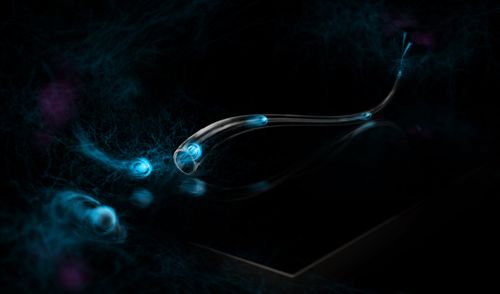
Figure 1. Artistic impression of quantum-limited heat conduction of photons over macroscopic distances. (Image: Heikka Valja)
DARPA Futurist’s visions of the future: non breakable parts and improving energy usage. Interesting, we both had worked at the National Labs.
Although we’re still awaiting the mass production of flying cars and miniature fusion reactors, some predictions in the 1985 film Back to the Future for 2015 have, indeed, come true. Among them are in-home videoconferencing and voice and fingerprint recognition for personal devices.
On the 30th anniversary of the movie, the US Defense Advanced Research Projects Agency (DARPA) issued some predictions about the world in 2045. Some of them seem pretty far-fetched (click here for a look), but given the pace of technological development, they might be realized much sooner. So, what would an idealized future for the advanced composites industry look like? And rather than looking out 30 years, how about the next 10 to 20? Here are some of my thoughts:
“Make it and break it” is a thing of the past. Today’s “building block” approach to composites, from coupon level to full structures, is both time-consuming and expensive. As computing power evolves, the necessity to fabricate and test thousands of coupons to derive design allowables goes away. Instead, we manufacture a modest set of critical panels and measure a handful of mechanical properties, and use proven and reliable mathematical models to accurately predict the remaining design properties, called “virtual allowables.” Most important, we believe in them. From these, we are able to predict behavior of as-manufactured components and assemblies in impact, crash, fatigue and other potential failure modes, leading us to design parts at minimum weight and cost. We also characterize the rheology of the various polymers in composites, as well as forming behavior of fibers and textile forms to confidently simulate composite manufacturing processes.
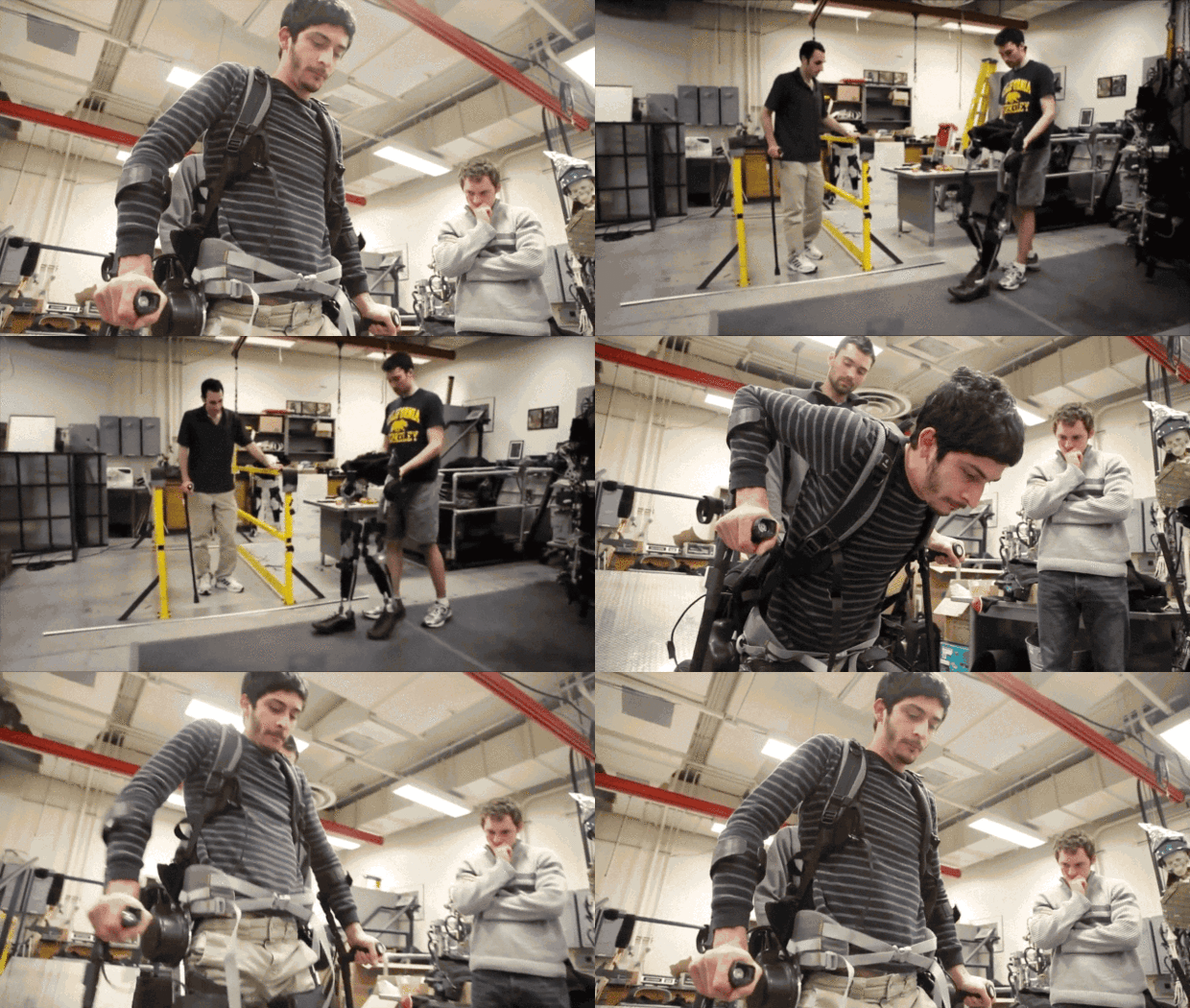
The Phoenix lets paraplegic people sit, stand, and walk. It costs just $40,000. Here’s how the designers pulled it off.
In 2005, Steven Sanchez was trying to do a flip off a BMX dirt ramp when he was paralyzed from the belly button down. 11 years later, with no miracle surgery to speak of, he stands like any other tourist in line at the Vatican.
“I had this awesome robotic suit on, and nobody cared,” he says. “They just waited for me to move up like everyone else moved up.” It was a moment of incredible, touristy normalcy, provided by a bit of practice—and the Phoenix exoskeleton.