Toggle light / dark theme

If Americans used bidets fifteen million trees could be saved

Justin Thomas considers bidets to be “a key green technology” because they eliminate the use of toilet paper. According to his analysis, Americans use 36.5 billion rolls of toilet paper every year, representing the pulping of some 15 million trees. Says Thomas: “This also involves 473,587,500,000 gallons of water to produce the paper and 253,000 tons of chlorine for bleaching.” He adds that manufacturing requires about 17.3 terawatts of electricity annually and that significant amounts of energy and materials are used in packaging and in transportation to retail outlets.

That’s a lot of water, far more than is actually used by the bidet itself.

toto toiletLloyd Alter/ toto toilet with washlet/CC BY 2.0

Three national laboratories achieve record magnetic field for accelerator focusing magnet

In a multiyear effort involving three national laboratories from across the United States, researchers have successfully built and tested a powerful new magnet based on an advanced superconducting material. The eight-ton device—about as long as a semi-truck trailer—set a record for the highest field strength ever recorded for an accelerator focusing magnet and raises the standard for magnets operating in high-energy particle colliders.

The Department of Energy’s Fermilab, Brookhaven National Laboratory and Lawrence Berkeley National Laboratory designed, built and tested the new magnet, one of 16 they will provide for operation in the High-Luminosity Large Hadron Collider at CERN laboratory in Europe. The 16 magnets, along with another eight produced by CERN, serve as “optics” for charged particles: They will focus beams of protons into a tiny, infinitesimal spot as they approach collision inside two different particle detectors.

The ingredient that sets these U.S.-produced magnets apart is niobium-tin—a superconducting material that produces strong magnetic fields. These will be the first niobium-tin quadrupole magnets ever to operate in a particle accelerator.

Behold the smooth, gliding motions of this robot noodle chef

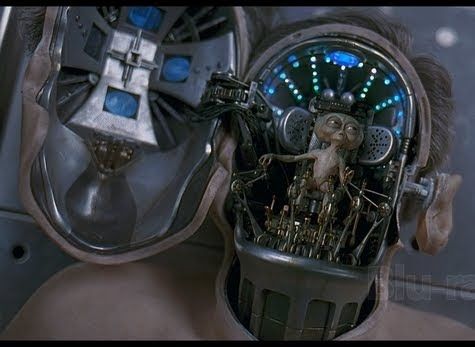
I have spent the past several years of my life desperately trying to warn humanity that the robots are coming to destroy us all, and everybody laughed at me. But this week—shortly after the T-1000 was seen smooching his miniature horse and donkey—a robot noodle chef has taken over soba-making duties at a Tokyo train station, so who’s laughing now? (The robots are laughing now.)

An Earth-sized exoplanet found with a star that zooms *way* up and down in the Milky Way

I frankly think this of exotic species unknown but it has exotic movement.


With over 4,000 exoplanets found so far, it takes a particularly interesting one to stand out.

LHS 1815b literally does that. While most planet-bearing stars we find orbit the Milky Way in the plane of its disk, this planet’s host star’s orbit takes it well out of that plane, flying way up over the galaxy and way down below it over time, giving it a pretty interesting view of our galaxy.

First, the planet: It was found in TESS data, the Transiting Exoplanet Survey Satellite. This mission is surveying the entire sky, looking for planets around brighter stars. These tend to be closer to us, so TESS is finding planets that are in our neighborhood, galactically speaking.

Has Samsung Found The Holy Grail Of Solid State Batteries?

This video was made possible thanks to the kind donations of our supporters on Patreon and Ko-fi. Join them in supporting us.

Buy the team a coffee — or a meal! https://ko-fi.com/transportevolved
Follow our ‘second’ channel — Transport Evolved Take Two, at https://www.youtube.com/transportevolvedtake2
Follow the show on Twitter https://www.twitter.com/TransportEvolve
Buy Transport Evolved SWAG : https://teespring.com/stores/transport-evolved
Join our Discord Channel: https://discord.gg/9WAjfQn
Support us on Patreon: https://www.patreon.com/transportevolved
Follow Nikki’s personal channel at https://www.youtube.com/channel/UCZWSrDEYcNoio7QaetV_JKA
——
While most electric cars already travel further per charge than most people need them to on a daily basis, there’s still a massive hunt to find the longest-range, cheapest, longest-life battery pack possible for future generations of EVs.

We’ve known for a while that solid-state technology is likely to play a massive part in next-generation electric cars — but exactly what the make up of those solid-state batteries will be is still unknown.

Earlier today though, Samsung announced a new battery breakthrough that it says will make it possible to build a solid-state battery pack capable of more than 800-miles per charge while halving the physical battery size compared to today’s battery packs.

Watch the video above to find out more, support us with the provided links, and let us know what you think below — but remember to keep your comments civil!

Presenter: nikki gordon-bloomfield produced: transport evolved

DARPA taps four companies for critical unmanned underwater vehicle tech

DARPA has announced the four companies it has selected to work under its Manta Ray Program. Three of the companies will be tasked with developing ‘an integrated solution’ for the program’s operational and technology areas, according to DARPA. The fourth company will instead focus on the topic of undersea energy harvesting options capable of working at the depths DARPA has planned.

Amelia Earhart

Based on myth and such it could a definite possibility that this tale is true.


Amelia Earhart was one of the first female pilots in Earth history. She had been on expeditions all over the world, and recalled seeing people doing all kinds of strange things to their bodies. In the mid–20th century she became famous for being the first woman to fly across the Atlantic Ocean. In 1937 she attempted to fly around the world, and on July 2nd, she and her navigator, Fred Noonan, took off from New Guinea and headed east, around the equator.

However, while over the Pacific Ocean, their Lockheed L-10 Electra airplane ran low on gas. They began looking for an atoll to set down on, and tried to send out an SOS. Suddenly, they saw a huge light behind them. The plane stopped dead, and then started moving backwards towards the light. That was the last Earhart remembered of the event. They were in fact being abducted by an alien species, the Briori. To the outside world, it appeared that the plane just vanished somewhere in the South Seas.

Unbeknownst at the time was that the mission was financed by her government and was part of an intelligence operation to gather information about the Japanese. Rumors about this emerged after the Pearl Harbor attack in 1941, and it later became part of established history.

/* */