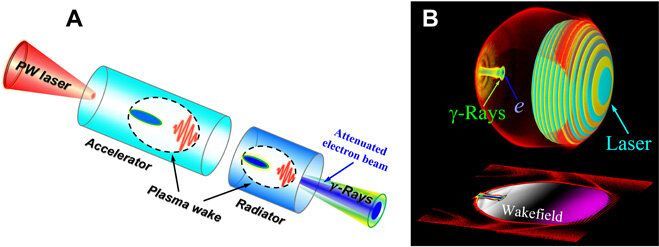
Laser-wakefield accelerators have led to the development of compact, ultrashort X-ray or gamma-ray sources to deliver peak brilliance, similar to conventional synchrotron sources. However, such sources are withheld by low efficiencies and limited to 107–8 photons per shot in the kiloelectron volt (KeV) to megaelectron volt (MeV) range. In a new report now published on Science Advances, Xing-Long Zhu and a research team in physics and astronomy in China and the U.K., presented a new approach to efficiently produce collimated, ultrabright gamma (γ)-ray beams. The resulting photon energies were tunable for up to gigaelectron volts by focussing a multi-petawatt laser pulse into a 2-stage wakefield accelerator. The high-intensity laser allowed them to efficiently generate a multi-gigaelectron volt electron beam with a high density and charge during the first stage of the experiment. The laser and electron beams entered a high-density plasma region in the second stage thereafter. Using numerical simulations, they demonstrated the production of more than 1012 gamma ray photons per shot with energy conversion efficiency above 10 percent for photons above 1 megaelectron volt (MeV) and achieved a peak brilliance above 1026 photons S-1 mm-2 mrad-2 per 0.1 percent bandwidth at 1 MeV. This research outcome will offer new avenues in both fundamental and applied physics and engineering.
Bright sources of high-energy gamma rays are versatile for broad areas of applications, including fundamental research in astrophysics, particle and nuclear physics, as well as high-resolution imaging. Researchers can improve such applications with compact gamma ray sources with low divergence, short pulse duration, high energy, and high peak brilliance. While widely used synchrotrons and X-ray free electron lasers (XFELS) can deliver X-ray pulses with peak brilliance, they are limited to low photon energies. The size and cost of such research structures can also limit their regular applications. Researchers have therefore rapidly developed compact laser-wakefield accelerators (LWFAs) in the past two decades to offer a radically different approach to drive the acceleration and radiation of high-energy particles on a much smaller scale. Continuous advancements in the field of ultrahigh-power laser technology will enable brilliant high-energy gamma sources.