Toggle light / dark theme

Has the transhumanist movement lost its way? Nikola Danaylov interview

You might like this interview I did with futurist writer Nikola Danaylov, who runs the Singularity Weblog and wrote ‘Conversations with the Future: 21 Visions for the 21st century’, on how advances in AI could utterly transform human society and the health of the global transhumanist movement.

I’m trying to grow my futurism YouTube channel (transhumanism, AI, space colonisation etr) so if this is of interest to you I’d be very grateful for any subscribers.

https://www.youtube.com/channel/UCnVLqMgLDwO-aSk5YcYo1dA


I interview Nikola Danaylov (@singularityblog), founder of the Singularity Weblog and author of Conversations with the Future: 21 Visions for the 21st Century. We discuss advances in AI, the singularity, whether western political leaders appreciate how fast technology is evolving and the global transhumanist movement.

You can buy Danaylov’s book here: https://www.amazon.com/gp/product/B01N4QF7GU/ref=as_li_qf_sp…5f50cf0e90

Morpheus: Powerful New AI Technique Detects and Classifies Astronomical Objects

UCSC researchers developed a deep-learning framework called Morpheus to perform pixel-level morphological classifications of objects in astronomical images.

Researchers at UC Santa Cruz have developed a powerful new computer program called Morpheus that can analyze astronomical image data pixel by pixel to identify and classify all of the galaxies and stars in large data sets from astronomy surveys.

Morpheus is a deep-learning framework that incorporates a variety of artificial intelligence technologies developed for applications such as image and speech recognition. Brant Robertson, a professor of astronomy and astrophysics who leads the Computational Astrophysics Research Group at UC Santa Cruz, said the rapidly increasing size of astronomy data sets has made it essential to automate some of the tasks traditionally done by astronomers.

New Evolutionary Algorithm Predicts Optimal Materials Among All Possible Compounds

Skoltech researchers have offered a solution to the problem of searching for materials with required properties among all possible combinations of chemical elements. These combinations are virtually endless, and each has an infinite multitude of possible crystal structures; it is not feasible to test them all and choose the best option (for instance, the hardest compound) either in an experiment or in silico. The computational method developed by Skoltech professor Artem R. Oganov and his PhD student Zahed Allahyari solves this major problem of theoretical materials science. Oganov and Allahyari presented their method in the MendS code (stands for Mendelevian Search) and tested it on superhard and magnetic materials.

“In 2006, we developed an algorithm that can predict the crystal structure of a given fixed combination of chemical elements. Then we increased its predictive powers by teaching it to work without a specific combination — so one calculation would give you all stable compounds of given elements and their respective crystal structures. The new method tackles a much more ambitious task: here, we pick neither a precise compound nor even specific chemical elements — rather, we search through all possible combinations of all chemical elements, taking into account all possible crystal structures, and find those that have the needed properties (e.g., highest hardness or highest magnetization)” says Artem Oganov, Skoltech and MIPT professor, Fellow of the Royal Society of Chemistry and a member of Academia Europaea.

The researchers first figured out that it was possible to build an abstract chemical space so that compounds that would be close to each other in this space would have similar properties. Thus, all materials with peculiar properties (for example, superhard materials) will be clustered in certain areas, and evolutionary algorithms will be particularly effective for finding the best material. The Mendelevian Search algorithm runs through a double evolutionary search: for each point in the chemical space, it looks for the best crystal structure, and at the same time these found compounds compete against each other, mate and mutate in a natural selection of the best one.

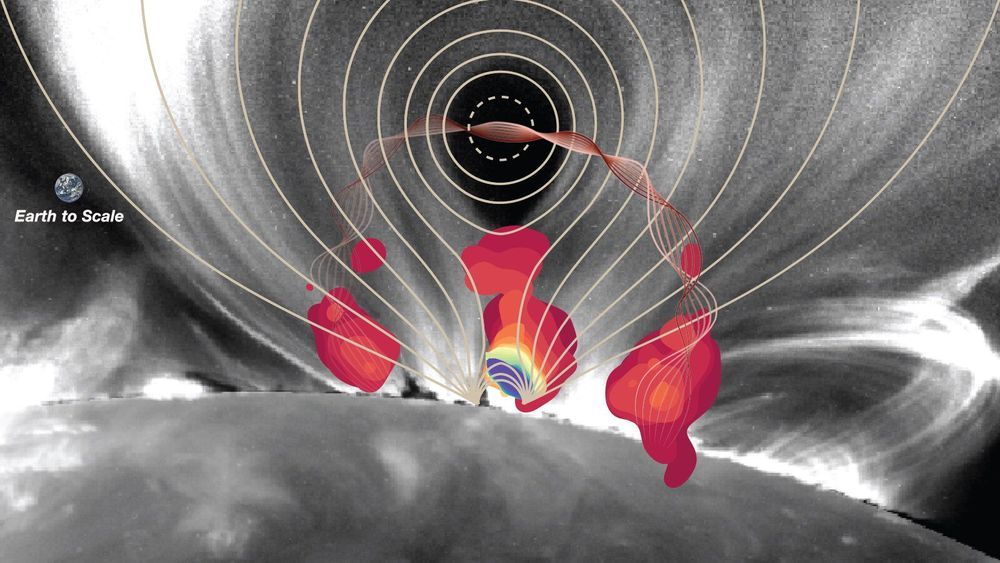
Our Sun is an active star

It releases a constant stream of material called the solar wind, along with more occasional bursts of particles, material and energy that flow out into the solar system. Here on Earth, the effects of those events can range from issues like satellite problems and communications failures to stunning natural phenomena like airglow and auroras.

Here are a few ways we study the Sun, its effects on Earth, and everything in between to better understand when and how these events happen. Learn more about our research at http://nasa.gov/sunearth.

Astrophysicists Warn That Entire Galaxies “Are Being Killed”

Cosmic Starvation

The first possibility is called ram pressure stripping, a process through which all of the gas that a galaxy would use to form stars is vacuumed away by nearby intergalactic plasma. The other is that the environment inside a galactic cluster simply becomes too hot for cosmic gases to cool and condense into stars, rendering it useless as fuel.

“When you remove the fuel for star formation, you effectively kill the galaxy,” Brown writes, “turning it into a dead object in which no new stars are formed.”

/* */