China’s cyber-space regulator has unveiled draft measures that would make companies responsible for the data used to train generative artificial intelligence (AI) models, such as Midjourney and ChatGPT.

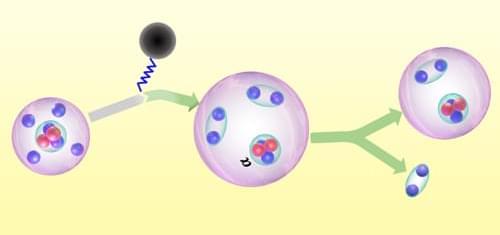
In its ground state, the helium-8 (8He) nucleus consists of an alpha particle (4He nucleus) and four neutrons. If, before its few-hundred-milliseconds life ends, an 8 He nucleus is nudged into its first 0+ excited state, the four neutrons form two pairs known as dineutron clusters. According to theory, the alpha particle and the two neutron clusters settle into a three-member nuclear analog of a Bose-Einstein condensate. That outcome has now been observed for the first time by Zaihong Yang of Peking University and his colleagues at the RIKEN Nishina Center in Japan [1].
The experiment entailed firing a high-intensity beam of 8 He nuclei at polyethylene and carbon targets. Some collisions excited the nuclei into the sought-after condensate state, which promptly broke up into a helium-6 (6He) nucleus and a single neutron pair. The 6 He nuclei made their way through dipole magnets to drift detectors and plastic scintillators for characterization. The neutrons struck a plastic scintillator whose layered construction made it possible to identify which neutrons were correlated—that is, members of a dineutron cluster—and which were not. The correlated neutron pairs and the scattering count rate’s dependence on energy, angle, and type of target were all consistent with theoretical predictions of the nature of the correlated 8 He excited state.
The 8 He condensate resembles the so-called Hoyle state of carbon-12, which consists of three alpha particles in the condensed state. Astronomer Fred Hoyle predicted the state in 1954 to account for the synthesis of carbon in helium-burning stars. Yang points out that nuclear condensates could also have implications for understanding the structures of exotic nuclei and neutron stars.

An organizer of an upcoming software and developer conference called DevTernity has been accused of cooking up fake women speakers featured on the event’s website — AI-generated headshots and all.
It looks a lot like a horrifically misfired attempt to pad out the apparent diversity in a heavily male-dominated space, a hypothesis the event’s organizer Eduards Sizovs has since forcefully denied.
The bizarre development triggered a resounding outcry, leading to high-profile engineering leaders from the likes of Microsoft and Google to bow out of the conference.
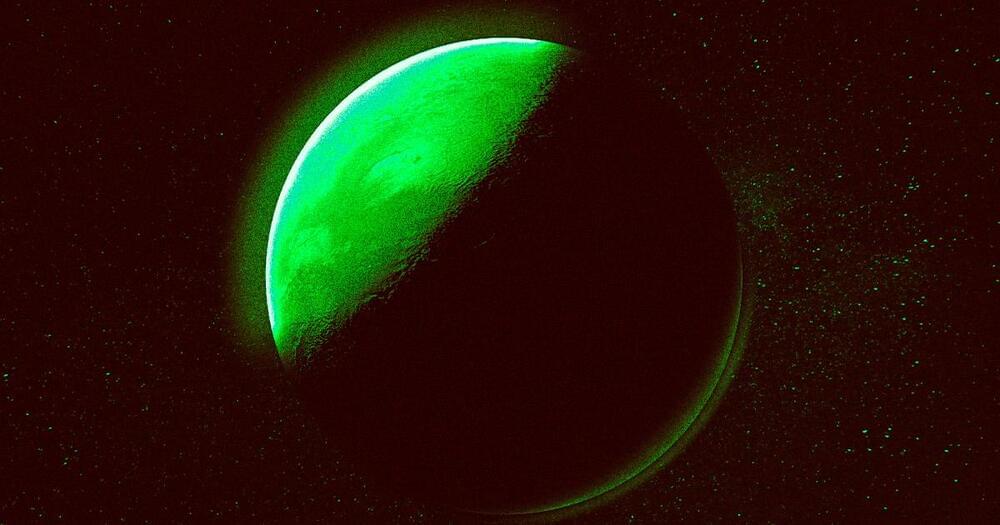
Scientists have discovered an impossibly large planet — so big, they say, that it should be too big to exist.
And yet. In a new study published in the journal Science, researchers out of Pennsylvania State described their whopper discovery: a Neptune-sized planet that’s 13 times the mass of Earth, which is orbiting a tiny ultracool star that’s nine times less massive than our Sun.
As a press release about the new research explains, this finding is exceptional because the mass ratio between the planet and the dwarf star, dubbed LHS 3,154, is 100 times greater than the same ratio Earth has with its Sun — which scientists didn’t think was possible until they saw it with their own eyes.

China’s Mars rover has uncovered underground polygon structures buried beneath the Red Planet’s surface — and it looks like they’re related to Mars’ long-lost water, too.
In a new study published in the journal Nature Astronomy, a team of researchers from the Chinese Academy of Sciences (CAS) say that using data from the Zhurong rover’s ground-penetrating radar capabilities, they’ve found several mysterious subterranean polygons located some 35 feet below its surface that are likely formed by ice.
Using this high-tech radar, the rover combed Utopia Planitia, a large plain in the planet’s northern hemisphere where Zhurong’s inactive husk still rests, to see what was happening below. The CAS team found, per Zhurong’s readings, a total of 16 “polygonal wedges” in an area of about three-quarters of a square mile, “suggesting a wide distribution of such terrain under Utopia Plainitia,” the Nature Astronomy paper explains.
How do we really move through spacetime? Sadly the books have sold out. In the meantime, before I do the next print run, here’s a floating moon lamp! https://www.encalife.com/pages/_go_/f…
Astrum merch now available!
Apparel: https://astrum-shop.fourthwall.com/
Metal Posters: https://displate.com/promo/astrum?art… SUBSCRIBE for more videos about our other planets. Subscribe! http://goo.gl/WX4iMN Facebook! http://goo.gl/uaOlWW Twitter! http://goo.gl/VCfejs Instagram! / astrumspace TikTok!
/ astrumspace Astrum Spanish: https://bit.ly/2KmkssR Astrum Portuguese:
/ @astrumbrasil Donate! Patreon: http://goo.gl/GGA5xT Ethereum Wallet: 0x5F8cf793962ae8Df4Cba017E7A6159a104744038 Become a Patron today and support my channel! Donate link above. I can’t do it without you. Thanks to those who have supported so far! #Causality #fourthdimension #astrum.
SUBSCRIBE for more videos about our other planets.
Subscribe! http://goo.gl/WX4iMN
Facebook! http://goo.gl/uaOlWW
Twitter! http://goo.gl/VCfejs.
Instagram! / astrumspace.
TikTok! / astrumspace.
Astrum Spanish: https://bit.ly/2KmkssR
Astrum Portuguese: / @astrumbrasil.
Donate!
Patreon: http://goo.gl/GGA5xT
Ethereum Wallet: 0x5F8cf793962ae8Df4Cba017E7A6159a104744038
Become a Patron today and support my channel! Donate link above. I can’t do it without you. Thanks to those who have supported so far!
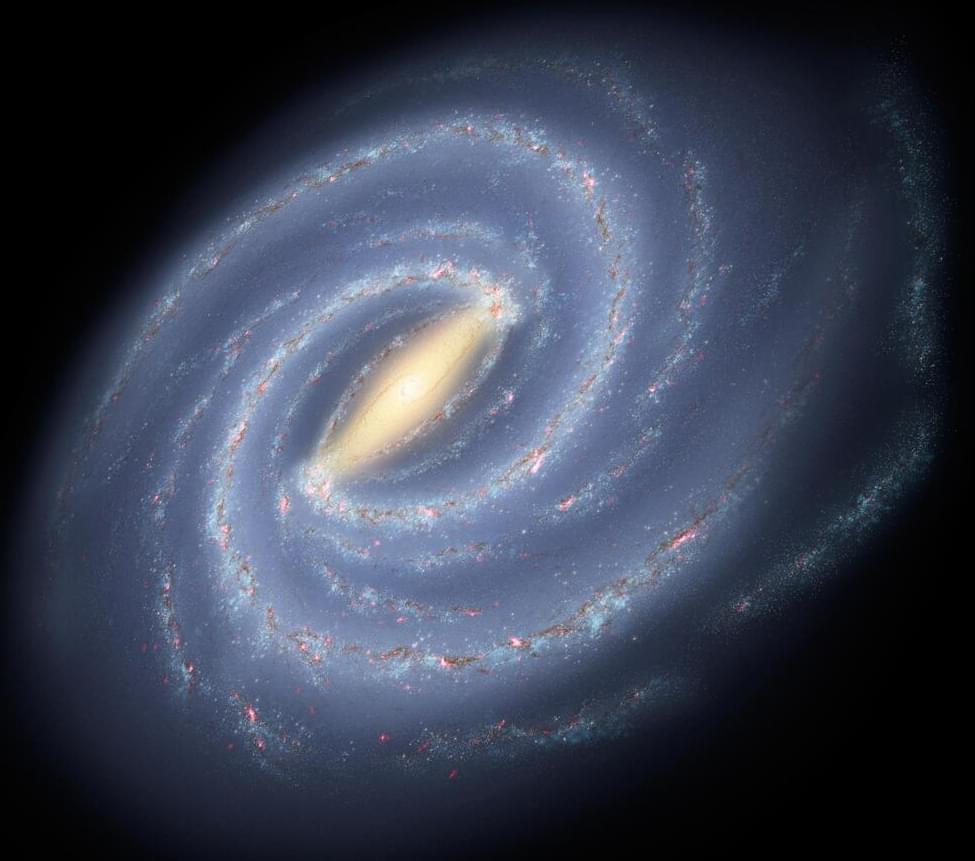
Astrophysicists have discovered why spiral galaxies like the Milky Way are rare in the Supergalactic Plane, a dense region in our Local Universe. The research, led by Durham University and the University of Helsinki, used the SIBELIUS supercomputer simulation to show that galaxies in dense clusters on the Plane often merge, transforming spiral galaxies into elliptical ones. This finding, which aligns with telescope observations and supports the standard model of the Universe, helps explain a long-standing cosmic anomaly about galaxy distribution.
Astrophysicists say they have found an answer to why spiral galaxies like our own Milky Way are largely missing from a part of our Local Universe called the Supergalactic Plane.
The Supergalactic Plane is an enormous, flattened structure extending nearly a billion light years across in which our own Milky Way galaxy is embedded.

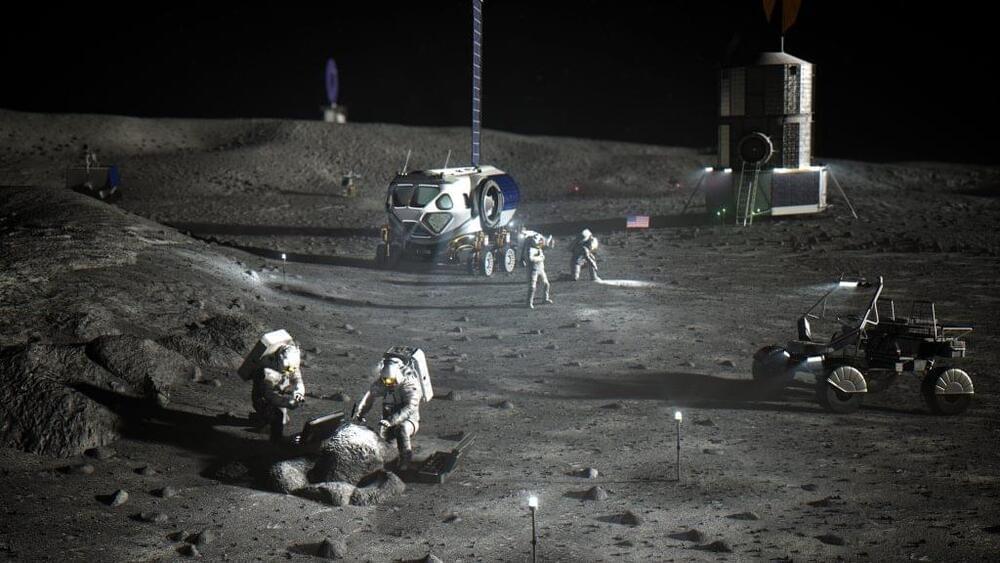
It’s especially relevant these days considering that America’s NASA is planning to get boots on the ground as soon as late 2025 as part of its Artemis program, with the construction of a permanent habitat following sometime in the 2030s — that is, if everything goes according to plan.
And while we’ve seen plenty of early mockups and renders, we may finally be honing in on some actual designs of what such a future fixture on the Moon could look like.
Last week, Thales Alenia Space announced it had signed a contract with the ASI to build the “first permanent outpost on the Moon” — and the news has us giddy with excitement.
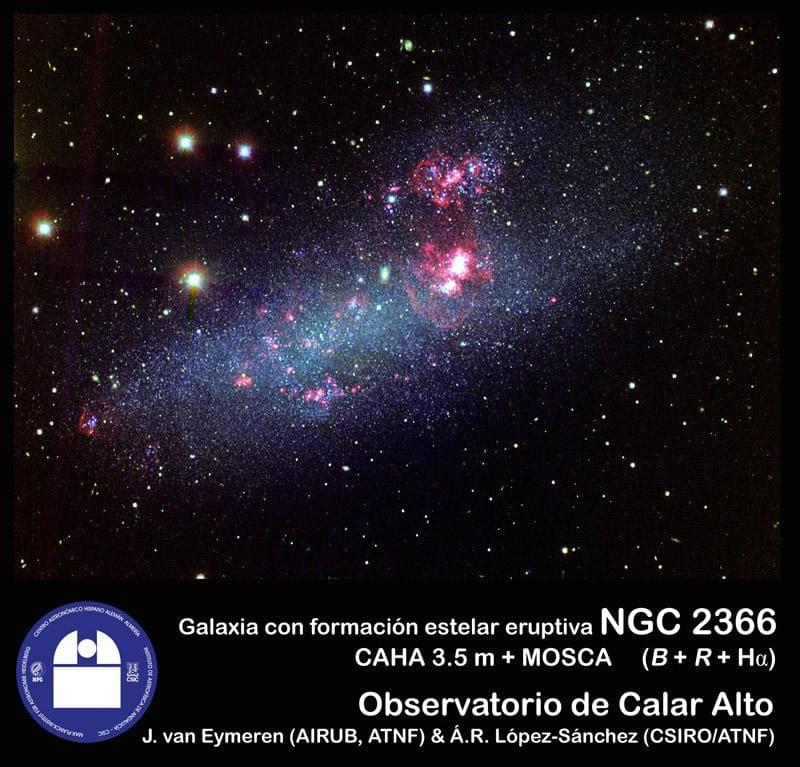
If you gaze at the vast galaxies filled with countless stars, it’s easy to assume they are star factories, churning out brilliant balls of gas. However, it’s the less evolved dwarf galaxies dwarf galaxies have bigger regions of star factories, with higher rates of star formation.
Recent findings by researchers from the University of Michigan shed light on this phenomenon: Dwarf galaxies experience a delay of about 10 million years before they expel the gas congesting their space. This delay allows star-forming regions in these galaxies to retain their gas and dust longer, fostering the formation and development of more stars.