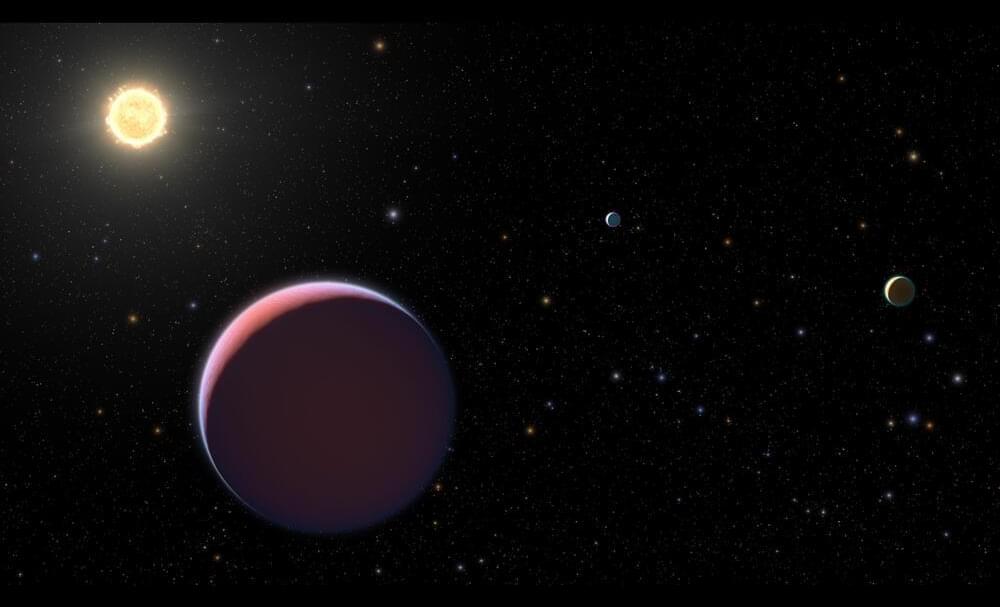
The unusual system of three ‘super puff’ planets has at least one more planet, revealed by its gravitational tug on other planets. An unusual planetary system with three known ultra-low density “super-puff” planets has at least one more planet, according to new research led by researchers from Penn State and Osaka University. The research team set out to study Kepler-51d, the third planet in the system, with NASA’s James Webb Space Telescope (JWST) but almost missed their chance when the planet unexpectedly passed in front of its star two hours earlier than models predicted. After scrutinizing new and archival data from a variety of space and Earth-based telescopes, the researchers found that the best explanation is the presence of a fourth planet, whose gravitational pull impacts the orbits of the other planets in the system.
The new planet’s discovery is detailed in a paper appearing Dec. 3 in the Astronomical Journal.
“Super puff planets are very unusual in that they have very low mass and low density,” said Jessica Libby-Roberts, Center for Exoplanets and Habitable Worlds Postdoctoral Fellow at Penn State and co-first author of the paper. “The three previously known planets that orbit the star, Kepler-51, are about the size of Saturn but only a few times the mass of Earth, resulting in a density like cotton candy. We think they have tiny cores and huge atmospheres of hydrogen of helium, but how these strange planets formed and how their atmospheres haven’t been blown away by the intense radiation of their young star has remained a mystery. We planned to use JWST to study one of these planets to help answer these questions, but now we have to explain a fourth low-mass planet in the system!”