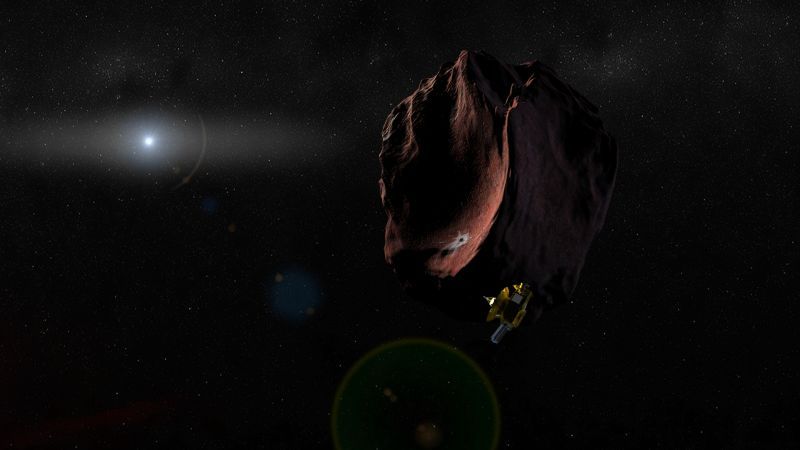
The SpaceX founder has shed more light on his ambitious plans for the Red Planet.

Time now for a very cute video about a rather terrible prospect—the very grim possibility of the universe spawning a lethal bubble of pure vacuum that expands in all directions at the speed of light.

ESA’s Mars Test Lander likely exploded on impact after dropping from a height of four kilometers after its retrorockets prematurely switched off. Just another lesson in how difficult these missions actually are; a cautionary tale for new space entrepreneurs.
New NASA images of the Martian surface indicate that the European Space Agency’s (ESA) Schiaparelli ExoMars 2016 test lander likely crashed from a height of at least two to four kilometers as it made its way through the Red planet’s thin atmosphere.
Surface markings imaged by NASA’s Mars Reconnaissance Orbiter and released via NASA JPL, identifies new markings believed to be related to ESA’s Schiaparelli Entry, Descent and Landing Demonstrator Module (EDM), which arrived at Mars on Oct. 19th. Schiaparelli may have exploded on impact after impacting at speeds greater than 300 kilometers per hour.
ESA’s ExoMars 2016 Trace Gas Orbiter (TGO) released the lander for what was to have been a six minute descent to the touchdown site at Meridiani Planum, a plain near Mars’ equator.
Group metals, a lil history on aluminum, technology needed, space law and more. The one great idea presented here is that many folks think stuff will be brought back to Earth. Though there would be some of that the resources out there will be used out there.
As Humans venture out far away from the Earth into the solar system, they will need material resources to keep us going. Where do we get those from? One for-profit company, Planetary Resources, wants to be the one to make it happen.
We had a chance to speak with the company’s President and CEO, Chris Lewicki about the company’s plans to survey, prospect, and exploit near-Earth asteroids. The company has a lot of financial backing and has plans to send its first satellite to an asteroid in 2020.
This interview was originally broadcast as part of our ongoing Facebook Live segment, The Convo: https://www.facebook.com/PCMag/videos/10154546668188396/
You can see more of our past interviews here: http://www.pcmag.com/article/346681/the-convo-pcmag-nerds-it…-interesti
Mars colonization — getting there is only a small part of the equation. The bigger problem is how to survive. Synthetic biology may be able to help.
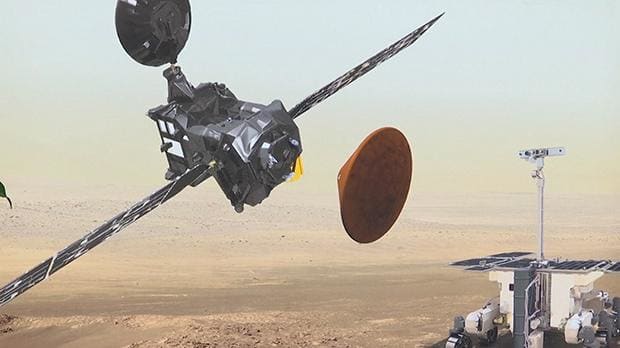
The Mars lander touched down late on Wednesday night but was emitting no signal, ground controllers have announced. It was not known whether the craft was intact.
“The lander touched down, that is certain,” Thierry Blancquaert, manager of the European Space Agency’s “Schiaparelli” lander told AFP.
“Whether it landed intact, whether it hit a rock or a crater or whether it simply cannot communicate, that I don’t know.”


I never get tired of articles highlighting the potential around leveraging Quantum teleporting as a method to replace networks and communications. Now the real question is how soon and how much of the existing infrastructure will need to be replaced to begin taking advantage of this technology earlier than others? As with most things, governments are often early adopters as well as Financial Services and ISPs are a close 2nd in the adoption of such technologies.
An experiment conducted about quantum teleportation could improve and transform the modern phone and Internet communication by having highly secure and encrypted messaging.
A recent study has suggested that comet outbursts are caused by avalanches and not geysers.
Will the testing of the new electric aircraft start a revolution in the aviation industry? Read what NASA has to say.