Toggle light / dark theme

Study solves mysteries of Voyager 1‘s journey into interstellar space

In a study published today in the Astrophysical Journal Letters, scientists from the University of New Hampshire and colleagues answer the question of why NASA’s Voyager 1, when it became the first probe to enter interstellar space in mid-2012, observed a magnetic field that was inconsistent with that derived from other spacecraft observations.

Voyager 1 sent back several different indications that it had punched through the edge of our sun’s massive protective bubble inflated by solar wind—the heliosphere—after a 35-year journey. But the magnetic field data gathered by the spacecraft was not what scientists had expected to see. The UNH-led study resolves the inconsistencies.

“There are still naysayers out there regarding Voyager 1 crossing through the heliopause—the edge of the heliosphere,” says astrophysicist Nathan Schwadron of the UNH Institute for the Study of Earth, Oceans, and Space and department of physics and lead author of the paper. “And the reason for this doubt is that when the spacecraft supposedly broke through the heliopause we should have seen some sort of distinctive shift in the magnetic field from one medium to the other,” Schwadron says.

Read more

Warp Factor 11 — ships powered by BLACK HOLES to “outpace Enterprise”, say scientists

The novel its a bit older, but it‘s an incredible vision!


When Star Trek’s Scotty warns the Captain that the engines can’t “take it”, he might just be best off switching fuel — a new book claims that humanity could reach the stars using vast spacecraft harnessing the energy of black holes with the power to “eat planets”.

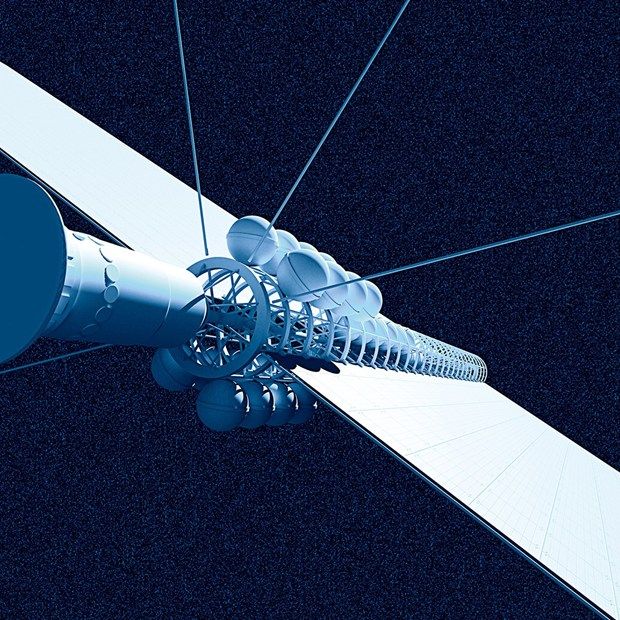
Inside would be an artificial black hole — created by spheres of generators firing “gravitons”- and, claims author Dr Roger Hoskins, Fellow of the Royal Astronomical Society, would curve space-time — and would be “faster than anti matter drives.”

Captain Kirk would be jealous of the speeds offered by a black hole powered craft — which displaces or curves space time, like a warp drive, thus appearing to go faster than light.

Read more

Russia announces plans to send humans to the Moon in 2029

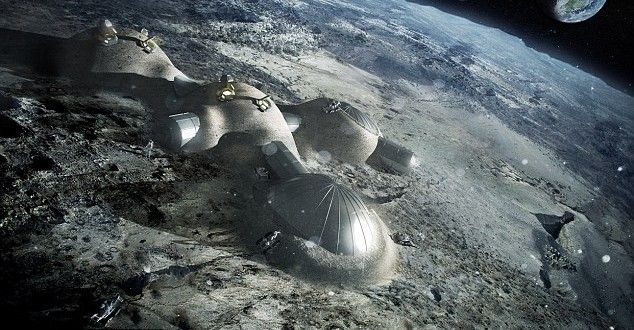
The Russian Federal Space Agency — commonly referred to as Roscosmos — just announced its plans to send humans to the Moon in 2029, RT News reported. It’s part of the agency’s ultimate goal of creating and maintaining a lunar station. Vladimir Solntsev, head of Roscomsos Energia, made the announcement Tuesday at a space and technology conference in Moscow; he noted that they are currently building the spacecraft for the mission now, with its first flight into space planned for 2021.

After its initial flight, the plan is to have the spacecraft dock with the International Space Station in 2023, according to Solntsev. Then in 2025, Roscosmos will send an uncrewed version of the spacecraft to the Moon, before finally sending astronauts in the vehicle in 2029.

It also looks like the European Space Agency may be along for the ride. Two weeks ago, BBC News reported that the ESA had been in talks with Roscosmos to collaborate on sending a lander to the Moon’s south pole. The mission, called Luna 27, would be the first in a series of missions that would eventually return humans to the lunar surface. “We have an ambition to have European astronauts on the Moon. There are currently discussions at international level going on for broad cooperation on how to go back to the Moon,” Bérengère Houdou, head of lunar exploration at ESA, told BBC News.

Read more

A Simple Design Change Could Make a Thruster To Get Us to Mars

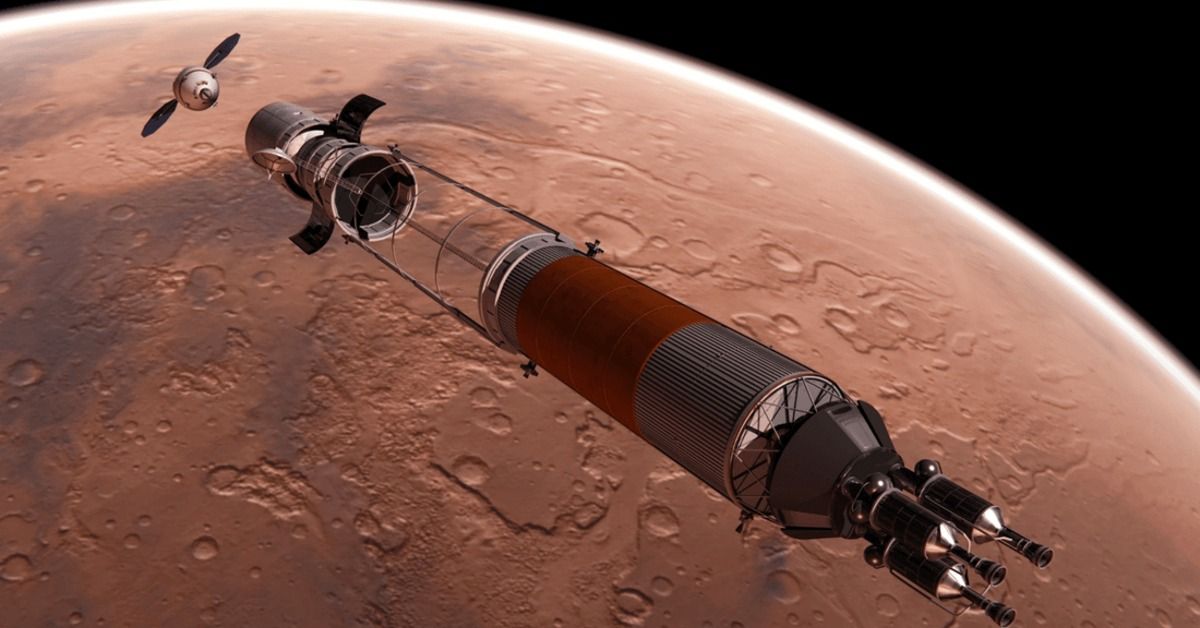
A Hall thruster is powering many of the satellites moving around Earth right now. It needs 100 million (yes, you read that right, 100 million) times less fuel than chemical thrusters. But it was never remotely sturdy enough to get anything to Mars—until now.

Typical chemical thrusters are pretty simple. Fuel combusts, gases shoot one way, and a rocket shoots the other way.

Ion thrusters are a little different. They contain charged electrodes, an anode and a cathode, and allow positively charged ions to shoot from the anode to the cathode. Thanks to momentum, the ions will “overshoot” the cathode. Under regular circumstances they’d be sucked back, but once they’ve cleared the cathode, they’re hit by a beam of electrons, neutralizing them and allowing them to go on their way without interference from the charged cathode. So the neutralized atoms shoot one way, and the rocket shoots another.

Read more

5 REAL Possibilities for Interstellar Travel | Space Time | PBS Digital Studios

Tweet at us! @pbsspacetime.
Facebook: facebook.com/pbsspacetime
Email us! pbsspacetime [at] gmail [dot] com.

Comment on Reddit: http://www.reddit.com/r/pbsspacetime

The prospect of interstellar travel is no longer sci-fi. It COULD be achievable within our lifetime! But, how would an interstellar rocket-ship work? On this week’s episode of Space Time, Matt talks options for interstellar travel — from traditional rocket fuel to antimatter drives, could we travel to other star systems? Watch this episode of Space Time to find out!

“Quantum Entanglement & Spooky Action at a Distance”:
https://www.youtube.com/watch?v=ZuvK-od647c

“The Real Meaning of E=Mc²”:
https://www.youtube.com/watch?v=Xo232kyTsO0

“Could You Fart Your Way To The Moon”:

100 Year Starship Celebrates Awarding First Interstellar Writing Prize during Science Fiction Stories Night

Inaugural Canopus Award Winners to be Announced

Award-winning authors and social and physical science experts will gather at Science Fiction Stories Night and honor winners of the first annual Canopus Awards for Interstellar Writing on Halloween Eve during 100 Year Starship’s ® (100YSS®) fourth annual public symposium in Silicon Valley from October 29-November 1, at the Santa Clara Marriott in Santa Clara, California.

100 Year Starship® (100YSS®) is the independent, long-term global initiative led by former astronaut Dr. Mae Jemison to ensure the capability for human travel beyond our solar system exist within the next 100 years and the advances are applied to enhance life here on Earth every step of the way.

Science fiction frequently leads to science fact. In fact, the extremes of scientific discovery today fuel the imagination and possibilities for science fiction writers tomorrow who catapult them into our collective realm of possibility with their stories. Join the discussion on Science Fiction Stories Night with awarding winning authors, including Nebula Award winner Pat Murphy (The Falling Woman, Bones, and Points of Departure); Juliette Wade (short fiction published in Analog Magazine and Clarkesworld); Brenda Cooper (Edge of Dark and Beyond the Waterfall Door); and, Jacob Weisman, publisher of Tachyon (titles have won the Nebula, Hugo, Sturgeon, Locus, Mythopoeic and World Fantasy Awards).

In addition, 100YSS will announce the inaugural winners of its Canopus Awards for Excellence in Interstellar Writing™. The awards recognize and highlight the importance of great story telling to propel the Interstellar movement. Winners will be named in the categories of “Previously Published Long-Form Fiction;” “Previously Published Short-Form Fiction;” “Original Fiction;” and, “Original Non-Fiction.” (See below for list of finalists.)

With the timely theme of “Finding Earth 2.0,” the symposium invites the public to explore the game-changing processes required to indisputably find a planet outside our solar system capable of supporting Earth-evolved life. Symposium attendees will examine what specific capabilities and systems—scientific, technical and societal—will be needed and impacted over the next five to 25 years to definitively identify at least one Earth 2.0.

A powerful four-day event, the symposium will feature experiences involving transdisciplinary approaches that require attendees to stretch their imaginations and appreciate today’s cutting-edge technologies. They will be challenged to discuss and take action on thought-provoking frontiers of science, civilization, space, technology, society, music and art, both now and in the future.

Organized by the global 100YSS team, the 2015 Public Symposium will bring together experts, enthusiasts, students, celebrities, innovators, educators, and thought leaders from around the world.

Other participants include renown scientists, thinkers, artists, policy makers and celebrities like George Whitesides, CEO, Virgin Galactic; Mickey Fisher, Creator, EXTANT; Lou Friedman, Ph.D. astronomer and co-founder of the Planetary Society; Jill Tarter, Ph.D., co-founder of SETI Institute, astronomer and TED Prize winner; Mae Jemison, M.D., physician, engineer and entrepreneur; Hakeem Oluseyi, Ph.D., TED Fellow and Chief Science Officer, Discovery Channel; Amy Millman, CEO and co-founder Springboard Enterprises; Mmboneni Muofhe, Deputy Director, South African Department of Science and Technology; Pam Contag, Ph.D., CEO, Molecular Sciences Institute; Pete Worden, Ph.D., Chairman, Breakthrough Prize Foundation and former Director, NASA Ames; and, Kurt Zatloukal, M.D., Professor, Medical University of Graz (Austria), among others.

Dr. Jemison stated, “100 Year Starship is building an inclusive movement that spurs us to achieve the extraordinary — human travel beyond our solar system. Simultaneously, 100 Year Starship is applying the radical leaps in knowledge, technologies, social systems and other capabilities learned and discovered to improve life here on Earth today. While it might take years to uncover these Earth-bound solutions, it might not. However, we might not find them at all without the unique perspective afforded by such an audacious goal of interstellar travel.”

For more information or to register to attend, visit: http://2015.symposium.100yss.org/

About 100 Year Starship®

100 Year Starship® (100YSS), an independent, non-governmental, long-term initiative to ensure the capabilities for human interstellar flight exist as soon as possible, and definitely within the next 100 years. 100YSS was started in 2012 with seed-funding through a competitive grant from DARPA (Defense Advanced Research Projects Agency) and support from NASA (National Aeronautics and Space Administration) for the purpose of fostering the type of explosive innovation and technology and social advances born from addressing such an incredible challenge. 100YSS is part of the Dorothy Jemison Foundation for Excellence. For more information, visit www.100yss.org.

FIRST ANNUAL CANOPUS AWARD™ FOR EXCELLENCE IN INTERSTELLAR WRITING

FINALISTS

In the category of “Previously Published Long-Form Fiction” (40,000 words or more):

  • “Other Systems” by Elizabeth Guizzetti
  • “The Creative Fire” by Brenda Cooper
  • “InterstellarNet: Enigma” by Edward M. Lerner
  • “Aurora” by Kim Stanley Robinson
  • “Coming Home” by Jack McDevitt

In the category of “Previously Published Short-Form Fiction” (between 1,000 and 40,000 words):

  • “Race for Arcadia” by Alex Shvartsman
  • “Stars that Make Dark Heaven Light” by Sharon Joss
  • “Homesick” by Debbie Urbanski
  • “Twenty Lights to the Land of Snow” by Michael Bishop
  • “Planet Lion” by Catherynne M. Valente
  • “The Waves” by Ken Liu
  • “Dreamboat” by Robin Wyatt Dunn

In the category of “Original Fiction” (1,000–5,000 words):

  • “Landfall” by Jon F. Zeigler
  • “Project Fermi” by Michael Turgeon
  • “Everett’s Awakening” by Ry Yelcho
  • “Groundwork” by G. M. Nair
  • “His Holiness John XXIV about Father Angelo Baymasecchi’s Diary” by Óscar Garrido González
  • “The Disease of Time” by Joseph Schmidt

In the category of “Original Non-Fiction” (1,000–5,000 words):

  • “Why Interstellar Travel?” by Jeffrey Nosanov
  • “Finding Earth 2.0 from the Focus of the Solar Gravitational Lens” by Louis D. Friedman and Slava Turyshev
/* */