Toggle light / dark theme

Light Can ‘heal’ Defects in New Solar Cell Materials

A family of compounds known as perovskites, which can be made into thin films with many promising electronic and optical properties, has been a hot research topic in recent years. But although these materials could potentially be highly useful in applications such as solar cells, some limitations still hamper their efficiency and consistency.

Now, a team of researchers at MIT and elsewhere say they have made significant inroads toward understanding a process for improving perovskites’ performance, by modifying the material using intense light. The new findings are being reported in the journal Nature Communications, in a paper by Samuel Stranks, a researcher at MIT; Vladimir Bulovic, the Fariborz Maseeh (1990) Professor of Emerging Technology and associate dean for innovation; and eight colleagues at other institutions in the U.S. and the U.K. The work is part of a major research effort on perovskite materials being led by Stranks, within MIT’s Organic and Nanostructured Electronics Laboratory.

Tiny defects in perovskite’s crystalline structure can hamper the conversion of light into electricity in a solar cell, but “what we’re finding is that there are some defects that can be healed under light,” says Stranks, who is a Marie Curie Fellow jointly at MIT and Cambridge University in the U.K. The tiny defects, called traps, can cause electrons to recombine with atoms before the electrons can reach a place in the crystal where their motion can be harnessed.

Large-scale technique to produce quantum dots

Nice new method in producing Q-Dots which seems to be more cost effective, efficient and reliable.


Large-scale technique to produce quantum dots.

Wearable Technology 2015-2025

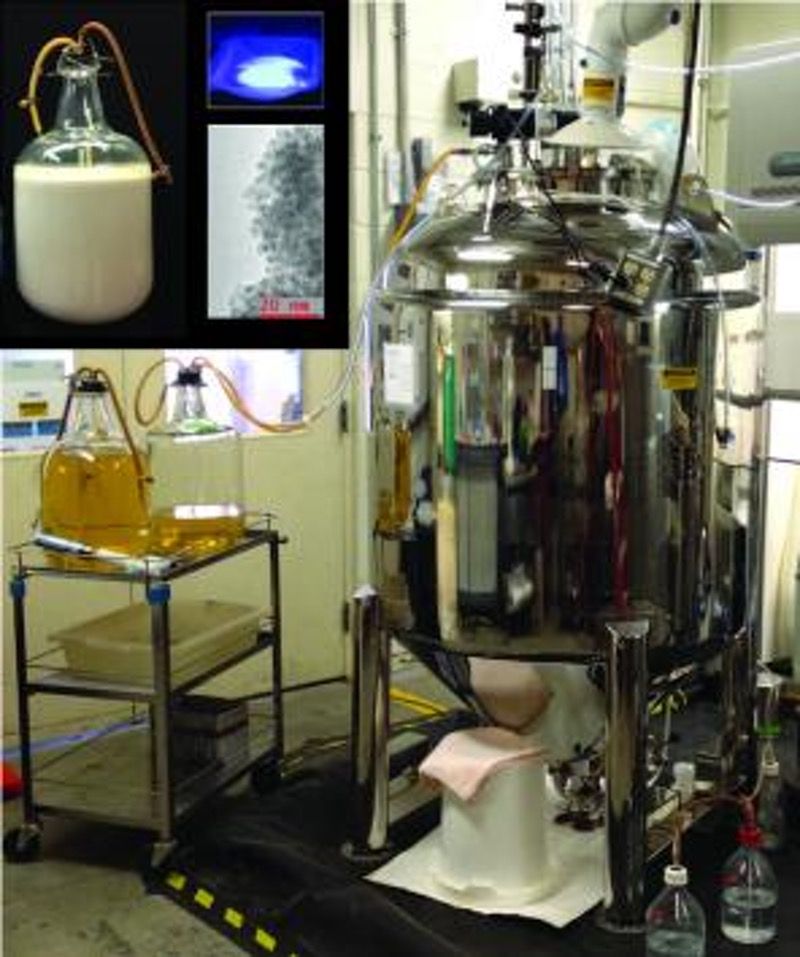
A method to produce significant amounts of semiconducting nanoparticles for light-emitting displays, sensors, solar panels and biomedical applications has gained momentum with a demonstration by researchers at the Department of Energy’s Oak Ridge National Laboratory.

Nanotechnology could enable use of Solar Energy at night

Using the power of nano to solar power our homes at night.


MIT researchers have built a new experimental solar cell which could greatly enhance power efficiency. The “Shockley-Queisser’ limit is the estimated maximum efficiency of a solar cell, which is commonly about 32%; that means almost 70% of energy is wasted in the form of heat.

One way to reduce energy loss is by stacking cells. However if sunlight could be turned into heat and then be re-emitted as light, the solar cells could utilize more energy. Solar cells work best with visible light which occurs midway of the radiation spectrum. As a result the radiations with shorter and greater wavelengths usually go to waste.

The researchers at MIT have developed a structure of carbon nano-tubes that will function between the sun and solar cell. These carbon nano-tubes are very good absorbents of light (all types of radiation) and convert it to heat; heat is easier to store unlike light.

A Battery Made From Metal and Air Is Electrifying the Developing World

Got to luv this.


Is this brand new type of battery the key to clean energy and off-grid electricity?

Lithium-ion batteries are having a moment. After becoming the de facto battery in laptops and cell phones over the years, they’re now starting to power electric cars (like those made by Tesla) and plug into the power grid.

But lithium-ion batteries aren’t the only battery type in town. Some brand new battery varieties could actually be more promising than lithium-ion when it comes to storing energy generated by solar panels or used to power remote villages in Africa, India, and Asia.

Airbus Defence and Space Enters Solar Cell Production Contract with MicroLink Devices for Next Generation Zephyr HAPS

Nice.


NILES, Ill., May 18, 2016 /PRNewswire/ — MicroLink Devices is proud to announce that Airbus Defence and Space has issued a production contract for MicroLink’s epitaxial liftoff (ELO)-based multijunction solar sheets for use on the new Zephyr S platform.

Photo — http://photos.prnewswire.com/prnh/20160517/368562

Space exploration will spur transhumanism and mitigate existential risk

Friends have been asking me to write something on space exploration and my campaign policy on it, so here it is just out on TechCrunch:


When people think about rocket ships and space exploration, they often imagine traveling across the Milky Way, landing on mysterious planets and even meeting alien life forms.

In reality, humans’ drive to get off Planet Earth has led to tremendous technological advances in our mundane daily lives — ones we use right here at home on terra firma.

I recently walked through Boston’s Logan International Airport; a NASA display reminded me that GPS navigation, anti-icing systems, memory foam and LED lights were all originally created for space travel. Other inventions NASA science has created include the pacemaker, scratch-resistant lenses and the solar panel.

These types of advancements are one of the most important reasons I am hoping our next U.S. president will try to jump-start the American space program — both privately and publicly. Unfortunately, it doesn’t appear any of them are talking about the issue. But they should be. As we enter the transhumanist age — the era of bionic limbs, brain implants and artificial intelligence — space exploration might once again dramatically lead us forward in discovering the most our species can become.

This ‘nanocavity’ may improve ultrathin solar panels, video cameras and more

The future of movies and manufacturing may be in 3D, but electronics and photonics are going 2-D; specifically, two-dimensional semiconducting materials.

One of the latest advancements in these fields centers on (MoS2), a two-dimensional semiconductor that, while commonly used in lubricants and steel alloys, is still being explored in optoelectronics.

Recently, engineers placed a single layer of MoS2 molecules on top of a photonic structure called an optical nanocavity made of aluminum oxide and aluminum. (A nanocavity is an arrangement of mirrors that allows beams of light to circulate in closed paths. These cavities help us build things like lasers and optical fibers used for communications.)

/* */