Toggle light / dark theme

Solar cell mystery solved, expected to greatly increase efficiency

(Phys.org)—For the past 17 years, spiro-OMeTAD, has been keeping a secret. Despite intense research efforts, its performance as the most commonly used hole-transporting material in perovskite and dye-sensitized solar cells has remained stagnant, creating a major bottleneck for improving solar cell efficiency. Thinking that the material has given all it has to offer, many researchers have begun investigating alternative materials to replace spiro-OMeTAD in future solar cells.

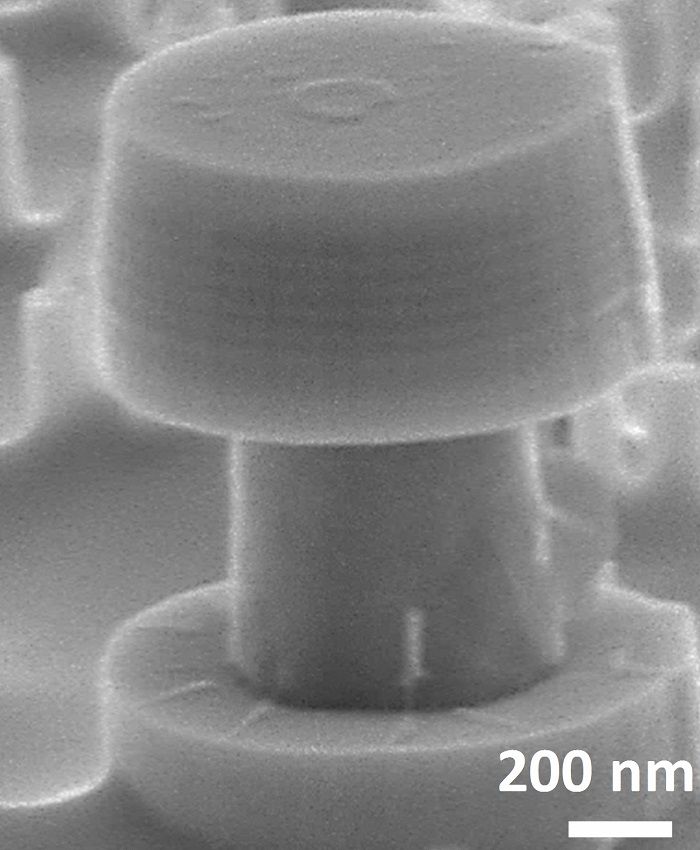
But in a new study published in Science Advances, Dong Shi et al. have taken a closer look at spiro-OMeTAD and found that it still has a great deal of untapped potential. For the first time, they have grown single crystals of the pure material, and in doing so, they have made the surprising discovery that spiro-OMeTAD’s single-crystal structure has a hole mobility that is three orders of magnitude greater than that of its thin-film form (which is currently used in solar cells).

“This paper reports a major breakthrough for the fields of perovskite and solid-state by finally clarifying the potential performance of the material and showing that improving the crystallinity of the hole transport layer is the key strategy for further breakthroughs in device engineering of these solar cells,” Osman Bakr, a professor of engineering at King Abdullah University of Science and Technology (KAUST) in Saudi Arabia and leader of the study, told Phys.org.

SolaBat: A Hybrid Solar Cell and Battery System

SolaBat is developing a hybrid device that utilizes both solar cells and more traditional electrochemical energy storage systems.

Last month, the Austrian Research Promotion Agency (FFG) announced a groundbreaking new project called SolaBat. Spearheaded by a group of researchers at the Graz University of Technology (TU Graz) led by Illie Hanzu, it aims to combine photovoltaic cells and electrochemical energy storage systems into a single hybrid device. Fundamentally, SolaBat plans to create a more simplified system of converting and storing solar power.

“Currently, single systems of photovoltaic cells which are connected together – mostly lead-based batteries and vast amounts of cable – are in use. Solar panels on the roof with a battery in the cellar. This takes up a lot of space, needs frequent maintenance and is not optimally efficient,” says Hanzu. “We want to make a battery and solar cell hybrid out of two single systems which is not only able to convert electrical energy but also store it.”

Caltech’s 2500 Orbiting Solar Panels Could Provide Earth With Limitless Energy

The Space Solar Power Initiative (SSPI), a collaboration between Caltech and Northrup Grumman, has developed a system of lightweight solar power tiles which can convert solar energy to radio waves and can be placed in orbit to beam power to an energy-thirsty Earth.

One of the greatest challenges facing the 21st Century is the issue of power—how to generate enough of it, how to manufacture it cheaply and with the least amount of harmful side-effects, and how to get it to users.

The solutions will have to be very creative—rather like what the Space Solar Power Initiative (SSPI), a partnership between Caltech and Northrup Grumman, has devised.

Membrane spacecraft with 7.7 kW/kg power-to-weight ratio and 4000 ISP

A ‘brane’ is a dynamical object that can propagate through spacetime. Flattening a spacecraft into a membrane, or 2-brane, can produce a low mass vehicle with ultra-high power-to-weight ratio (7.7 kW/kg using thin film solar cells). If most of this power is used by an array of thinned, distributed electrospray thrusters with a specific impulse of 4000 s, a Brane Craft could start in low Earth orbit, land on Phobos, and return to low Earth orbit.

Other possible targets include any near-Earth asteroid and most main belt asteroids. Propellant is stored as a liquid within a 10-micron wide gap between two Kapton sheets that form the main structure of the Brane Craft.

This NASA NIAC project will study how to design an ultra-light dynamic membrane spacecraft, with 3-axis attitude determination and control plus navigation, that can significantly change both its shape and orbit. Conventional sensors like star trackers will have to be replaced by 2-dimensional alternatives. Estimated mass is about 35 grams for a 1 square meter Brane Craft.

Scientists are developing graphene solar panels that generate energy when it rains

Solar power is making huge strides as a reliable, renewable energy source, but there’s still a lot of untapped potential in terms of the efficiency of photovoltaic cells and what happens at night and during inclement weather. Now a solution has been put forward in the form of producing energy from raindrops.

Key to the new process is graphene: a ‘wonder’ material we’ve heard plenty about before. Because raindrops are not made up of pure water, and contain various salts that split up into positive and negative ions, a team from the Ocean University of China in Qingdao thinks we can harness power via a simple chemical reaction. Specifically, they want to use graphene sheets to separate the positively charged ions in rain (including sodium, calcium, and ammonium) and in turn generate electricity.

Early tests, using slightly salty water to simulate rain, have been promising: the researchers were able to generate hundreds of microvolts and achieve a respectable 6.53 percent solar-to-electric conversion efficiency from their customised solar panel.

Quantum dots enhance light-to-current conversion in layered metal dichalcogenide semiconductors

Improving light-sensing devices with Q-Dots.


Harnessing the power of the sun and creating light-harvesting or light-sensing devices requires a material that both absorbs light efficiently and converts the energy to highly mobile electrical current. Finding the ideal mix of properties in a single material is a challenge, so scientists have been experimenting with ways to combine different materials to create “hybrids” with enhanced features.

In two just-published papers, scientists from the U.S. Department of Energy’s Brookhaven National Laboratory, Stony Brook University, and the University of Nebraska describe one such approach that combines the excellent light-harvesting properties of quantum dots with the tunable electrical conductivity of a layered tin disulfide semiconductor. The hybrid material exhibited enhanced light-harvesting properties through the absorption of light by the quantum dots and their energy transfer to tin disulfide, both in laboratory tests and when incorporated into electronic devices. The research paves the way for using these materials in optoelectronic applications such as energy-harvesting photovoltaics, light sensors, and light emitting diodes (LEDs).

Quantum Dots

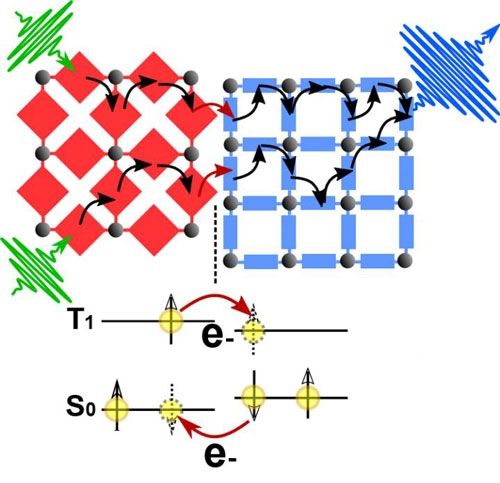
Single nanocrystal spectroscopy identifies the interaction between zero-dimensional CdSe/ZnS nano crystals (quantum dots) and two-dimensional layered tin disulfide as a non-radiative energy transfer, whose strength increases with increasing number of tin disulfide layers. Such hybrid materials could be used in optoelectronic devices such as photovoltaic solar cells, light sensors, and LEDs. (click on image to enlarge)

Student-designed ‘FemtoSats’ aim to bring cost of satellite deployment below $1,000

Got a grand burning a hole in your pocket? You could get a new laptop — or you could send this tiny, palm-sized satellite to space. That’s what a team of engineers at Arizona State hope, anyway: their “FemtoSats” are meant to be as cheap a space-bound platform as has ever been devised.

At just 3cm per side and 35 grams (that’s about 1.2 inches and 0.077 pounds, dogs of the Imperial system), the SunCube 1F is the prototype FemtoSat. It’s powered by a salvaged scrap of solar panel (they don’t make them small enough off the shelf), the tiny unit includes propulsion, imaging, communication, and data collection.

“The design standard bootstraps from the Cal Poly CubeSat standard and is extensible, allowing major customization,” wrote Jekan Thanga, the ASU assistant professor who heads up the project, in an email to TechCrunch.

/* */