Toggle light / dark theme

Running thousands of LLMs on one GPU is now possible with S-LoRA

VentureBeat presents: AI Unleashed — An exclusive executive event for enterprise data leaders. Hear from top industry leaders on Nov 15. Reserve your free pass

Fine-tuning large language models (LLM) has become an important tool for businesses seeking to tailor AI capabilities to niche tasks and personalized user experiences. But fine-tuning usually comes with steep computational and financial overhead, keeping its use limited for enterprises with limited resources.

To solve these challenges, researchers have created algorithms and techniques that cut the cost of fine-tuning LLMs and running fine-tuned models. The latest of these techniques is S-LoRA, a collaborative effort between researchers at Stanford University and University of California-Berkeley (UC Berkeley).

YouTube Creators Will Be Forced To Disclose AI Content

YouTube will soon make users add a disclaimer when they post artificial intelligence-generated or manipulated videos.

In a company blog post, the video giant outlined its forthcoming rule change that will not only require a warning label, but will display disclaimers larger for certain types of “sensitive” content such as elections and public health crises.

As Bloomberg reports, this change at the Alphabet-owned company comes after a September announcement that election ads across the firm’s portfolio will require “prominent” disclosures if manipulated or generated by AI — a rule that’s slated to begin mid-November, the outlet previously reported.

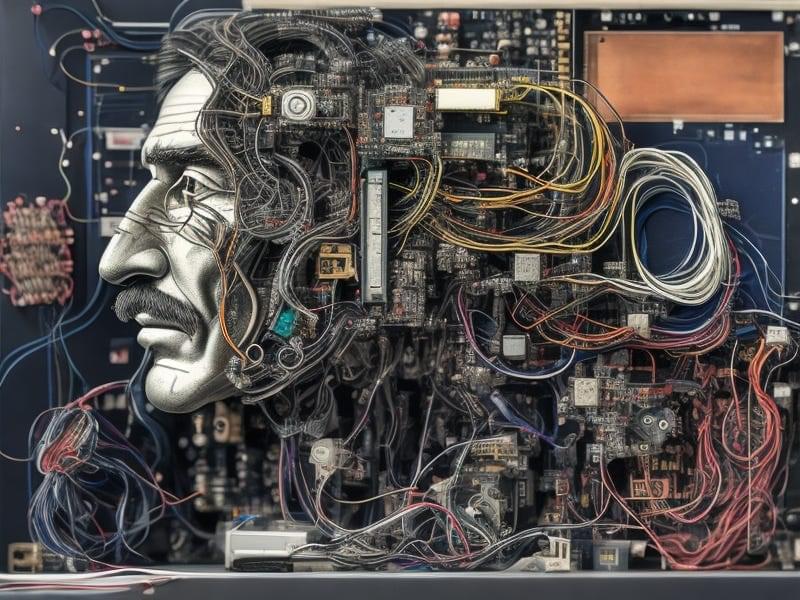
Can you spot the AI impostors? Research finds AI faces can look more real than actual humans

This is why i laughed at all that un canny valley crap talk in early 2010s. notice term is almost never used anymore. And, as for makin robots more attractive than most people. done in mid 2030s.


Does ChatGPT ever give you the eerie sense you’re interacting with another human being?

Artificial intelligence (AI) has reached an astounding level of realism, to the point that some tools can even fool people into thinking they are interacting with another human.

The eeriness doesn’t stop there. In a study published today in Psychological Science, we’ve discovered images of white faces generated by the popular StyleGAN2 algorithm look more “human” than actual people’s faces.

NVIDIA announces H200 Tensor Core GPU

The world’s most valuable chip maker has announced a next-generation processor for AI and high-performance computing workloads, due for launch in mid-2024. A new exascale supercomputer, designed specifically for large AI models, is also planned.

H200 Tensor Core GPU. Credit: NVIDIA

In recent years, California-based NVIDIA Corporation has played a major role in the progress of artificial intelligence (AI), as well as high-performance computing (HPC) more generally, with its hardware being central to astonishing leaps in algorithmic capability.

Super Computing Conference Digital Storage Announcements

In this article we look at several introductions of digital storage related products at the 2023 Supercomputing Conference.


WDC was also showing its hybrid storage JBOD Ultrastar Data102 and Data60 platforms to support disaggregated storage and software-defined storage (SDS). This comes in dual-port SAS or single-port SATA configurations. The Data102 has storage capacities up to 2.65PB and the Data60 has up to 1.56TB in a 4U enclosure that includes IsoVibe and ArticFlow technologies for improved performance and reliability. The Data102 and Data60 capacity numbers assume using 26TB SMR HDDs.

WDC was also showing a GPUDirect storage proof of concept combining the company’s RaidFlex technology with Ingrasys ES2100 with integrated NVIDIA Spectrum Ethernet switches as well as NVIDIA’s GPUs, Magnum IO GPUDirect storage, BlueField DPUs and ConnectX SmartNICs. The proof-of-concept demonstration can provide 25GB/s bandwidth for a single NVIDIA A100 Tensor Core GPU and over 100GB/s for four NVIDIA A100 GPUs.

At SC23 Arcitecta and DDN introduced software defined storage solutions for AI and cloud applications. WDC was also showing SDS, its OpenFlex NVMe storage and GPUDirect storage.

/* */