If you consider 50% to be a passing grade…


DeepSeek is a ‘wake-up call’ that will spur American investment: Alex Karp
Yoshua Bengio and Max Tegmark, two of the world’s most prominent AI scientists, warned of the dangers of uncontrollable artificial intelligence.
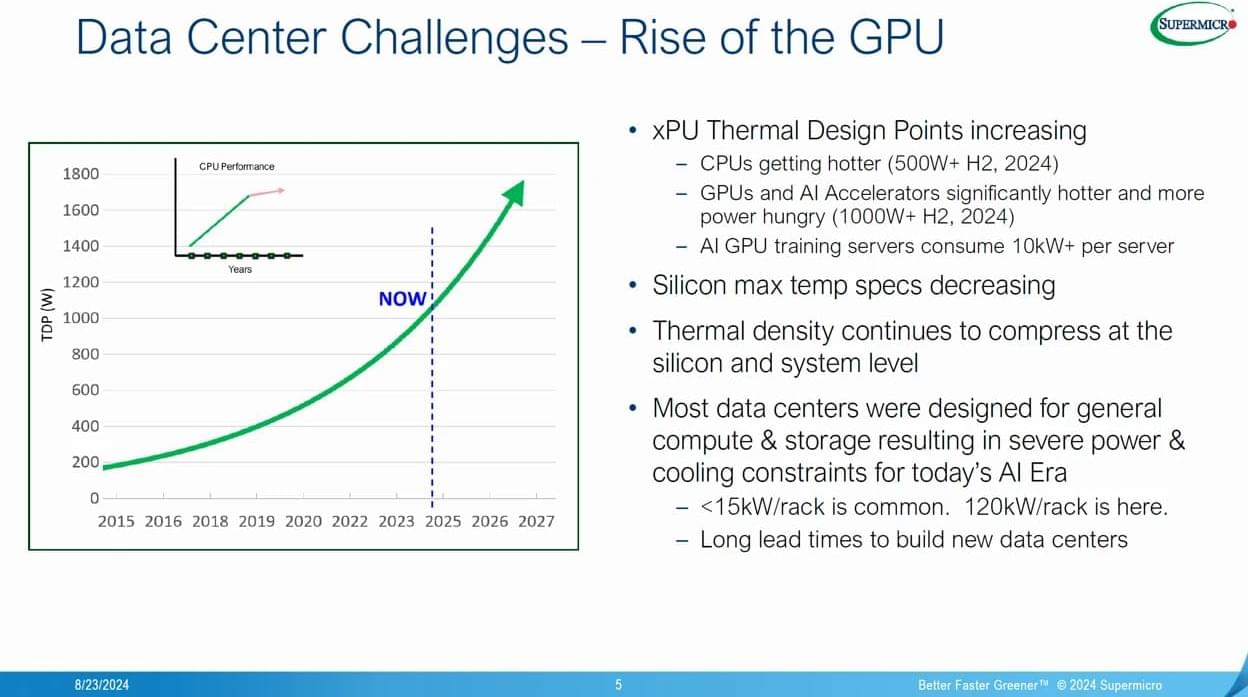
Adopting liquid cooling technology could significantly reduce electricity costs across the data center.
Many Porsche “purists” reflect forlornly upon the 1997, 5th generation, 996 version of the iconic 911 sports car. It was the first year of the water-cooled engine versions of the 911, which had previously been based on air-cooled engines since their entry into the market in 1964. The 911 was also the successor to the popular air-cooled 356. For over three decades, Porsche’s flagship 911 was built around an air-cooled engine. The two main reasons often provided for the shift away from air-cooled to water-cooled engines were 1) environmental (emission standards) and 2) performance (in part cylinder head cooling). The writing was on the wall: If Porsche was going to remain competitive in the sports car market and racing world, the move to water-cooled engines was unavoidable.
Fast forward to current data centers trying to meet the demands for AI computing. For similar reasons, we’re seeing a shift towards liquid cooling. Machines relying on something other than air for cooling date back at least to the Cray-1 supercomputer which used a freon-based system and the Cray-2 which used Fluorinert, a non-conductive liquid in which boards were immersed. The Cray-1 was rated at about 115kW and the Cray-2 at 195kW, both a far cry from the 10’s of MWs used by today’s most powerful supercomputers. Another distinguishing feature here is that these are “supercomputers” and not just data center servers. Data centers have largely run on air-cooled processors, but with the incredible demand for computing created by the explosive increase in AI applications, data centers are being called on to provide supercomputing-like capabilities.

Discovering new deposits of critical and rare earth minerals is paramount to delivering global net-zero ambitions. However, finding new ore bodies is becoming more challenging due to increasing costs and geopolitical tensions. What is more, much of the low-hanging fruit, so to speak, has already been exploited.
Could technological advances help broaden the search and speed up the process? Dr Bryony Richards, a senior research scientist with the Energy & Geoscience Institute at the University of Utah in the US, believes so.
Richards and her colleagues are incorporating NASA’s and Japan’s global Advanced Spaceborne Thermal Emission and Reflection Radiometer (ASTER) imagery with that of new satellite data, advances in computing power and AI. With this approach, they are developing a comprehensive first-of-a-kind method to uncover the ‘fingerprints’ of mineral deposits that could eventually provide a more cost and time-effective way of mapping minerals in remote areas.
Researchers in Utah are combining satellites, hyperspectral imaging and AI to discover mineral deposits in remote locations.
At GTC 2025, NVIDIA CEO Jensen Huang introduced Blue, a cutting-edge AI-powered robot developed in collaboration with Disney Research and Google DeepMind. Watch as Jensen interacts with Blue and discusses this exciting partnership. While details are scarce, this brief moment showcases NVIDIA’s vision for the future of AI and robotics.
📺 Subscribe for more tech updates!
#NVIDIA #GTC2025 #AI #DisneyResearch #WaltDisneyWorld.
Thanks For Watching!
========================================================
Follow us on:
Website: http://samsdisneydiary.com/
FACEBOOK: https://web.facebook.com/SamsDisneyDiary.
…
INSTAGRAM: https://www.instagram.com/SamsDisneyDaily.
…
=========================================================
It’s difficult to build devices that replicate the fluid, precise motion of humans, but that might change if we could pull a few (literal) strings. At least, that’s the idea behind “cable-driven” mechanisms in which running a string through an object generates streamlined movement across an object’s different parts. Take a robotic finger, for example: You could embed a cable through the palm to the fingertip of this object and then pull it to create a curling motion.
While cable-driven mechanisms can create real-time motion to make an object bend, twist, or fold, they can be complicated and time-consuming to assemble by hand. To automate the process, researchers from MIT’s Computer Science and Artificial Intelligence Laboratory (CSAIL) have developed an all-in-one 3D printing approach called “Xstrings.” Part design tool, part fabrication method, Xstrings can embed all the pieces together and produce a cable-driven device, saving time when assembling bionic robots, creating art installations, or working on dynamic fashion designs.
In a paper to be presented at the 2025 Conference on Human Factors in Computing Systems (CHI2025), the researchers used Xstrings to print a range of colorful and unique objects that included a red walking lizard robot, a purple wall sculpture that can open and close like a peacock’s tail, a white tentacle that curls around items, and a white claw that can ball up into a fist to grab objects.