Stanford Medicine researchers trained a large language model to read medical charts, looking for signs that kids with ADHD received the right follow-up care when using new medications.

Stanford Medicine researchers trained a large language model to read medical charts, looking for signs that kids with ADHD received the right follow-up care when using new medications.

Targeting therapeutic nanoparticles to the brain poses a challenge due to the restrictive nature of the blood–brain barrier (BBB). Here we report the development of mRNA-loaded lipid nanoparticles (LNPs) functionalized with BBB-interacting small molecules, thereby enhancing brain delivery and gene expression. Screening brain-targeted mRNA-LNPs in central nervous system (CNS) in vitro models and through intravenous administration in mice demonstrated that acetylcholine-conjugated LNPs achieved superior brain tropism and gene expression, outperforming LNP modifications with nicotine, glucose, memantine, cocaine, tryptophan, and other small molecules. An artificial intelligence (AI)-based model designed to predict the BBB permeability of small-molecule ligands showed strong alignment with our experimental results, providing in vivo validation of its predictive capacity. Cell-specific biodistribution analysis in Cre-reporter Ai9 mice showed that acetylcholine-functionalized LNPs preferentially transfected neurons and astrocytes following either intravenous or intracerebral administration. Mechanistic studies suggest that acetylcholine-LNP uptake is mediated by the functional engagement of acetylcholine receptors (AchRs) followed by endocytosis, which synergistically enhances intracellular mRNA delivery. Moreover, acetylcholine-LNPs successfully crossed a human BBB-on-a-chip model, enabling transgene expression in human iPSC-derived neurons. Their effective penetration and transfection in human brain organoids further support their potential activity in human-based systems. These findings establish a predictive and modular framework for engineering CNS-targeted LNPs, advancing precision gene delivery for brain disorders.


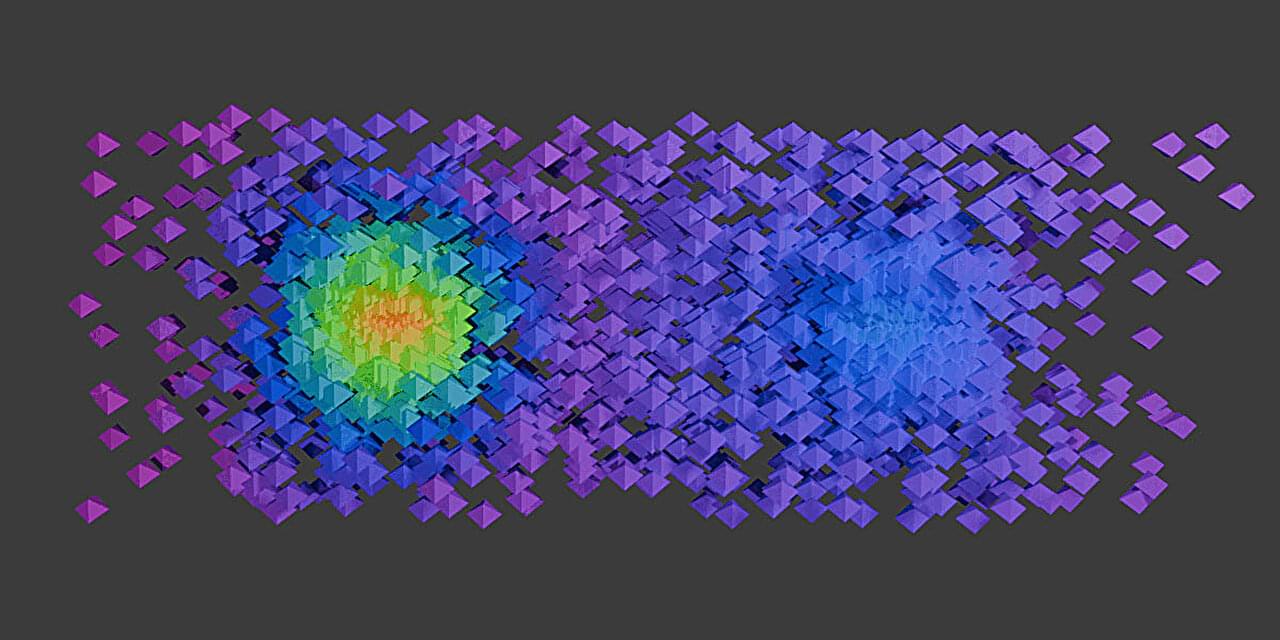
A new trick for modeling molecules with quantum accuracy takes a step toward revealing the equation at the center of a popular simulation approach, which is used in fundamental chemistry and materials science studies.
The effort to understand materials and chemical reactions eats up roughly a third of national lab supercomputer time in the U.S. The gold standard for accuracy is the quantum many-body problem, which can tell you what’s happening at the level of individual electrons. This is the key to chemical and material behaviors as electrons are responsible for chemical reactivity and bonds, electrical properties and more. However, quantum many-body calculations are so difficult that scientists can only use them to calculate atoms and molecules with a handful of electrons at a time.
Density functional theory, or DFT, is easier—the computing resources needed for its calculations scale with the number of electrons cubed, rather than rising exponentially with each new electron. Instead of following each individual electron, this theory calculates electron densities—where the electrons are most likely to be located in space. In this way, it can be used to simulate the behavior of many hundreds of atoms.

ShadowLeak zero-click flaw in ChatGPT Deep Research leaks Gmail data via hidden HTML prompts, bypassing security

The phishing-as-a-service (PhaaS) offering known as Lighthouse and Lucid has been linked to more than 17,500 phishing domains targeting 316 brands from 74 countries.
“Phishing-as-a-Service (PhaaS) deployments have risen significantly recently,” Netcraft said in a new report. “The PhaaS operators charge a monthly fee for phishing software with pre-installed templates impersonating, in some cases, hundreds of brands from countries around the world.”
Lucid was first documented by Swiss cybersecurity company PRODAFT earlier this April, detailing the phishing kit’s ability to send smishing messages via Apple iMessage and Rich Communication Services (RCS) for Android.
Microsoft has begun rolling out the beta version of its AI-powered Gaming Copilot to Windows 11 systems for users aged 18 or older, excluding those in mainland China.
Tagged as a “personal gaming sidekick,” Gaming Copilot will also be pushed to Xbox mobile app users on Apple and Android devices starting next month.
To start using Gaming Copilot in the Game Bar, Windows users must install the Xbox PC app on their PC and use the Windows logo key + G keyboard shortcut to open the Game Bar. Next, they can find the Gaming Copilot icon in the Home Bar, open the widget, and log in to their Xbox account.