Traditional microscopy often relies on labeling samples with dyes, but this process is costly and time-consuming. To overcome these limitations, researchers have developed a computational quantitative phase imaging (QPI) method using chromatic aberration and generative AI.
By leveraging the natural variations in focus distances of different wavelengths, the technique constructs through-focus image stacks from a single exposure. With the help of a specially trained diffusion model, this approach enables high-quality imaging of biological specimens, including real-world clinical samples like red blood cells. The breakthrough could revolutionize diagnostics, providing an accessible and efficient alternative to conventional imaging techniques.
The future of warfare starts in your mind. Understand how Neuroscience, Technology/AI and the OODA loop affects your flow. The world is changing, and cognitive warfare is at the forefront. In our latest podcast episode, we sit down with James Giordano, PhD, a Navy veteran and an expert in neurocognitive science, to delve into the world of cognitive warfare. Stay in the Loop: https://www.aglx.com/newsletter-signup-north-america. From the impact of emotions on decision-making to the integration of artificial intelligence and human cognition, this episode challenges your perspective on the battlefield. Join us as we explore the ethical implications of genetic modifications, the transformative effects of psychedelics, and the complexities of data usage in the digital age. Get ready to reimagine the relationship between technology, culture, and language. Don’t miss out on this opportunity to gain valuable insights from our thought-provoking conversation with Dr. Giordano. Tune in now to stay ahead of the curve on the evolving landscape of warfare!
00:00 — Understanding the OODA loop: A Neuroscience Perspective. 09:11 — Exploring Fifth Generation Warfare and Liminal Warfare. 16:06 — The Long Game: China’s Strategic Plan. 22:19 — Understanding Cognitive Warfare and Human-Machine Teaming. 25:52 — The Evolution of Human-Machine Teaming. 29:11 — Human Involvement in AI Decision Making. 36:01 — The Ethics of Paternalistic AI Systems. 40:43 — Technology’s Impact on Cognitive Engagement. 45:13 — Exploring Technologies for Human Performance Enhancement. 55:59 — Diving Into Attacking Mode and Ethics. 56:24 — Hacking the Human Genome. 59:37 — Epigenetic Modification and Phenotypic Shift. 1:04:54 — The Psychedelic Revolution. 1:11:18 — Revisiting Alcohol and Caffeine: Benefits and Burdens. 1:19:18 — Impact of Technology on Cognitive Capacity. 1:23:33 — Information Overload and Burdens. 1:27:02 — Ownership and Security of Personal Data. 1:31:56 — Identifying Predispositional Traits. 1:33:49 — Data Manipulation and Biometrics. 1:40:13 — Cultural Impact of Technology. 1:48:55 — The Role of Education in Integrating Science, Technology, Ethics, and Policy. 1:54:30 — Major Threats and Concerns in Today’s World.
Carl Feynman, who pioneered cloth simulation in computer graphics, expressed amazement and concern over AI’s rapid progress. He noted how an AI model managed to create a complex cloth animation in minutes, a task that previously required extensive human effort and powerful computers.
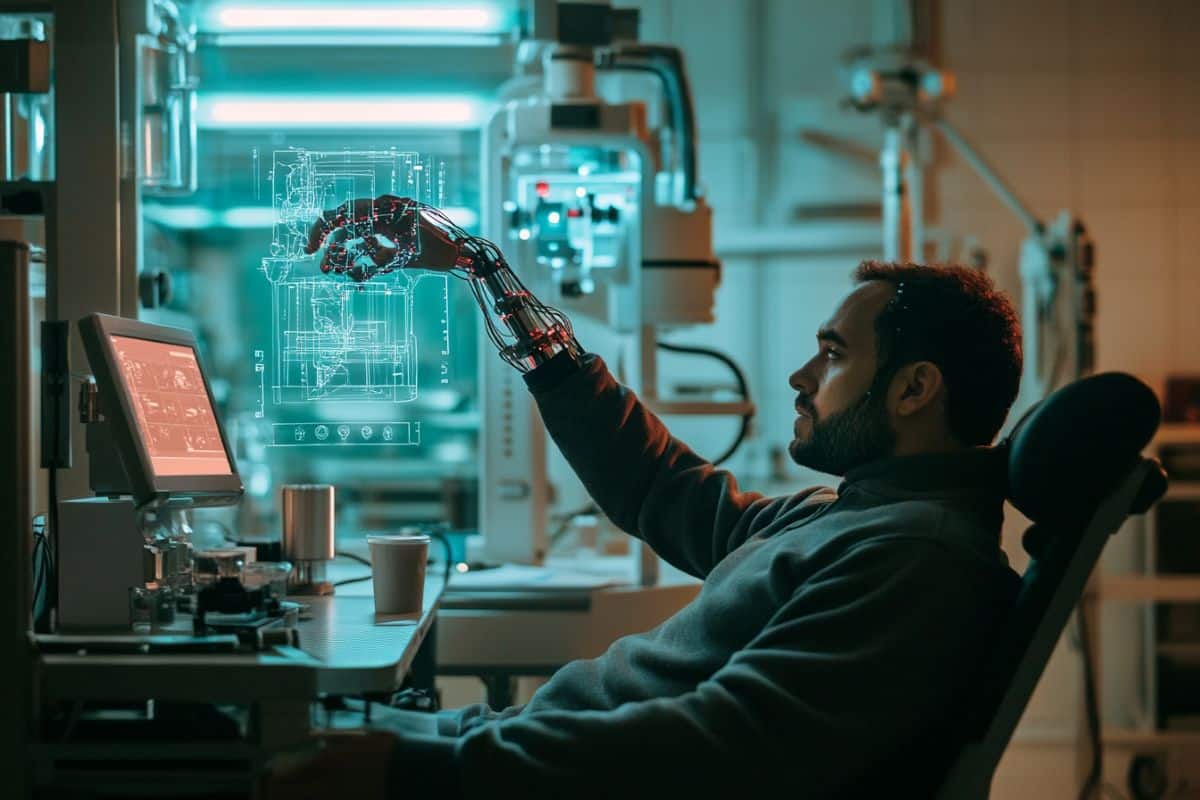
Summary: A new brain-computer interface (BCI) has enabled a paralyzed man to control a robotic arm by simply imagining movements. Unlike previous BCIs, which lasted only a few days, this AI-enhanced device worked reliably for seven months. The AI model adapts to natural shifts in brain activity, maintaining accuracy over time.
After training with a virtual arm, the participant successfully grasped, moved, and manipulated real-world objects. The technology represents a major step toward restoring movement for people with paralysis. Researchers are now refining the system for smoother operation and testing its use in home settings.
In IDB, macrophages, a type of immune cell begins producing excessive levels of pro-inflammatory cytokines. These proteins then stick to macrophage receptors which triggers them to produce even more of this inflammatory protein. But UC San Diego researchers can break that cycle with a microrobot.
In previous experiments, UC San Diego researchers delivered drugs with microrobots, most notably in the lungs, and succeeded in minimizing the drug’s side effects. For the IBD study, however, they didn’t even need to use a drug.
Using body parts from simple animals in robotics is not as controversial. But it’s still important to consider the impact on these living creatures. It may seem that bugs and jellyfish and mollusks aren’t capable of caring about how we use their bodies. But what if we’re wrong about that? Some researchers are finding that such creatures might have more awareness and feelings than expected.
Living robots also interact with the environment. What if a jellyfish outfitted with electronics got eaten? Xu is hoping to develop biodegradable electronics that wouldn’t harm other animals or pollute the ocean.
Biohybrid robots blur the line between machine and living thing. The jellyfish cyborgs are obviously still alive. But most biohybrids don’t really fit into one category or the other. Shin says of her heart-cell-covered bot: “it’s not a creature.” But it’s not a typical robot, either.
“Nanobrain: The Making of an Artificial Brain from a Time Crystal” by Anirban Bandyopadhyay Book Link: https://amzn.to/3QQ4s44
The hosts discuss the book “Nanobrain” by Anirban Bandyopadhyay, an in-depth exploration of a nanobrain, an artificial brain built on the principles of fractal geometry and prime numbers, which claims to mimic human thought. It introduces Prime Phase Metric (PPM) which expands time crystals from natural events, and Geometric Musical Language (GML) which assigns fifteen primes to letters, similar to the English alphabet, and how the combination is consciousness-centric. The document contrasts this artificial brain’s functioning with traditional Turing machines and quantum computing, emphasizing its unique approach to data processing and decision-making and self-learning, and discusses its potential limitations and advantages. It investigates the use of time crystals, dynamic geometric shapes, and fractal mechanics, and the role that they may have in memory and learning in this new computer. Finally, the work explores the philosophical implications of such a machine, including its potential for achieving consciousness and the idea of recreating nature through a non-computational paradigm, such as modeling a new type of robot.