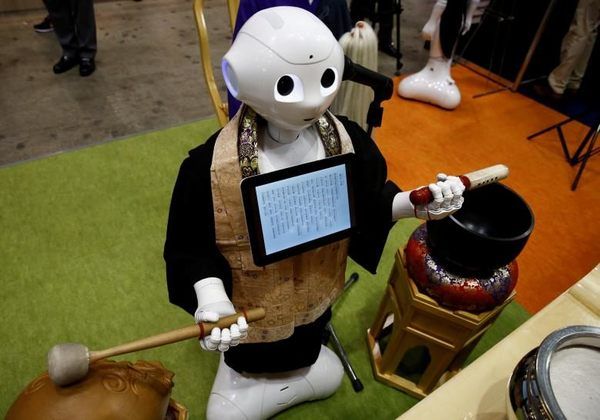
It’s pretty cheerful-looking for a robot that gives funeral services.

Japan’s largest container line plans to test a remote-controlled vessel across the Pacific Ocean in 2019 as it pursues fully autonomous technology that could disrupt the global shipping industry.
Nippon Yusen K.K. is considering using a large container ship for the test from Japan to North America and a crew will be on standby for safe operations, Hideyuki Ando, a senior general manager at Monohakobi Technology Institute, said in an interview Wednesday. The institute, a unit of Nippon Yusen, conducts research and development in areas such as safe vessel operation, energy saving, and logistics.
What if traffic flowed through our streets as smoothly and efficiently as blood flows through our veins? Transportation geek Wanis Kabbaj thinks we can find inspiration in the genius of our biology to design the transit systems of the future. In this forward-thinking talk, preview exciting concepts like modular, detachable buses, flying taxis and networks of suspended magnetic pods that could help make the dream of a dynamic, driverless world into a reality.
“Some people are obsessed by French wines. Others love playing golf or devouring literature. One of my greatest pleasures in life is, I have to admit, a bit special. I cannot tell you how much I enjoy watching cities from the sky, from an airplane window.”

SpaceX head Elon Musk and other industry leaders write that autonomy will lead to wider and faster war.
The prospect of tanks, machine guns, and drones that think for themselves becoming widespread is giving tech luminaries the heebie-jeebies.
In an open letter today (Aug. 21), a group of specialists from 26 nations called for the United Nations to ban the development and use of autonomous weapons. The signatories include Tesla CEO Elon Musk and DeepMind co-founder Mustafa Suleyman, as well as other leaders in robotics and artificial-intelligence companies. (Google acquired DeepMind in 2014.)
The original date of this broadcast was on August 20, 2017. Zoltan Istvan is the creator of the Transhumanist political party.
Subjects discussed: Cryonics, The merging of machines and humans, advance technology, transhumanism, CRISPR and Artificial Intelligence.
Listen to Flow of Wisdom Radio Live Sundays 3 — 5:00 PM EST on a radio station near you! Also, streaming live on GCNLive.com Call in 877−300−7645. http://flowofwisdom.com
Flow Of Wisdom with Sean Anthony is a syndicated, ground-breaking radio talk show with inspiration, insightful interviews, controversial guests, and a platform for alternative news on the GCN Radio Networks. http://gcnlive.com/JW1D/index.php/showinfo?showCode=62
The information is delivered in an unconventional way that brings understanding to some of the worlds controversial conspiracies.
Download Sean Anthony’s book, “Conversations With Hip Hop” http://www.amazon.com/dp/B00BIJP42G?tag=lifeboatfound-20
If the idea of processing data at the edge sounds familiar, it should. Levine points out computing has gone in massive cycles, shifting from centralized to distributed and back again, and the coming move to the edge is just another manifestation of that.
In his view, it only makes sense that the next trend will swing back to a distributed system driven by the sheer volume of Internet of Things devices. When the number of devices on the planet is no longer limited by the number of humans, it has the potential to raise the number of computers in the world by an order of magnitude, and that will force a change in the way we think about computing in the future.
As crazy as that sounds — and he fully recognizes that it does — Levine says it’s based on sound analysis of where he sees computing going — and he believes his job as an investor is to recognize where the industry is heading before it happens.
He theorizes that as devices like drones, autonomous cars and robots proliferate, they are going to require extremely rapid processing — so fast, in fact, that sending data up to the cloud and back to get an answer will simply be too slow.

Mimetic Evolution or the collective will of humanity to imitate the most successful achievements of nature with technology, has finally set in. At this dawn of artificial intelligence humanity is trying to not only find its place again, but to do the inevitable, the inescapable – merging with the technology we created. We have to be the artificial intelligence by incorporating the transcendent aspects of an artificiality that otherwise could easily become a mastermind, both in control of us and out of control.
Yes, it will begin slowly with AI helping us to achieve dreams of humanity, ways for us to live longer and healthier. Just ask what the many biotech companies focus on and the answer unanimously will be putting an end to aging.
The idea of eternal youth and immortality is a blessing, albeit a mixed one. We learned that progress never stops and it isn’t plausible to think that we now revert back and suddenly stop working on machine learning and connected devices as well as connected thinking.
Note by note, machines are learning to express themselves. But if you think the fusion of artificial intelligence and music is bound to produce soulless, robotic-sounding tunes, Taryn Southern urges you to give our weird future another listen. The singer and internet personality is prepping what she calls the world’s first AI-composed album, I AM AI. Of course, others have dabbled in AI-generated music, and the finished product is not entirely computer-composed (the lyrics and vocal melodies were written by Southern), but the human intervention is minimal. The output isn’t exactly Grammy material, but it’s not far off from something you might hear on a pop playlist on Spotify.
Using AI music creation software by Amper, Southern plugged in various parameters like mood, style, and tempo to auto-compose the underlying chords and instrumentation. The album will even be distributed online through Stem, a platform that allows royalties to be divvied up between various creators. So not only will machines write music in the future, they might even get paid.
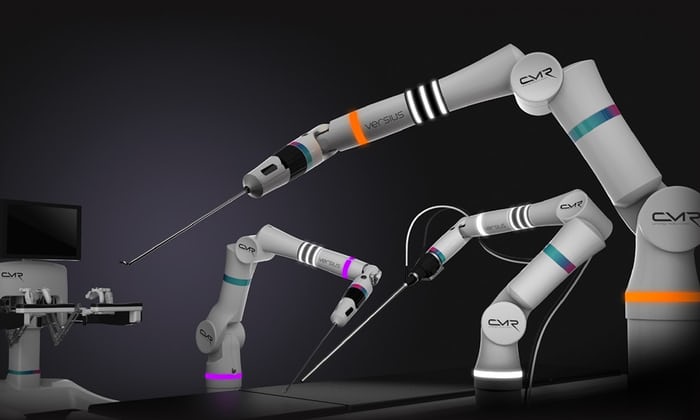
“British scientists have developed the world’s smallest surgical robot which could transform everyday operations for tens of thousands of patients.”
Listen to the first pop song composed entirely by an AI!