Artificial Intelligence has come a long way in a short time. So at what point will it be able to emulate the great artists and writers of our time?
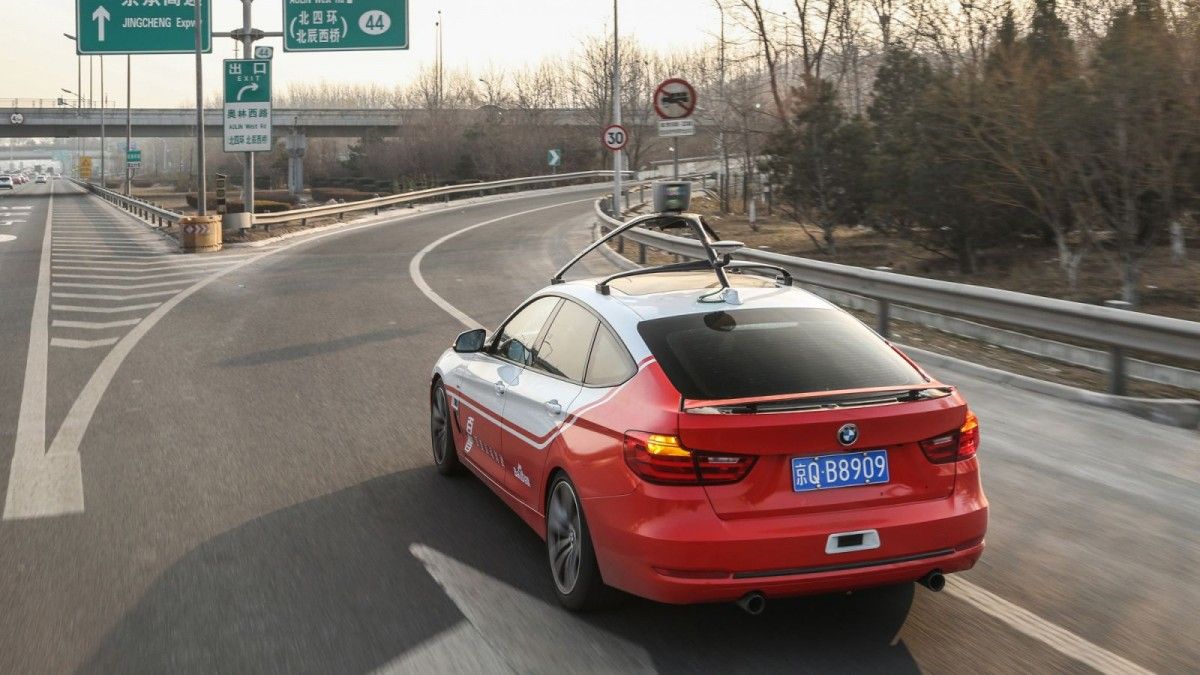
Drivers in Beijing, beware: soon, you’ll be driving alongside autonomous vehicles.
On Monday, Beijing’s Municipal Commission of Transport announced (Chinese) provisional regulations for testing self-driving cars on city roads. Companies that are registered in China and have tested self-driving cars in enclosed spaces can now apply for permission to test their vehicles on Beijing’s bustling roads.
It certainly won’t be the first city in Asia—or the rest of the world—to embrace autonomous vehicles: self-driving startup nuTonomy already operates in Singapore, and several U.S. cities are home to the cars of Uber, Waymo, and others. But the news is the latest sign of China’s commitment to making autonomous vehicles a reality, in hopes of alleviating congestion on city streets and becoming a leading technology power.
A whole new meaning to machine learning.
Brendan John Frey FRSC (born 29 August 1968) is a Canadian-born machine learning and genome biology researcher, known mainly for his work on factor graphs, the wake-sleep algorithm for deep learning, and using machine learning to model genome biology and understand genetic disorders. He founded Deep Genomics and is currently its CEO, and he is a Professor of Engineering and Medicine at the University of Toronto. He co-developed a new computational approach to identifying the genetic determinants of disease, was one of the first researchers to successfully train a deep neural network, and was a pioneer in the introduction of iterative message-passing algorithms.
Frey studied computer engineering and physics at the University of Calgary (BSc 1990) and the University of Manitoba (MSc 1993), and then studied neural networks and graphical models as a doctoral candidate at the University of Toronto under the supervision of Geoffrey Hinton (PhD 1997). He was an invited participant of the Machine Learning program at the Isaac Newton Institute for Mathematical Sciences in Cambridge, UK (1997) and was a Beckman Fellow at the University of Illinois at Urbana Champaign (1999).
Following his undergraduate studies, Frey worked as a Junior Research Scientist at Bell-Northern Research from 1990 to 1991. After completing his postdoctoral studies at the University of Illinois at Urbana-Champaign, Frey was an Assistant Professor in the Department of Computer Science at the University of Waterloo, from 1999 to 2001.
In 2001, Frey joined the Department of Electrical and Computer Engineering at the University of Toronto and was cross-appointed to the Department of Computer Science, the Banting and Best Department of Medical Research and the Terrence Donnelly Centre for Cellular and Biomolecular Research. From 2008 to 2009, he was a Visiting Researcher at Microsoft Research, Cambridge, UK, and a Visiting Professor in the Cavendish Laboratories and Darwin College at Cambridge University. Between 2001 and 2014, Frey consulted for several groups at Microsoft Research and acted as a member of its Technical Advisory Board.
In 2014, Frey co-founded Deep Genomics, a Toronto company that develops machine learning methods to model the deep biological architectures that relate genetic mutations to disease. The company’s goal is to bridge the genotype-phenotype gap, which is a pain point in genetic testing, pharmaceuticals, personalized medicine and health insurance.
——-
Future robots won’t be limited to humanoid form (like Boston Robotics’ formidable backflipping Atlas). They’ll be invisibly embedded everywhere in common objects.
Such as a shoe that can intelligently support your gait, change stiffness as you’re running or walking, and adapt to different surfaces — or even help you do backflips.
Even as autonomous robots get better at doing things on their own, there will still be plenty of circumstances where humans might need to step in and take control. New software developed by Brown University computer scientists enables users to control robots remotely using virtual reality, which helps users to become immersed in a robot’s surroundings despite being miles away physically.
The software connects a robot’s arms and grippers as well as its onboard cameras and sensors to off-the-shelf virtual reality hardware via the internet. Using handheld controllers, users can control the position of the robot’s arms to perform intricate manipulation tasks just by moving their own arms. Users can step into the robot’s metal skin and get a first-person view of the environment, or can walk around the robot to survey the scene in the third person—whichever is easier for accomplishing the task at hand. The data transferred between the robot and the virtual reality unit is compact enough to be sent over the internet with minimal lag, making it possible for users to guide robots from great distances.
“We think this could be useful in any situation where we need some deft manipulation to be done, but where people shouldn’t be,” said David Whitney, a graduate student at Brown who co-led the development of the system. “Three examples we were thinking of specifically were in defusing bombs, working inside a damaged nuclear facility or operating the robotic arm on the International Space Station.”
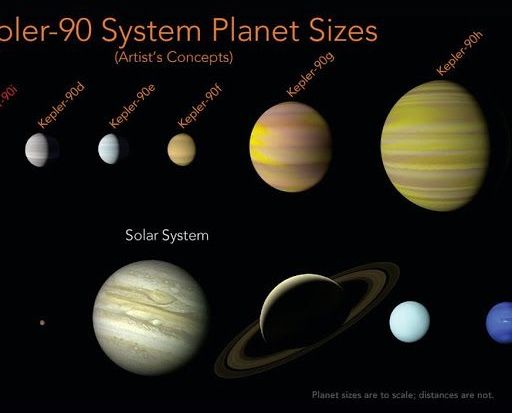
Dec. 14 (UPI) — NASA scientists have found a planetary system with as many planets as our own.
“Scientists have found for the first time eight planets in a distant planetary system,” Paul Hertz, astrophysics division director at NASA Headquarters, said during a teleconference on Thursday that was live-streamed on NASA TV.
Astronomers were aware of seven of the eight planets orbiting the Kepler 90 star. The discovery of the new planet, Kepler-90i, was made possible by machine learning.