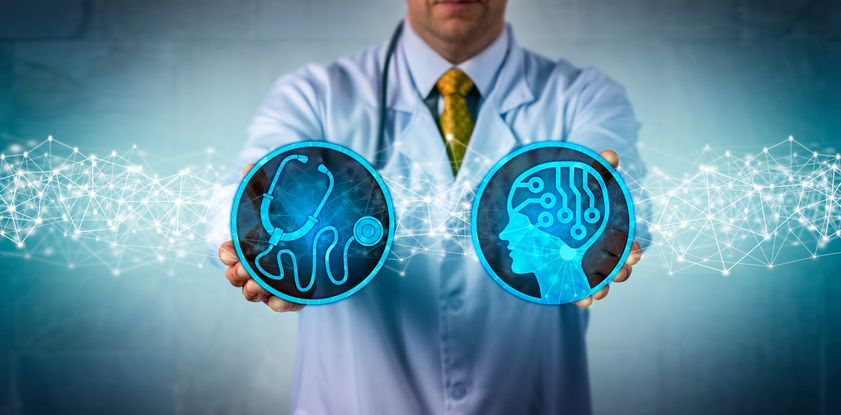
Last year, my brother, then an employee at Silicon Valley-based tech company Nvidia, declared that all the AI and deep learning that is happening in healthcare is being powered by Nvidia’s graphics processing units (GPUs)…however that’s just the tip of the iceberg.
Nvidia holds a dominant position in terms of making the chips that power artificial intelligence projects, but can the Silicon Valley tech company with roots in the world of gaming and graphics succeed in healthcare?
Over the last three years, Google and Verily—Alphabet’s life sciences and healthcare arm—have developed a machine learning algorithm to make it easier to screen for disease, as well as expand access to screening for DR and DME. As part of this effort, we’ve conducted a global clinical research program with a focus on India. Today, we’re sharing that the first real world clinical use of the algorithm is underway at the Aravind Eye Hospital in Madurai, India.
Google and Verily share updates to their initiative to diagnose diabetic eye disease leveraging machine learning.
Neuroscientists have used an artificial intelligence to read brain signals resulting in intelligible, recognizable, audible speech for the first time ever.
“A software tool called CaImAn automates the arduous process of tracking the location and activity of neurons. It accomplishes this task using a combination of standard computational methods and machine-learning techniques. In a new paper, the software’s creators demonstrate that CaImAn achieves near-human accuracy in detecting the locations of active neurons based on calcium imaging data.”
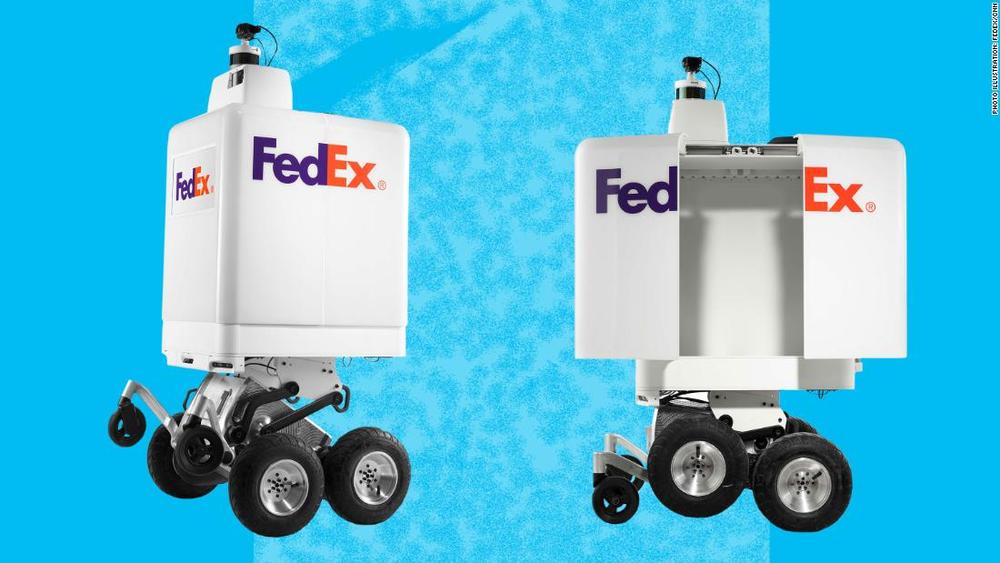
FedEx is the latest company to join the delivery robot craze.
The company said Wednesday it will test a six-wheeled, autonomous robot called the SameDay Bot in Memphis, Tenn. this summer and plans to expand to more cities.
It’s partnering with major brands,including Walmart, Target, Pizza Hut and AutoZone, to understand how delivery robots could help other businesses.
A team of researchers at The University of Cambridge has recently introduced a unique experimental testbed that could be used for experiments in cooperative driving. This testbed, presented in a paper pre-published on arXiv, consists of 16 miniature Ackermann-steering vehicles called Cambridge Minicars.
“Using true-scale facilities for vehicle testbeds is expensive and requires a vast amount of space,” Amanda Prorok. “Our main objective was to build a low-cost, multi-vehicle experimental setup that is easy to maintain and that is easy to use to prototype new autonomous driving algorithms. In particular, we were interested in testing and tangibly demonstrating the benefits of cooperative driving on multi-lane road topographies.”
Studies investigating cooperative driving are often expensive and time consuming due to a lack of available low-cost platforms that researchers can use to test their systems and algorithms. Prorok and her colleagues thus set out to develop an effective and inexpensive experimental testbed that could ultimately support research into cooperative driving and multi-car navigation.
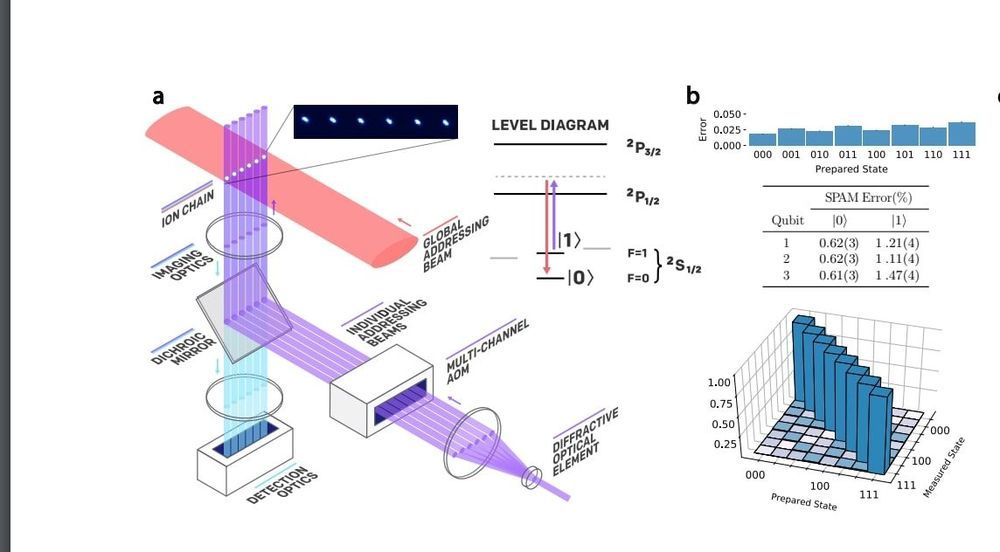
Quantum chemistry is a promising application where quantum computing might overcome the limitations of known classical algorithms, hampered by an exponential scaling of computational resource requirements. One of the most challenging tasks in quantum chemistry is to determine molecular energies to within chemical accuracy.
At the end of 2018, IonQ announced that they had loaded 79 operating qubits into their trapped ion system and had loaded 160 ions for storage in another test. This new research shows that they are making progress applying their system to useful quantum chemistry problems. They are leveraging the trapped-ions system longer stability to process many steps. The new optimization methods developed for this first major quantum chemistry problem can also be used to solve significant optimization and machine learning problems.
“It’s dangerous to directly correlate things like, ‘This is a brain!’” Gimzewski told ZDNet. “It’s exhibiting electrical characteristics which are very similar to a functional MRI of brains, similar to the electric characteristics of neuronal cultures, and also EEG patterns.”