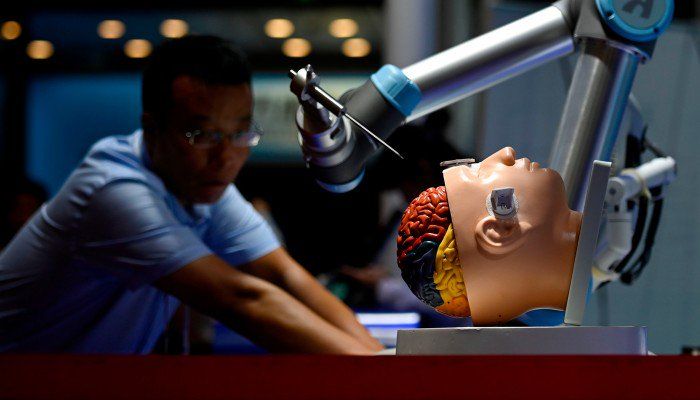
Research from Google Cloud finds that applying AI to medicine is tricky.
Alphabet’s self-driving arm Waymo is introducing a new vehicle into its fleet of driverless rides, an all-electric car produced by Jaguar Land Rover.
Waymo unveiled the new vehicle, called the Jaguar I-Pace, at a press event in New York City on Tuesday and said it expected to begin production on the cars equipped with its technology in 2020. In the first two years, the companies expect to manufacture 20,000 cars.
The vehicles will first be available in a ride-hail service in Phoenix, Ariz., where the company will begin testing prototypes this year. Waymo currently has a fleet of driverless Chrysler Pacifica vans as part of its ongoing agreement with Fiat Chrysler.
Elevation — How Drones Will Change Cities
Drones will transform cities, revolutionising how people travel, how goods are delivered and how buildings look and are constructed, according to a documentary by Dezeen.
“Aerial highways” will relieve pressure on roads as deliveries and human transportation take to the skies in unmanned electric vehicles.
Transhumanist thinking has gained a remarkable amount of traction and publicity this year. Powerful Silicon Valley interests have been mounting a charm offensive designed to persuade us of both the value and the inevitability of this transformation.
In a startling leap towards a future that many thought only existed in sci-fi, a Wisconsin high-tech company, Three Square Market, started microchipping its employees last year.
The announcement followed on the heels of a similar move by Swedish company Epicenter, the first to begin this practice. While Three Square Market’s approach is voluntary, the company is financially subsidizing the procedure.
Transhumanist agenda
There is a name of this kind of cultural weirdness: Transhumanism, a strange agglomeration of technology, politics, and even aspects of religion. The Transhumanist view of the future features a fully mechanized simulacrum of society teeming with visible and invisible robots and robotic functions that will engineer the minutia of life at every turn, presumably to make life easier and more fulfilling.
In five years, small autonomous AI microscopes, networked in the cloud and deployed around the world, will continually monitor the condition of the natural resource most critical to our survival: water.