The 13ft robot responds to the actions of its handler who is seated in a central cockpit 🙌
Ruptly.
The 13ft robot responds to the actions of its handler who is seated in a central cockpit 🙌
Ruptly.
He claims that humans risk being overtaken by AI within the next five years, and that AI could eventually view us in the same way we currently view house pets.
“I don’t love the idea of being a house cat, but what’s the solution?” he said in 2016, just months before he founded Neuralink. “I think one of the solutions that seems maybe the best is to add an AI layer.”

While Photoshop can do a pretty good job at removing shadows from faces, there’s a fair amount of legwork involved. One scientist has shown that neural networks and artificial intelligence can produce some very impressive results, suggesting that it will soon be a part of how we edit our photos.
Károly Zsolnai-Fehér of Two Minute Papers and the Institute of Computer Graphics and Algorithms, Vienna University of Technology, Austria, just released a video demonstrating how he has taught a neural network using large data sets to recognize and eliminate shadows from a face in a photograph. As detailed in the video, the neural network was taught by giving it photographs of faces to which shadows had been added artificially.
Given its effectiveness and the quality of the results, it seems only a matter of time before smartphones give you the option to remove shadows. In theory, you might even be able to switch on shadow removal while taking the photograph.

It’s extremely difficult to make a fair comparison of US and Chinese spend on technology like AI as funding and research in this area is diffuse. Although China announced ambitious plans to become the world leader in AI by 2030, America still outspends the country in military funding (which increasingly includes AI research), while US tech companies like Google and Microsoft remain world leaders in artificial intelligence.
The Trump administration will likely present today’s news as a counterbalance to its dismal reputation for supporting scientific research. For four years in a row, government budgets have proposed broad cuts for federal research, including work in pressing subjects like climate change. Only the fields of artificial intelligence and quantum computing, with their overt links to military prowess and global geopolitics, have seen increased investment.
“It is absolutely imperative the United States continues to lead the world in AI and quantum,” said US Chief Technology Officer Michael Kratsios ahead of today’s announcement, according to The Wall Street Journal. “The future of American economic prosperity and national security will be shaped by how we invest, research, develop and deploy these cutting edge technologies today.”
This 12-ton robot will represent Team USA in an epic robot duel.

Artificial intelligence applications are popping up everywhere these days, from our Internet browsing to smart homes and self-driving cars. Now a group of researchers is launching a new AI-led study that will collect data from recently released prisoners. The ultimate goal of the project is to identify – and, ostensibly, one day eliminate – the psychological and physiological triggers that cause recidivism among parolees.
According to project-leads Marcus Rogers and Umit Karabiyik, the resulting data will assist them in conducting a forensic psychological analysis. While the monitoring will be gauged in intervals – not real-time – they believe it will help build a profile of the risky behaviors and stressful triggers that recent parolees face when returning to the outside world.
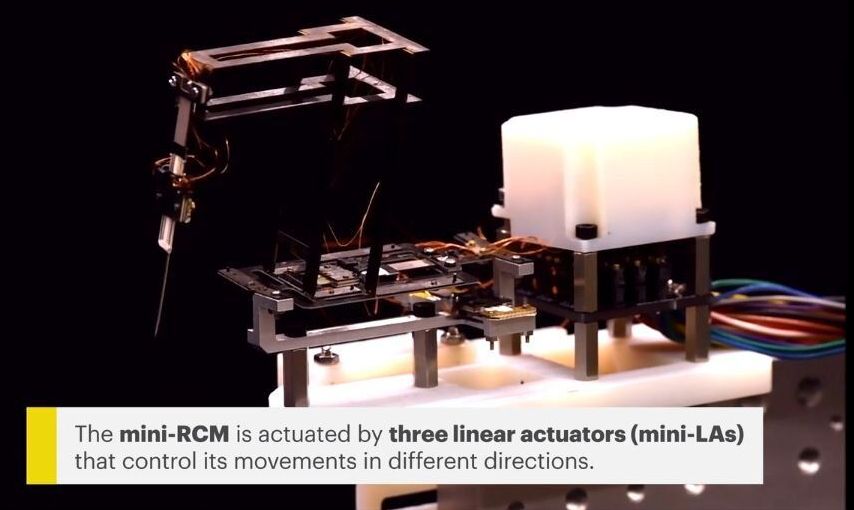
Minimally invasive laparoscopic surgery, in which a surgeon uses tools and a tiny camera inserted into small incisions to perform operations, has made surgical procedures safer for both patients and doctors over the last half-century. Recently, surgical robots have started to appear in operating rooms to further assist surgeons by allowing them to manipulate multiple tools at once with greater precision, flexibility, and control than is possible with traditional techniques. However, these robotic systems are extremely large, often taking up an entire room, and their tools can be much larger than the delicate tissues and structures on which they operate.
A collaboration between Wyss Associate Faculty member Robert Wood, Ph.D. and Robotics Engineer Hiroyuki Suzuki of Sony Corporation has brought surgical robotics down to the microscale by creating a new, origami-inspired miniature remote center of motion manipulator (the “mini-RCM”). The robot is the size of a tennis ball, weighs about as much as a penny, and successfully performed a difficult mock surgical task, as described in a recent issue of Nature Machine Intelligence.
“The Wood lab’s unique technical capabilities for making micro-robots have led to a number of impressive inventions over the last few years, and I was convinced that it also had the potential to make a breakthrough in the field of medical manipulators as well,” said Suzuki, who began working with Wood on the mini-RCM in 2018 as part of a Harvard-Sony collaboration. “This project has been a great success.”
His motto is “Aim high, fly-fight-win.” But for a top U.S. Air Force fighter pilot and weapons school graduate, aiming high—and in one instance aiming low—wasn’t enough to prevail against an AI opponent in a simulated competition last week.
The Defense Advanced Research Project Agency (DARPA) sponsored the AlphaDogfight trials as part of its effort to use AI to help pilots in realtime combat and encourage developers to sign up for its Air Combat Evolution (ACE) program to design AI defense systems.
The winning program, designed by a Maryland-based defense contractor Heron Systems, outmaneuvered its human opponent flawlessly in a five-round sweep. Encouragingly, ‘Banger,’ a District of Columbia Air National Guard pilot and recent Air Force Weapons School Instructor Course graduate with over 2,000 hours of experience flying F-16s, was able to last longer each round. By the last round he realized he might outgun the AI foe by diving below its ability to point its guns towards him, but the tactic’s success was only momentary as the Heron AI recalculated its path and dealt the final blow.