Toggle light / dark theme

Police Robots Are Not a Selfie Opportunity, They’re a Privacy Disaster Waiting to Happen

The arrival of government-operated autonomous police robots does not look like predictions in science fiction movies. An army of robots with gun arms is not kicking down your door to arrest you. Instead, a robot snitch that looks like a rolling trash can is programmed to decide whether a person looks suspicious —and then call the human police on them. Police robots may not be able to hurt people like armed predator drones used in combat— yet —but as history shows, calling the police on someone can prove equally deadly.

Long before the 1987 movie Robocop, even before Karel Čapek invented the word robot in 1920, police have been trying to find ways to be everywhere at once. Widespread security cameras are one solution—but even a blanket of CCTV cameras couldn’t follow a suspect into every nook of public space. Thus, the vision of a police robot continued as a dream, until now. Whether they look like Boston Dynamics’ robodogs or Knightscope’s rolling pickles, robots are coming to a street, shopping mall, or grocery store near you.

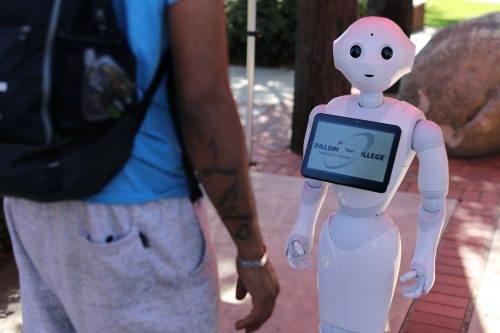
The Orwellian menace of snitch robots might not be immediately apparent. Robots are fun. They dance. You can take selfies with them. This is by design. Both police departments and the companies that sell these robots know that their greatest contributions aren’t just surveillance, but also goodwill. In one brochure Knightscope sent to University of California-Hastings, a law school in the center of San Francisco, the company advertises their robot’s activity in a Los Angeles shopping district called The Bloc. It’s unclear if the robot stopped any robberies, but it did garner over 100000 social media impressions and Knightscope claims the robot’s 193 million overall media impressions was worth over $5.8 million. The Bloc held a naming contest for the robot, and said it has a “cool factor” missing from traditional beat cops and security guards.

Apple and Hyundai are reportedly planning to team up and build a ‘beta’ version of an electric car by 2022

Hyundai and Apple teaming up to challenge Tesla? 😃


Apple and Hyundai plan to sign a deal that would lead to a “beta” version of an Apple electric vehicle as early as 2022, according to a Sunday report from Reuters.

Reuters cited a report from Korea IT News that said the companies are planning to sign a deal by March 2021 to partner on the self-driving electric cars, according to a Sunday report from Korea IT News.

With a deal in place, the companies may have a beta version of the vehicle ready by next year, according to the report. Mass production of the self-driving electric vehicles could begin by 2024. The plan would be to build about 100000 vehicles in the US that year, according to Reuters.

Paralyzed Man Controls Two Robotic Arms With His Mind For The First Time

Hey it’s Han from WrySci HX coming to you with exciting news out of Johns Hopkins University. A man was able to control two robotic arms simultaneously via a brain computer interface to the point of feeding himself. Amazing stuff! More below ↓↓↓

Subscribe! =]

Please consider supporting 🙏

Patreon: https://www.patreon.com/wrysci_hx.

Follow me on twitter: https://twitter.com/han_xavier_

Or better yet, consider supporting any of the following =].

World’s Fastest, Most Powerful Neuromorphic Processor for AI Unveiled

RELATED: HUAWEI LAUNCHES WORLD’S MOST POWERFUL AI PROCESSOR

Optical micro-combs.

The invention could revolutionize neural networks and neuromorphic processing in general. “This breakthrough was achieved with ‘optical micro-combs’, as was our world-record internet data speed reported in May 2020,” said in a statement Swinburne’s Professor David Moss.

MIT Deep-Learning Algorithm Finds Hidden Warning Signals in Measurements Collected Over Time

A new deep-learning algorithm could provide advanced notice when systems — from satellites to data centers — are falling out of whack.

When you’re responsible for a multimillion-dollar satellite hurtling through space at thousands of miles per hour, you want to be sure it’s running smoothly. And time series can help.

A time series is simply a record of a measurement taken repeatedly over time. It can keep track of a system’s long-term trends and short-term blips. Examples include the infamous Covid-19 curve of new daily cases and the Keeling curve that has tracked atmospheric carbon dioxide concentrations since 1958. In the age of big data, “time series are collected all over the place, from satellites to turbines,” says Kalyan Veeramachaneni. “All that machinery has sensors that collect these time series about how they’re functioning.”

Artificial Intelligence Finds Hidden Roads Threatening Amazon Ecosystems

(Inside Science) — It took years of painstaking work for Carlos Souza and his colleagues to map out every road in the Brazilian Amazon biome. Official maps of the 4.2 million-square-kilometer region only show roads built by federal and local governments. But by carefully tracing lines on satellite images, the researchers concluded in 2016 that the true length of all the roads combined was nearly 13 times higher.

“When we don’t have a good understanding of how much roadless areas we have on the landscape, we probably will misguide any conservation plans for that territory,” said Souza, a geographer at a Brazil-based environmental nonprofit organization called Imazon.

Now, Imazon researchers have built an artificial intelligence algorithm to find such roads automatically. Currently, the algorithm is reaching about 70% accuracy, which rises to 87%-90% with some additional automated processing, said Souza. Analysts then confirm potential roads by examining the satellite images. Souza presented the research last month at a virtual meeting of the American Geophysical Union.

Apple in Talks with Hyundai Motor Group for Electric Vehicle Tie-Up

O,.o.


It is no secret that Apple is working on the development of electric vehicle technology for almost 5–6 years now. Codenamed as Project Titan, the project contains many ex-employees of renowned automobile brands such as Tesla, Land Rover, and Aston Martin. Recently, there were rumours of Apple linking up with TSMC (Taiwan Semiconductor Manufacturing Company) for producing self-driving chips for their planned vehicles.

It was unclear until now whether Apple will be manufacturing the vehicles on their own, or will they act as a software provider for existing automobile brands. Now, however, there are reports that the tech company is in early talks with the Hyundai Motor Group, among others.

A Hyundai Motors representative confirmed yesterday that the South Korean automobile company is in discussion with Apple. Of course, ever since the tech company announced its intentions of developing an electric vehicle, it is in talks with a number of global manufacturers. However, Hyundai is one of the first major names to have come up.

Study suggests smart assistant design improvements for deaf users

Despite the inherent challenges that voice-interaction may create, researchers at the Penn State College of Information Sciences and Technology recently found that deaf and hard-of-hearing users regularly use smart assistants like Amazon’s Alexa and Apple’s Siri in homes, workplaces and mobile devices.

The work highlights a clear need for more inclusive design, and presents an opportunity for deaf and hard-of-hearing users to have a more active role in the research and development of new systems, according to Johnna Blair, an IST doctoral student and member of the research team.

“As smart assistants become more common, are preloaded on every smartphone, and continue to provide benefits to the user beyond just the ease of voice activation, it’s important to understand how deaf and hard-of-hearing users have made smart assistants work for them and the realistic challenges they continue to face,” said Blair.

/* */