The MIT engineers behind the robot mini cheetah released a video showcasing its new running and terrain-traversing skills on Thursday.
Category: robotics/AI – Page 1,959

What’s Inside a Black Hole? Physicist Probes Holographic Duality With Quantum Computing To Find Out
Dude, what if everything around us was just … a hologram?
The thing is, it could be—and a University of Michigan physicist is using quantum computing and machine learning to better understand the idea, called holographic duality.
Holographic duality is a mathematical conjecture that connects theories of particles and their interactions with the theory of gravity. This conjecture suggests that the theory of gravity and the theory of particles are mathematically equivalent: what happens mathematically in the theory of gravity happens in the theory of particles, and vice versa.
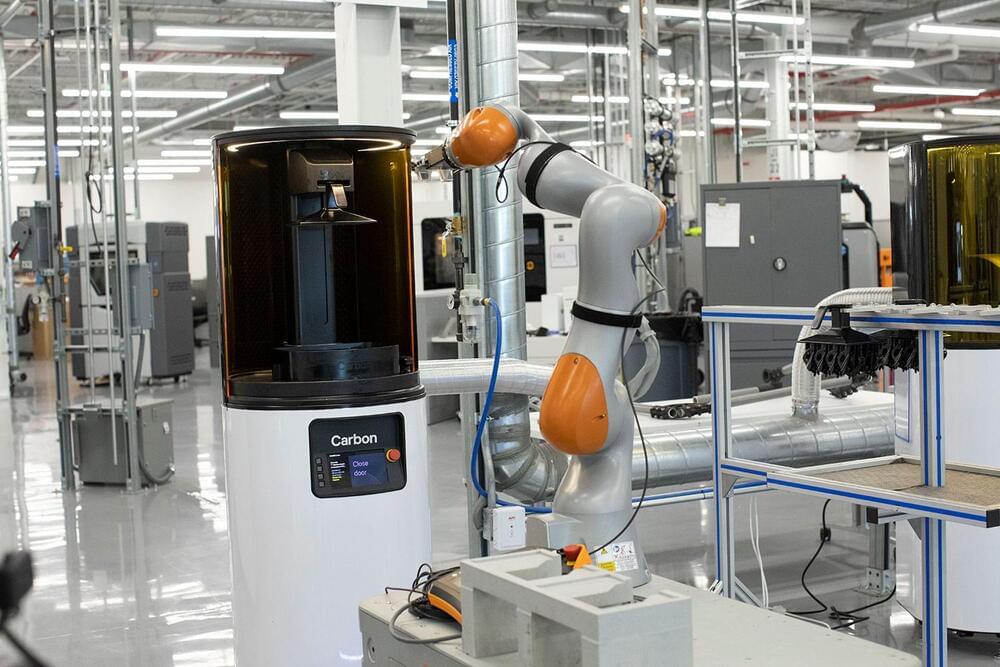
Ford uses mobile robots to operate 3D printers without human help
Engineers at Ford’s Advanced Manufacturing Center have tasked the innovative robot on wheels – called Javier – with operating the 3D printers completely on its own. The autonomous process enables the 3D printer to run continuously with no human interaction needed, increasing throughput and reducing the cost of custom-printed products.
Ford says Javier is always on time, very precise in its movements, mostly spends its day doing nothing but 3D printing, only taking a “short break” to recharge the batteries. The company has achieved great accuracy with Javier, using its feedback to significantly reduce margins of error. The method can also be applied to a vast array of robots already working at the company to increase efficiency and reduce cost.
Ford has filed several patents for the technology in its drive to innovate. Javier can communicate with Ford’s 3D printer, something that isn’t necessarily as easy to pull off as it sounds. The robot does not require the use of a camera vision system to “see.”

TOP 5 Female Humanoid Robots 2022 That Will Shock You | PRICE REVEALED!
PRICE REVEALED!🔔 Subscribe now for more Technology news, Future technology news, and Science.
news. In this age of innovation and technology, an increasing number of.
companies are developing extremely human-like robots that will.
collaborate attentively with actual humans in the hospitality or customer.
service sectors.
Such robots have a long history dating back to the 4th century when the.
concept of a humanoid robot first appeared in many different cultures.
around the world, including Greece, China, and even Japan!#humanodrobot #bostondynamics #artificialintelligence📺Interesting fact: Smart individuals watch the full video!
🤖 AI News brings you the most recent Artificial Intelligence news and trends. Investigate industry research and stories from the cutting edge of AI technology news.🕵️We take the greatest research and give it our own spin, report from the frontlines of the industry, and feature contributions from firms at the forefront of this revolution.
💼 Business Inquiries and Contact.
• For business inquiries, copyright matters or other inquiries please contact us at [email protected]❓ Copyright Questions • If you have any copyright questions or issues you can contact us at [email protected] ⚠️ Copyright Disclaimers • We use images and content in accordance with the YouTube Fair Use copyright guidelines • Section 107 of the U.S. Copyright Act states: “Notwithstanding the provisions of sections 106 and 106A, the fair use of a copyrighted work, including such use by reproduction in copies or phonorecords or by any other means specified by that section, for purposes such as criticism, comment, news reporting, teaching (including multiple copies for classroom use), scholarship, or research, is not an infringement of copyright.” • This video could contain certain copyrighted video clips, pictures, or photographs that were not specifically authorized to be used by the copyright holder(s), but which we believe in good faith are protected by federal law and the fair use doctrine for one or more of the reasons noted above.
The World in 2300: Top 9 Future Technologies
This video covers the world in 2,300 and its future technologies. Watch this next video about the world in 2200: https://bit.ly/3htaWEr.
► BlockFi: Get Up To $250 In Bitcoin: https://bit.ly/3rPOf1V
► M1 Finance: Open A Roth IRA And Get Up To $500: https://bit.ly/3KHZvq0
► Jarvis AI: Write 5x Faster With Artificial Intelligence: https://bit.ly/3HbfvhO
► SurfShark: Secure Your Digital Life (83% Off): https://surfshark.deals/BUSINESSTECH
► Udacity: 75% Off All Courses (Biggest Discount Ever): https://bit.ly/3j9pIRZ
► Brilliant: Learn Science And Math Interactively (20% Off): https://bit.ly/3HAznLL
► Business Ideas Academy: Start A Business You Love: https://bit.ly/3KI7B1S
SOURCES:
• https://www.futuretimeline.net.
• The Future of Humanity (Michio Kaku): https://amzn.to/3Gz8ffA
• The Singularity Is Near: When Humans Transcend Biology (Ray Kurzweil): https://amzn.to/3ftOhXI
• Physics of the Future (Michio Kaku): https://amzn.to/33NP7f7
• https://science.howstuffworks.com/science-vs-myth/everyday-m…tation.htm.
Patreon Page: https://www.patreon.com/futurebusinesstech.
Official Discord Server: https://discord.gg/R8cYEWpCzK
💡 On this channel, I explain the following concepts:
• Future and emerging technologies.
• Future and emerging trends related to technology.
• The connection between Science Fiction concepts and reality.
SUBSCRIBE: https://bit.ly/3geLDGO
Disclaimer:


LEAKED Artificial Intelligence News | Weekly Update #4
🔔 Subscribe now for more Artificial Intelligence news, Data science news, Machine Learning news and more.
🦾 Support us NOW so we can create more videos: https://www.youtube.com/channel/UCItylrp-EOkBwsUT7c_Xkxg.
Every week we will update you about the latest news of the week related with Artificial Intelligence! In this video we will talk about some leaked topics.
#ArtificialIntelligence #news #futuretechnology.
📺 Fun fact: Smart people watch the entire video!
Watch More from Artificial Intelligence News Daily.
🟢 Boston Dynamic News: https://youtube.com/playlist?list=PLi7ozibUCGOvQegVXq-ArQSyDcwXqQqls.
🟠 Robot news: https://youtube.com/playlist?list=PLi7ozibUCGOvWDRGAdGxOZx40pjk82hhd.
🔴 Artificial Intelligence News: https://youtube.com/playlist?list=PLi7ozibUCGOuaUErL6-zIj5_R2E7q_cf4