Toggle light / dark theme

The UK’s First Autonomous Passenger Bus Started Road Tests This Week

The steering wheel, gas, and brakes that safety drivers will use if they need to take over are separate from the system the buses use to navigate autonomously. During the initial two-week testing period, buses will run without passengers, but the companies involved are aiming to have riders on board by summer.

The self-driving software made by Fusion Processing, called CAVstar for “connected and autonomous vehicles,” isn’t limited to radar, lidar, or cameras, but rather integrates all three. The buses are clearly marked as autonomous so nearby drivers are aware that a computer’s running the show. The question is, how much will this impact drivers’ behavior and relevant driving decisions? Would you feel less rude cutting off a driverless bus? More obliged to let it pass you? Or just sort of confused by the whole situation?

Each bus can carry 36 passengers, and the number of planned trips per day mean the autonomous buses could move up to 10,000 passengers a week. The project’s leaders anticipate the self-driving buses reducing average trip time and improving schedule reliability of the route. This sounds like it’ll mostly be a good thing, but what will happen when, say, an elderly or disabled passenger needs some extra time to get on or off the bus?

How the world will change by 2050 |What the world of the future will be like | The future of mankind

https://youtube.com/watch?v=cIVRSquOEes&feature=share

👉For business inquiries: [email protected].
✅ Instagram: https://www.instagram.com/pro_robots.

You are on the PRO Robots channel and today we present an issue dedicated to the future of mankind. What will the world be like in 2030, 2040 and 2050? What future technologies will become reality? What does the future hold as technology and artificial intelligence evolve? How will humans themselves change in the future? The answers to these questions are in our video. Watch to the end and write in the comments, how do you imagine the world in 2050?

#prorobots #robots #robot #futuretechnologies #robotics.
More interesting and useful content:
✅ Elon Musk Innovation https://www.youtube.com/playlist?list=PLcyYMmVvkTuQ-8LO6CwGWbSCpWI2jJqCQ
✅Future Technologies Reviews https://www.youtube.com/playlist?list=PLcyYMmVvkTuTgL98RdT8-z-9a2CGeoBQF
✅ Technology news.
https://www.facebook.com/PRO.Robots.Info.

#prorobots #technology #roboticsnews.

PRO Robots is not just a channel about robots and future technologies, we are interested in science, technology, new technologies and robotics in all its manifestations, science news, technology news today, science and technology news 2022, so that in the future it will be possible to expand future release topics. Today, our vlog just talks about complex things, follows the tech news, makes reviews of exhibitions, conferences and events, where the main characters are best robots in the world! Subscribe to the channel, like the video and join us!

✅ Instagram: https://www.instagram.com/pro_robots.

Machine Intelligence — A conversation with Robert J. Sawyer, the award winning sci-fi author

Machine intelligence and artificial intelligence. How it may impact the future of humanity — A discussion with award winning science fiction author Robert J. Sawyer.


The exponential growth in computing powers, machine intelligence and artificial intelligence suggests that within a few decades intelligent machines will have more capability than us. How will they interact with humanity and what are the risks?

#booktube #authortube #writingtube #artificialintelligence #futurism.

Robert J. Sawyer’s WWW trilogy of Wake, Watch, and Wonder has just won this year’s Media Award from the Machine Intelligence Foundation for Rights and Ethics (MIFRE), a Washington-state-based non-profit.

The award is given annually for the best fictional representation “of human and machine intelligence forming and thriving in a cooperative peer relationship.”

A Physiology Clock for Human Aging: BP and FEV1 As Top Predictors

Join us on Patreon!
https://www.patreon.com/MichaelLustgartenPhD

Papers referenced in the video:
A Physiology Clock for Human Aging (preprint)
https://www.biorxiv.org/content/10.1101/2022.04.14.488358v1

Predicting Age by Mining Electronic Medical Records with Deep Learning Characterizes Differences between Chronological and Physiological Age.
https://www.ncbi.nlm.nih.gov/pmc/articles/PMC5716867/

Spirometry Reference Equations for Central European Populations from School Age to Old Age.
https://pubmed.ncbi.nlm.nih.gov/23320075/

An Integrated, Multimodal, Digital Health Solution for Chronic Obstructive Pulmonary Disease: Prospective Observational Pilot Study.
https://pubmed.ncbi.nlm.nih.gov/35142291/

Here’s What Makes Japan’s Futuristic City So Smart

Ken OtwellI thought the claim WAS fraud by Twitter? Twitter fraudulently under-reporting the bot numbers.

Mike Lorreymisrepresenting real user numbers is, actually, fraud, so he gets out of the billion dollar fee.

Shubham Ghosh Roy shared a post.

Michael MacLauchlan shared a link to the group: Futuristic Cities.


Smart cities are slowly becoming more than just a futuristic concept, and one such location is already being built in Japan by none other than Toyota.

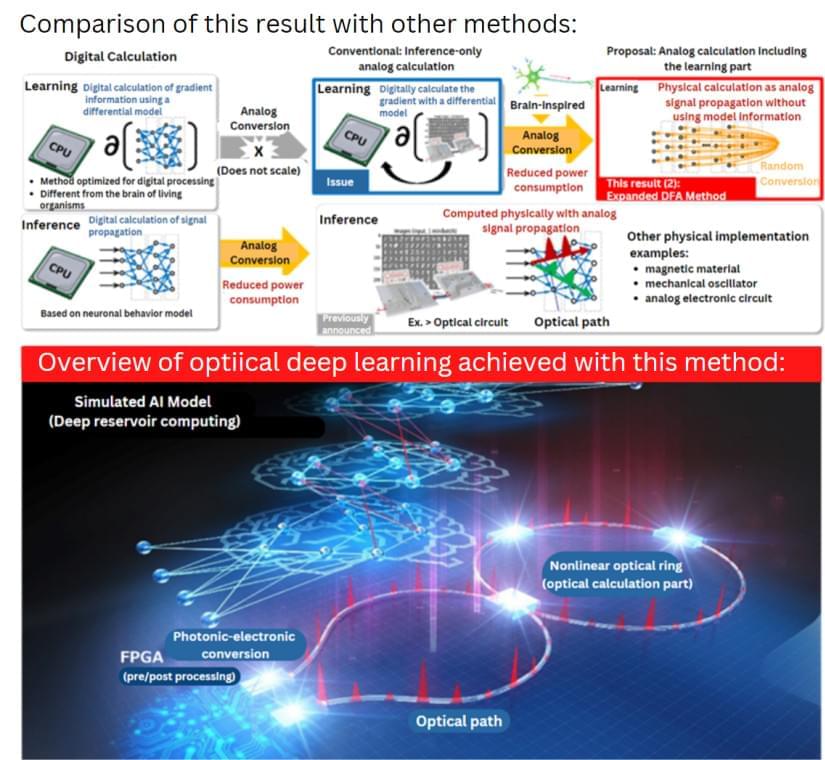
Simultaneous broadband image sensing and convolutional processing using van der Waals heterostructures

Efficiently processing broadband signals using convolutional neural networks (CNNs) could enhance the performance of machine learning tools for a wide range of real-time applications, including image recognition, remote sensing and environmental monitoring. However, past studies suggest that performing broadband convolutional processing computations directly in sensors is challenging, particularly when using conventional complementary metal-oxide-semiconductor (CMOS) technology, which underpins the functioning of most existing transistors.

Researchers at Huazhong University of Science and Technology and Nanjing University have recently investigated the possibility of achieving the convolutional processing of broadband signals using an alternative platform, namely van der Waals heterostructures. Their paper, published in Nature Electronics, could ultimately inform the development of better performing image recognition algorithms.

“Our paper was inspired by some our previous research works,” Tianyou Zhai, Xing Zhou and Feng Miao, three of the researchers who carried out the study, told TechXplore. “In studies published in Advanced Materials and Advanced Functional Materials, we realized type-III and type-II band-alignments in different heterostructures. Furthermore, we published a paper in Science Advances, where we realized a reconfigurable neural network vision sensor based on WSe2.”

An algorithm trained to detect unhappiness on social networks

Researchers have developed an algorithm that can identify the basic needs of users from the text and images they share on social networks. The experts hope this tool will help psychologists to diagnose possible mental health problems. The study suggests that Spanish-speaking users are more likely to mention relationship problems when feeling depressed than English speakers.

We spend a substantial amount of our time sharing images, videos or thoughts on social networks such as Instagram, Facebook and Twitter. Now, a group of researchers from the Universitat Oberta de Catalunya (UOC) has developed an algorithm that aims to help psychologists diagnose possible mental health problems through the content people post on these platforms.

According to William Glasser’s Choice Theory, there are five that are central to all human behavior: Survival, Power, Freedom, Belonging and Fun. These needs even have an influence on the images we choose to upload to our Instagram page. “How we present ourselves on can provide useful information about behaviors, personalities, perspectives, motives and needs,” explained Mohammad Mahdi Dehshibi, who led this study within the AI for Human Well-being (AIWELL) group, which belongs to the Faculty of Computer Science, Multimedia and Telecommunications at the UOC.

Artificial intelligence can offset human frailties, leading to better decisions

Modern life can be full of baffling encounters with artificial intelligence—think misunderstandings with customer service chatbots or algorithmically misplaced hair metal in your Spotify playlist. These AI systems can’t effectively work with people because they have no idea that humans can behave in seemingly irrational ways, says Mustafa Mert Çelikok. He’s a Ph.D. student studying human-AI interaction, with the idea of taking the strengths and weaknesses of both sides and blending them into a superior decision-maker.

In the AI world, one example of such a hybrid is a “centaur.” It’s not a mythological horse–, but a human-AI team. Centaurs appeared in chess in the late 1990s, when systems became advanced enough to beat human champions. In place of a “human versus machine” matchup, centaur or cyborg chess involves one or more computer chess programs and human players on each side.

“This is the Formula 1 of chess,” says Çelikok. “Grandmasters have been defeated. Super AIs have been defeated. And grandmasters playing with powerful AIs have also lost.” As it turns out, novice players paired with AIs are the most successful. “Novices don’t have strong opinions” and can form effective decision-making partnerships with their AI teammates, while “grandmasters think they know better than AIs and override them when they disagree—that’s their downfall,” observes Çelikok.

/* */