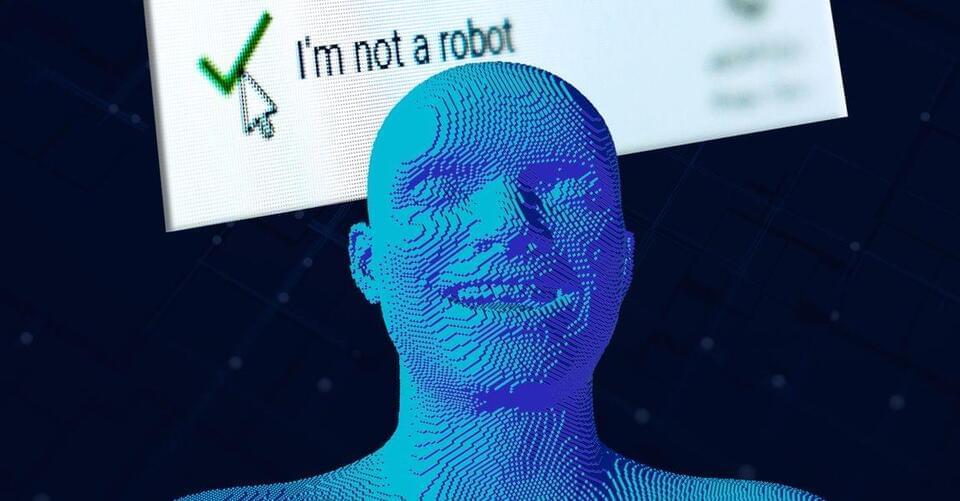
“Internet memes serve as excellent checkpoints to ensure humans have the upper hand over machines,” an expert tells us.
On Thursday, March 2 at 12:34 a.m. ET (12:34 UTC), Falcon 9 launched Dragon’s sixth operational human spaceflight mission (Crew-6) to the International Space Station from Launch Complex 39A (LC-39A) at NASA’s Kennedy Space Center in Florida. Following stage separation, Falcon 9’s first stage landed on the Just Read the Instructions droneship.
Dragon will autonomously dock with the space station on Friday, March 3 at approximately 12:43 a.m. ET (5:43 UTC). Follow Dragon and the crew’s flight below.
During their time on the orbiting laboratory, the crew will conduct over 200 science experiments and technology demonstrations in areas such as life and physical sciences to advanced materials, technology development, in-space production applications, and even student-led research.
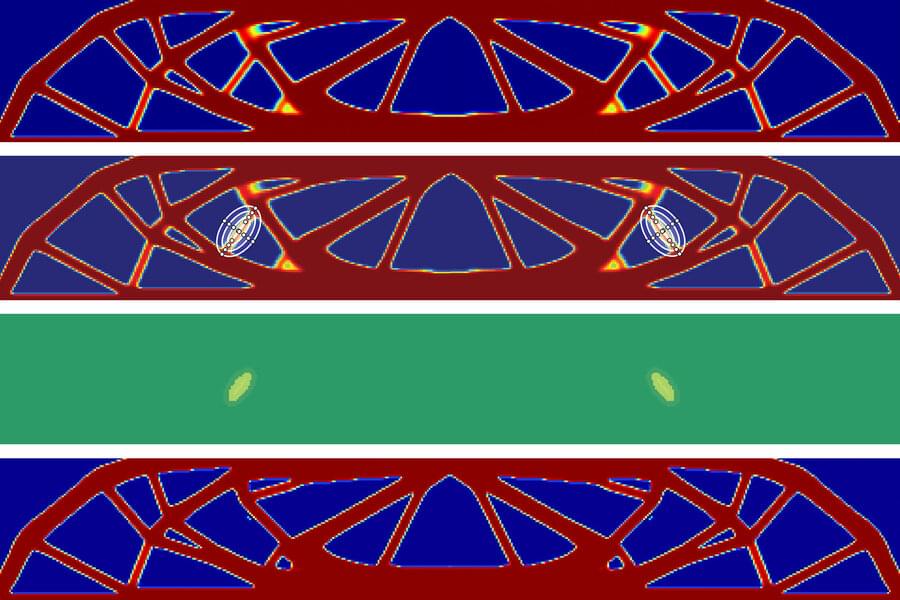
Modern fabrication tools such as 3D printers can make structural materials in shapes that would have been difficult or impossible using conventional tools. Meanwhile, new generative design systems can take great advantage of this flexibility to create innovative designs for parts of a new building, car, or virtually any other device.
But such “black box” automated systems often fall short of producing designs that are fully optimized for their purpose, such as providing the greatest strength in proportion to weight or minimizing the amount of material needed to support a given load. Fully manual design, on the other hand, is time-consuming and labor-intensive.
Now, researchers at MIT have found a way to achieve some of the best of both of these approaches. They used an automated design system but stopped the process periodically to allow human engineers to evaluate the work in progress and make tweaks or adjustments before letting the computer resume its design process. Introducing a few of these iterations produced results that performed better than those designed by the automated system alone, and the process was completed more quickly compared to the fully manual approach.

“A machine… of intelligent design.”
For the algorithm: UBI, singularity, Sydney bing ai, bing ai, microsoft, OpenAI, open ai, andrej karpathy, Ilya Sutskever, agi, artificial general intelligence, AI, ai, artificial intelligence, deep learning, how do neural networks work?, neural networks, machine learning, chatgpt, ChatGPT, GPT, bing, math, google, tech, technology, utopia.

Yuli Ban is talking about the prediction and emergence of generative AIs, the extent to which those can disrupt humanities reliance on creativity and productivity. He mentions ‘the dead internet theory’ that postulates that most content is autogenerated, obfuscating the actual people using the internet and reducing their actual exposure.
I think we already see this in social media, internet forums and other areas where fake content and profiles are detected. and this can spread to youtube and short form video platforms, telemarketing and scams. as well as use by political groups and states.
Yuli also mentions the long term implications — peaking human population and the notion of Transhumanism where humans merge with an infinitely more capable AI which assumes control. he mentions how biology is a quality many would like to preserve, to varying degrees.
Summary: Using AI, researchers identified Probucol, an existing anti-cholesterol drug that promotes the disposal of mitochondria, as a potential new therapy for the treatment of Parkinson’s disease.
Source: PLOS
The words that researchers use to describe their results can be harnessed to discover potential new treatments for Parkinson’s disease, according to a new study publishing March 2nd in the open access journal PLoS Biology by Angus McQuibban of the University of Toronto, Canada, and colleagues.
One of the often-overlooked parts of movie-making is how Hollywood blockbusters are distributed worldwide. While subtitles are common, dubbed audiences more widely embrace films to the point that certain native stars get associated with English-speaking performers. Variety reports that the Italian dubbing workers and voice actors are going on strike over the studios laying the groundwork to replace them with AI dubbing.
Italian voice actors and dubbing workers have been on strike since February 21st and will continue for at least another week. The complaints from the workers sound very similar to those of Marvel’s VFX contractors: low wages, long hours, and an unsustainable pace of work. Now that AI programs are becoming widely available and more cost-efficient than human work, the union worries dubbing will be fully overtaken by machines.
Rodolfo Bianchi, head of Italy’s dubbing director’s organization ADID, explained, “We are forced to sign contracts in which we give away the rights to the use of our voice, this also involves the use of our voice for artificial intelligence purposes.” AI is already capable of realistic deep fakes, including appropriating celebrity voices, and with how far the technology has come in a relatively short period, Bianchi’s fears are well-founded. While a computer program would struggle to match the tone and tenor of a voice during a dramatic performance, it can be done, and it can be done cheaply.
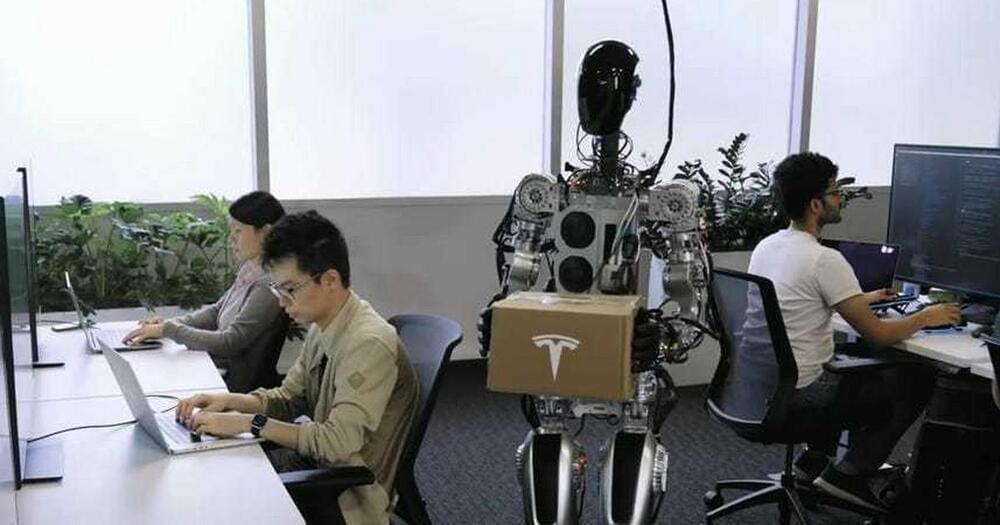
“You could sort of see a home use for robots, certainly industrial uses for robots, humanoid robots,” he said.
Musk’s musings about AI came during Tesla’s first-ever Investor Day presentation, which was held at the carmaker’s Austin, Texas, Gigafactory.
During the presentation, Musk showed an updated video of the company’s “Optimus” robot prototype, which Musk said he aims to use in Tesla factories and sell to the public.
On Monday, researchers from Microsoft introduced Kosmos-1, a multimodal model that can reportedly analyze images for content, solve visual puzzles, perform visual text recognition, pass visual IQ tests, and understand natural language instructions. The researchers believe multimodal AI—which integrates different modes of input such as text, audio, images, and video—is a key step to building artificial general intelligence (AGI) that can perform general tasks at the level of a human.
Visual examples from the Kosmos-1 paper show the model analyzing images and answering questions about them, reading text from an image, writing captions for images, and taking a visual IQ test with 22–26 percent accuracy (more on that below).