Toggle light / dark theme

6 Cool Things You Can Do With Bing Chat AI

Microsoft revealed an AI-powered Bing chatbot in February, dubbing it “the new Bing.” But what can you actually do with the new Bing, and where does it fall short?

The new Bing is impressive for an automated tool, as it can not only answer questions in full sentences (or longer paragraphs), but it can also draw information from recent web results. The web features give it an edge over ChatGPT, which has limited knowledge of current events and facts, but it still has problems providing factual answers or helpful responses. That significantly affects its usefulness as a tool, though Bing’s ability to cite sources can help you double-check its responses.

Engineers use psychology, physics, and geometry to make robots more intelligent

Robots are all around us, from drones filming videos in the sky to serving food in restaurants and diffusing bombs in emergencies. Slowly but surely, robots are improving the quality of human life by augmenting our abilities, freeing up time, and enhancing our personal safety and well-being. While existing robots are becoming more proficient with simple tasks, handling more complex requests will require more development in both mobility and intelligence.

Columbia Engineering and Toyota Research Institute computer scientists are delving into psychology, physics, and geometry to create algorithms so that robots can adapt to their surroundings and learn how to do things independently. This work is vital to enabling robots to address new challenges stemming from an aging society and provide better support, especially for seniors and people with disabilities.

A longstanding challenge in computer vision is object permanence, a well-known concept in psychology that involves understanding that the existence of an object is separate from whether it is visible at any moment. It is fundamental for robots to understand our ever-changing, dynamic world. But most applications in computer vision ignore occlusions entirely and tend to lose track of objects that become temporarily hidden from view.

Scientists can now read your MIND: AI turns people’s thoughts into images with 80% accuracy

Artificial intelligence can create images based on text prompts, but scientists unveiled a gallery of pictures the technology produces by reading brain activity. The new AI-powered algorithm reconstructed around 1,000 images, including a teddy bear and an airplane, from these brain scans with 80 percent accuracy.

Quantum computing is the key to consciousness

With the rapid development of chatbots and other AI systems, questions about whether they will ever gain true understanding, become conscious, or even develop a feeling agency have become more pressing. When it comes to making sense of these qualities in humans, our ability for counterfactual thinking is key. The existence of alternative worlds where things happen differently, however, is not just an exercise in imagination – it’s a key prediction of quantum mechanics. Perhaps our brains are able to ponder how things could have been because in essence they are quantum computers, accessing information from alternative worlds, argues Tim Palmer.

Ask a chatbot “How many prime numbers are there?” and it will surely tell you that there are an infinite number. Ask the chatbot “How do we know?” and it will reply that there are many ways to show this, the original going back to the mathematician Euclid of ancient Greece. Ask the chatbot to describe Euclid’s proof and it will answer correctly [ii]. [ii.

Of course, the chatbot has got all this information from the internet. Additional software in the computer can check that each of the steps in Euclid’s proof is valid and hence can confirm that the proof is a good one. But the computer doesn’t understand the proof. Understanding is a kind of Aha! moment, when you see why the proof works, and why it wouldn’t work if a minor element in it was different (for example the proof in the footnotes doesn’t work if any number but 1 is added when creating the number Q). Chatbots don’t have Aha! moments, but we do. Why?

They thought loved ones were calling for help. It was an AI scam

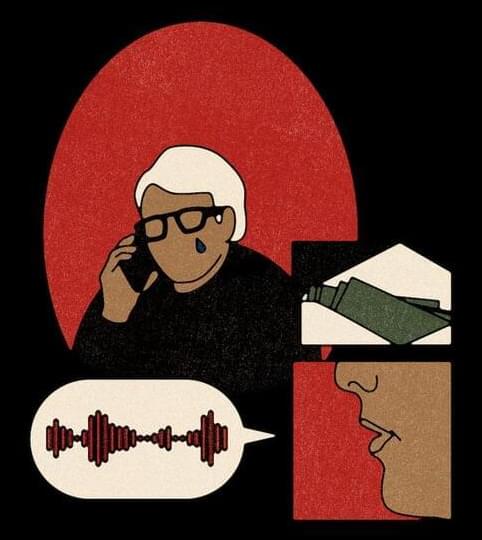
As impersonation scams in the United States rise, Card’s ordeal is indicative of a troubling trend. Technology is making it easier and cheaper for bad actors to mimic voices, convincing people, often the elderly, that their loved ones are in distress. In 2022, impostor scams were the second most popular racket in America, with over 36,000 reports of people being swindled by those pretending to be friends and family, according to data from the Federal Trade Commission. Over 5,100 of those incidents happened over the phone, accounting for over $11 million in losses, FTC officials said.

Advancements in artificial intelligence have added a terrifying new layer, allowing bad actors to replicate a voice with just an audio sample of a few sentences. Powered by AI, a slew of cheap online tools can translate an audio file into a replica of a voice, allowing a swindler to make it “speak” whatever they type.

Experts say federal regulators, law enforcement and the courts are ill-equipped to rein in the burgeoning scam. Most victims have few leads to identify the perpetrator and it’s difficult for the police to trace calls and funds from scammers operating across the world. And there’s little legal precedent for courts to hold the companies that make the tools accountable for their use.

/* */