Toggle light / dark theme

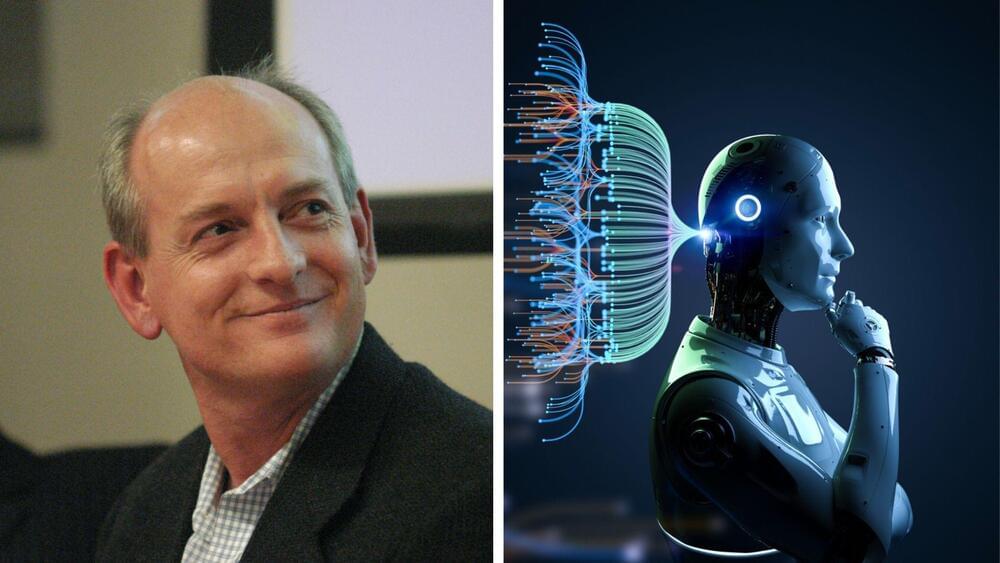
Scientist claims humans will be able to upload consciousness onto computer by the end of this YEAR

A computer scientist is urging the world to record their elderly parents and loved ones as he predicts consciousness could be uploaded onto a computer this year. Dr Pratik Desai, who has founded multiple Silicon Valley AI startups, said that if people have enough video and voice recorders of their loved ones, there is a ‘100 percent chance’ of relatives ‘living with you forever.’

Anthropic’s $5B, 4-year plan to take on OpenAI

AI research startup Anthropic aims to raise as much as $5 billion over the next two years to take on rival OpenAI and enter over a dozen major industries, according to company documents obtained by TechCrunch.

In the deck, Anthropic says that it plans to build a “frontier model” — tentatively called “Claude-Next” — 10 times more capable than today’s most powerful AI, but that this will require a billion dollars in spending over the next 18 months.

Artificial Intelligence In Space: The Amazing Ways Machine Learning Is Helping To Unravel The Mysteries Of The Universe

Space travel, exploration, and observation involve some of the most complex and dangerous scientific and technical operations ever carried out. This means that it tends to throw up the kinds of problems that artificial intelligence (AI) is proving itself to be outstandingly helpful with.

Because of this, astronauts, scientists, and others whose job it is to chart and explore the final frontier are increasingly turning to machine learning (ML) to tackle the everyday and extraordinary challenges they face.


AI is revolutionizing space exploration, from autonomous spaceflight to planetary exploration and charting the cosmos. ML algorithms help astronauts and scientists navigate and study space, avoid hazards, and classify features of celestial bodies.

Poe’s AI chatbot app now lets you make your own bots using prompts

An app called Poe will now let users make their own chatbot using prompts combined with an existing bot, like ChatGPT, as the base. First launched publicly in February, Poe is the latest product from the Q&A site Quora, which has long provided web searchers with answers to the most Googled questions. With chatbots now potentially powering the future of web search and Q&A, the company chose to expand into this market by allowing consumers to play with the latest AI technologies from companies like OpenAI and Anthropic via a simple mobile interface.

Initially, Poe debuted with support for a handful of general knowledge chatbots including Sage and Dragonfly, powered by OpenAI technology, and Claude, powered by Anthropic. Last month, Poe rolled out subscriptions that allow users to pay to access the more powerful bots based on new language models, including GPT-4 from OpenAI and Claude+ from Anthropic. Poe is also the only consumer-facing internet product with access to either Claude or Claude+, the company noted at the time.

Now, Poe will offer the ability for users to create their own bots using prompts — that is, ways of directing a chatbot to perform highly specific tasks.

Researchers train ‘world’s most advanced humanoid robot’ Ameca on GPT-4, finds her less responsive

The makers noticed that the processing time with GPT-4 was much longer than GPT-3 and made Ameca appear less responsive with her facial expressions.

In December 2021, we brought to you the ‘world’s most advanced humanoid robot’. Ameca, born of a UK-based company Engineered Arts, displayed a multitude of human-like expressions in August 2022. Now, the developers behind Ameca have released a new video in which the bot can be seen exhibiting its polyglot-like qualities — speaking several languages including Japanese, German, Chinese, French, British, and American English.


Engineered Arts.

This Ameca demonstration used GPT-3 for conversation and translation, DeepL for language detection, and Amazon Polly Neural voices, according to the YouTube description. The team is currently working on a demo using Eleven labs voice cloning which adds complexity, thanks to the additional “phoneme and Visme generation” for lip sync. They will be integrated into the company’s Tritium software platform. And a beta public version will be released in the coming months.

Rise of AI: Computer researcher warns of ‘Chernobyl’-like situation without safeguards

The explosion of AI to the tech scene is interesting but also scary at the same time.

A noted computer scientist at the University of Berkeley, Stuart Russell, has warned of dire consequences if artificial intelligence (AI) development remains unchecked. Russell is one of the noted scientists who co-signed a letter seeking a moratorium on releasing AI products for the next six months.

It would be hard for anyone to believe that ChatGPT has only been with us for a few months. While AI used to be a topic of discussion amongst a small group of computer researchers, the conversational chatbot has become a topic of conversation in mainstream media, too.


1,2.

New AI model can “cut out” any object within an image—and Meta is sharing the code

On Wednesday, Meta announced an AI model called the Segment Anything Model (SAM) that can identify individual objects in images and videos, even those not encountered during training, reports Reuters.

According to a blog post from Meta, SAM is an image segmentation model that can respond to text prompts or user clicks to isolate specific objects within an image. Image segmentation is a process in computer vision that involves dividing an image into multiple segments or regions, each representing a specific object or area of interest.

Italy became the first Western country to ban ChatGPT. Here’s what other countries are doing

It seems some countries in Europe might ban ChatGPT due to privacy reasons.


Italy isn’t the only country reckoning with the rapid pace of AI progression and its implications for society. Other governments are coming up with their own rules for AI, which, whether or not they mention generative AI, will undoubtedly touch on it. Generative AI refers to a set of AI technologies that generate new content based on prompts from users. It is more advanced than previous iterations of AI, thanks in no small part to new large language models, which are trained on vast quantities of data.

There have long been calls for AI to face regulation. But the pace at which the technology has progressed is such that it is proving difficult for governments to keep up. Computers can now create realistic art, write entire essays, or even generate lines of code, in a matter of seconds.

“We have got to be very careful that we don’t create a world where humans are somehow subservient to a greater machine future,” Sophie Hackford, a futurist and global technology innovation advisor for American farming equipment maker John Deere, told CNBC’s “Squawk Box Europe” Monday.

/* */