Toggle light / dark theme

Quantum Computer: We’re Planning to Create One That Acts Like a Brain

The human brain has amazing capabilities making it in many ways more powerful than the world’s most advanced computers. So it’s not surprising that engineers have long been trying to copy it. Today, artificial neural networks inspired by the structure of the brain are used to tackle some of the most difficult problems in artificial intelligence (AI). But this approach typically involves building software so information is processed in a similar way to the brain, rather than creating hardware that mimics neurons.

My colleagues and I instead hope to build the first dedicated neural network computer, using the latest “quantum” technology rather than AI software. By combining these two branches of computing, we hope to produce a breakthrough which leads to AI that operates at unprecedented speed, automatically making very complex decisions in a very short time.

We need much more advanced AI if we want it to help us create things like truly autonomous self-driving cars and systems for accurately managing the traffic flow of an entire city in real-time. Many attempts to build this kind of software involve writing code that mimics the way neurons in the human brain work and combining many of these artificial neurons into a network. Each neuron mimics a decision-making process by taking a number of input signals and processing them to give an output corresponding to either “yes” or “no”.

An entangled atom-light state realizes a paradoxical thought experiment

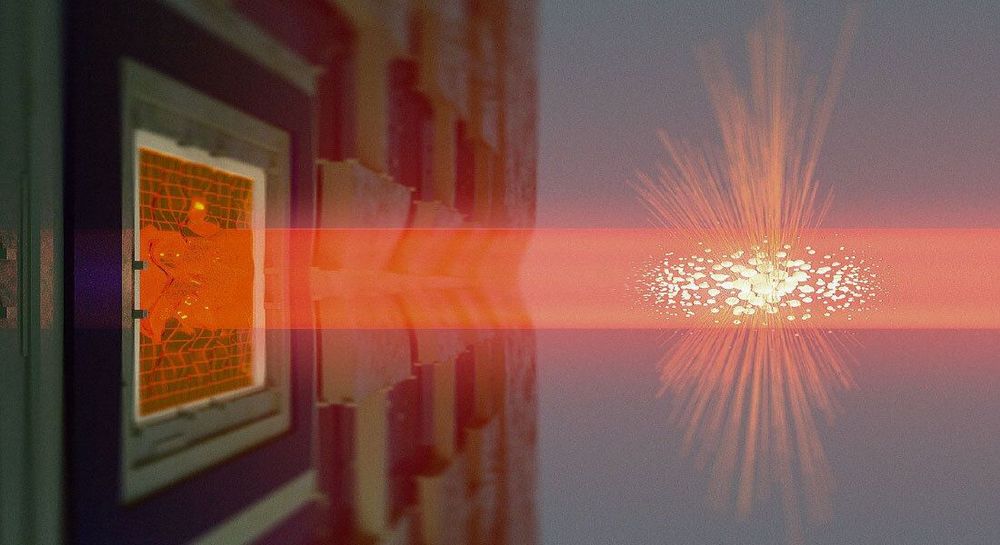
An old thought experiment now appears in a new light. In 1935 Erwin Schrödinger formulated a thought experiment designed to capture the paradoxical nature of quantum physics. A group of researchers led by Gerhard Rempe, Director of the Department of Quantum Dynamics at the Max Planck Institute of Quantum Optics, has now realized an optical version of Schrödinger’s thought experiment in the laboratory. In this instance, pulses of laser light play the role of the cat. The insights gained from the project open up new prospects for enhanced control of optical states, that can in the future be used for quantum communications.

Airbus wants to reinvent aircraft design with quantum computing challenge

Aeronautics giant Airbus today announced that it is creating a global competition to encourage developers to find ways quantum computing can be applied to aircraft design.

Quantum computing is one of many next-generation computing architectures being explored as engineers worry that traditional computing is reaching its physical limits.

Computers today process information using bits, either 0s or 1s, stored in electrical circuits made up of transistors. Quantum computers harness the power of quantum systems, such as atoms that can simultaneously exist in multiple states and can be used as “quantum bits” or “qubits.” These can theoretically handle far more complex calculations.

Why it is dangerous to build ever larger big bang machines

CERN has revealed plans for a gigantic successor of the giant atom smasher LHC, the biggest machine ever built. Particle physicists will never stop to ask for ever larger big bang machines. But where are the limits for the ordinary society concerning costs and existential risks?

CERN boffins are already conducting a mega experiment at the LHC, a 27km circular particle collider, at the cost of several billion Euros to study conditions of matter as it existed fractions of a second after the big bang and to find the smallest particle possible – but the question is how could they ever know? Now, they pretend to be a little bit upset because they could not find any particles beyond the standard model, which means something they would not expect. To achieve that, particle physicists would like to build an even larger “Future Circular Collider” (FCC) near Geneva, where CERN enjoys extraterritorial status, with a ring of 100km – for about 24 billion Euros.

Experts point out that this research could be as limitless as the universe itself. The UK’s former Chief Scientific Advisor, Prof Sir David King told BBC: “We have to draw a line somewhere otherwise we end up with a collider that is so large that it goes around the equator. And if it doesn’t end there perhaps there will be a request for one that goes to the Moon and back.”

“There

Scott Aaronson — The Winding Road to Quantum Supremacy

This was the first part in an interview series with Scott Aaronson — this one is on quantum computing — other segments are on Existential Risk, consciousness (including Scott’s thoughts on IIT) and thoughts on whether the universe is discrete or continuous.


First part in an interview series with Scott Aaronson — this one is on quantum computing — future segments will be on Existential Risk, consciousness (including Scott’s thoughts on IIT) and thoughts on whether the universe is discrete or continuous.

See ‘Complexity-Theoretic Foundations of Quantum Supremacy Experiments’
https://www.scottaaronson.com/papers/quantumsupre.pdf

Bio : Scott Aaronson is a theoretical computer scientist and David J. Bruton Jr. Centennial Professor of Computer Science at the University of Texas at Austin. His primary areas of research are quantum computing and computational complexity theory.

He blogs at Shtetl-Optimized: https://www.scottaaronson.com/blog/

The Ghost in the Quantum Turing Machine

Interview with Scott Aaronson — covering whether quantum computers could have subjective experience, whether information is physical and what might be important for consciousness — he touches on classic philosophical conundrums and the observation that while people want to be thorough-going materialists, unlike traditional computers brain-states are not obviously copyable. Aaronson wrote about this his paper ‘The Ghost in the Quantum Turing Machine’ (found here https://arxiv.org/abs/1306.0159). Scott also critiques Tononi’s integrated information theory (IIT).


Scott discusses whether quantum computers could have subjective experience, whether information is physical and what might be important for consciousness — he touches on classic philosophical conundrums and the observation that while people want to be thorough-going materialists, unlike traditional computers brain-states are not obviously copyable. Aaronson wrote about this his paper ‘The Ghost in the Quantum Turing Machine’ (found here https://arxiv.org/abs/1306.0159). Scott also critiques Tononi’s integrated information theory (IIT).

Questions include:
- In “Could a Quantum Computer Have Subjective Experience?” you speculate that a process has to ‘fully participate in the arrow of time’ to be conscious, and this points to decoherence. If pressed, how might you try to formalize this?

- In “Is ‘information is physical’ contentful?” you note that if a system crosses the Schwarzschild bound it collapses into a black hole. Do you think this could be used to put an upper bound on the ‘amount’ of consciousness in any given physical system?

- One of your core objections to IIT is that it produces blatantly counter-intuitive results. But to what degree should we expect intuition to be a guide for phenomenological experience in evolutionarily novel contexts? I.e., Eric Schwitzgebel notes “Common sense is incoherent in matters of metaphysics. There’s no way to develop an ambitious, broad-ranging, self- consistent metaphysical system without doing serious violence to common sense somewhere. It’s just impossible. Since common sense is an inconsistent system, you can’t respect it all. Every metaphysician will have to violate it somewhere.”

Bizarre Superfluid Could Explain the Existence of the Modern Universe

Back in the first moment of the universe, everything was hot and dense and in perfect balance. There weren’t any particles as we’d understand them, much less any stars or even the vacuum that permeates space today. The whole of space was filled with homogeneous, formless, compressed stuff.

Then, something slipped. All that monotonous stability became unstable. Matter won out over its weird cousin, antimatter, and came to dominate the whole of space. Clouds of that matter formed and collapsed into stars, which became organized into galaxies. Everything that we know about started to exist.

So, what happened to tip the universe out of its formless state? [How Quantum Entanglement Works (Infographic)].

New scale for electronegativity rewrites the chemistry textbook

Electronegativity is one of the most well-known models for explaining why chemical reactions occur. Now, Martin Rahm from Chalmers University of Technology, Sweden, has redefined the concept with a new, more comprehensive scale. His work, undertaken with colleagues including a Nobel Prize-winner, has been published in the Journal of the American Chemical Society.

The theory of is used to describe how strongly different atoms attract electrons. By using electronegativity scales, one can predict the approximate charge distribution in different molecules and materials, without needing to resort to complex quantum mechanical calculations or spectroscopic studies. This is vital for understanding all kinds of materials, as well as for designing new ones. Used daily by chemists and materials researchers all over the world, the concept originates from Swedish chemist Jöns Jacob Berzelius’ research in the 19th century and is widely taught at high-school level.

Now, Martin Rahm, Assistant Professor in Physical Chemistry at Chalmers University of Technology, has developed a brand-new scale of electronegativity.

/* */