Category: quantum physics – Page 1,158
Quantum Computing – Artificial Intelligence Is Here
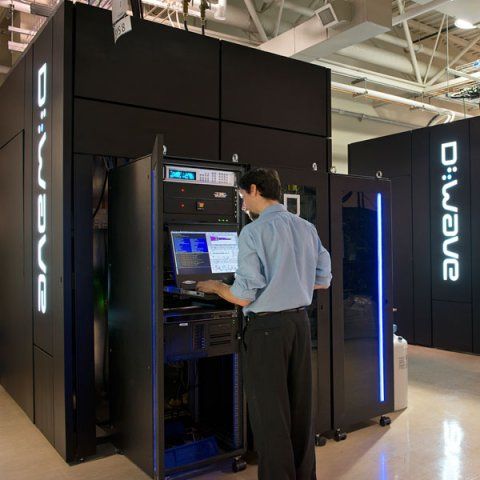
Geordie Rose, Founder of D-Wave (recent clients are Google and NASA) believes that the power of quantum computing is that we can ‘exploit parallel universes’ to solve problems that we have no other means of confirming. Simply put, quantum computers can think exponentially faster and simultaneously such that as they mature they will out pace us. Listen to his talk now!
We’re Officially Closer To Creating The World’s Most Powerful Computer
Tech giant, Intel has pledged $50 million (£33 million) to quantum computing research, which could ultimately give us a supercomputer unlike any machine we have known so far.
In an open letter, CEO Brian Krzanich announced a 10-year partnership with Delft University of Technology and TNO, the Dutch Organisation for Applied Research.
Describing the “exciting possibilities” about the research he said: “Quantum computing is one of the more promising areas of long-term research we’ve been exploring in our labs, with some of the smartest engineers in the world.
Nanotubes open new path toward quantum information technologies
“Beyond implementation of quantum communication technologies, nanotube-based single photon sources could enable transformative quantum technologies including ultra-sensitive absorption measurements, sub-diffraction imaging, and linear quantum computing. The material has potential for photonic, plasmonic, optoelectronic, and quantum information science applications…”
In optical communication, critical information ranging from a credit card number to national security data is transmitted in streams of laser pulses. However, the information transmitted in this manner can be stolen by splitting out a few photons (the quantum of light) of the laser pulse. This type of eavesdropping could be prevented by encoding bits of information on quantum mechanical states (e.g. polarization state) of single photons. The ability to generate single photons on demand holds the key to realization of such a communication scheme.
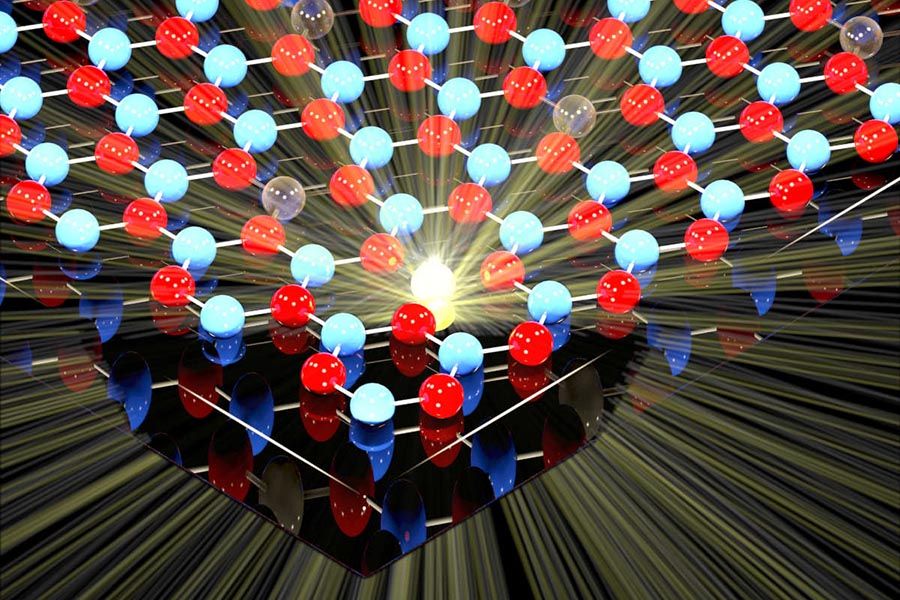
By demonstrating that incorporation of pristine single-walled carbon nanotubes into a silicon dioxide (SiO2) matrix could lead to creation of solitary oxygen dopant state capable of fluctuation-free, room-temperature single photon emission, Los Alamos researchers revealed a new path toward on-demand single photon generation. Nature Nanotechnology published their findings.
Magnetism generated in non-magnetic metals
By altering the quantum interactions of the electrons in the atoms of a metal’s atoms, scientists from the University of Leeds have generated magnetism in metals that aren’t normally magnetic. This move could one day reduce our reliance on rare or toxic metals in a range of fields.
Why’s IBM Investing $3 Billion In Quantum Computing & Synth Brains? Trillion Dollar Humanoid Market
1. Silicon technology has taken humanity a long way forward from 1947 when the first transistor was invented by the Nobel prize winners Shockley, Bardeen & Brattain.
2. From smart mobile telephones we rely on to the sophisticated satellite navigation systems guiding our cars, a lot of techno-magic we see around us is a result of our ability to scale silicon-tech that turns hitherto science fiction into everyday reality at affordable prices.
3. All the Nobel laureates, scientists and engineers we liaise with at Quantum Innovation Labs http://QiLabs.net collectively realise the end of the silicon-scaling era is coming to end as the Moore’s Law era for Silicon-based computers finally concludes.
Intel pledges $50M in quantum computing push to solve big problems
Intel today announced plans to invest $50 million over the next ten years as part of a quantum computing push to help solve problems such as “large-scale financial analysis and more effective drug development.”
But despite the ambitions and huge cost of the project, company vice president Mike Mayberry admits that “a fully functioning quantum computer is at least a dozen years away.”
The money will be channeled through QuTech, the quantum research institute of Delft University of Technology, and TNO, with Intel additionally pledging to commit its own “engineering resources” to the collaborative effort.
A little light interaction leaves quantum physicists beaming
A team of physicists has taken a step toward making the essential building block of quantum computers out of pure light. Their advance has to do with logic gates that perform operations on input data to create new outputs.
Quantum computer firm D-Wave claims massive performance boost
The world only quantum computer maker says its upgraded chip is 15 times faster than ordinary computers, but experts doubt the comparison is a fair test.