Toggle light / dark theme

Intelligent Robots Threaten Millions of Jobs

Why? Why are there so many folks hyping up AI devastation?

I truly caution folks from over hyping things before they hurt a lot of innocent people. Things like Quantum Computing and Internet, CRISPR, microbot technology, etc. could be badly damaged as a result of the over hype of AI and it’s under delivery.

Also, the ongoing changing numbers on when 50% of the jobs are lost or the ongoing shuffle/ changes in the capabilities of the AI story is also creating an environment of distrust which also hurts efforts around Quantum, CRISPR, etc.

Investors and consumers don’t forget things that easily; and could pull away in supporting these other much needed technologies.


Advances in artificial intelligence will soon lead to robots that are capable of nearly everything humans do, threatening tens of millions of jobs in the coming 30 years, experts warned Saturday.

“We are approaching a time when machines will be able to outperform humans at almost any task,” said Moshe Vardi, director of the Institute for Information Technology at Rice University in Texas.

Photon-Based Heat Transport May Advance Quantum Computing

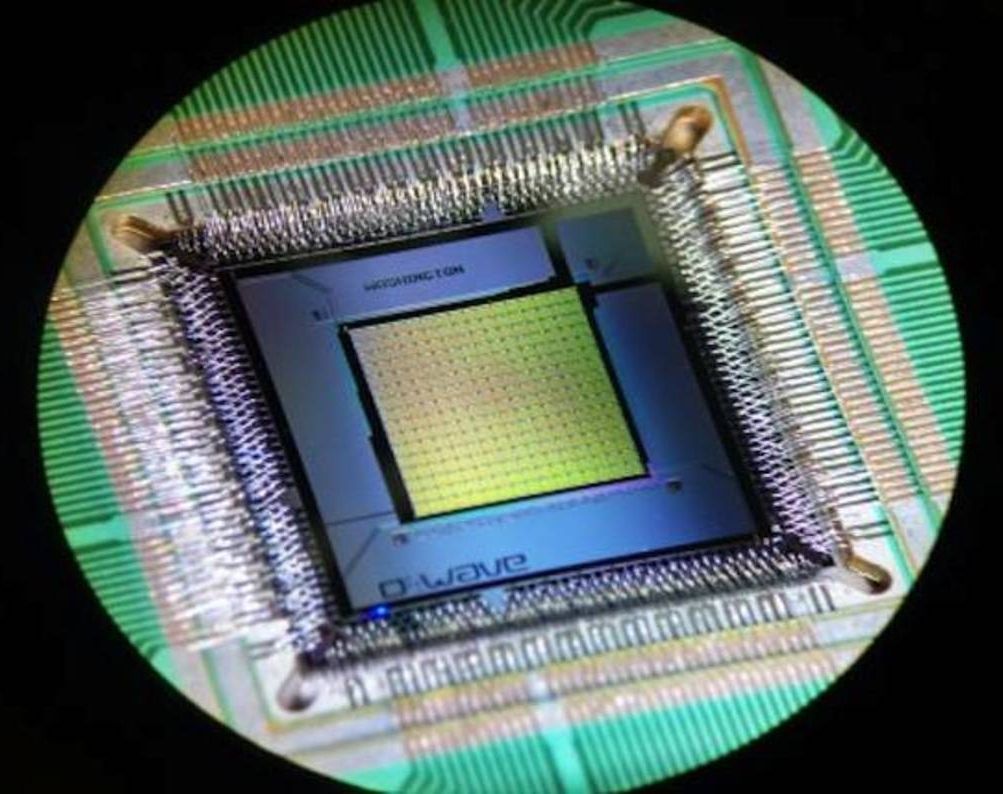
More advancement in Quantum Computing — researchers in Finland have found a way to keep the processor chip cooled without causing disrupting computer operations which has been a big challenge for Quantum Chips.


AALTO, Finland, Feb. 11, 2016 — A thermal-transport method that uses photons as carriers has been demonstrated over 1-m distances. The fundamental advance in heat conduction could drive the development of quantum computers.

Read more

How to Build a Quantum Computer

Quantum Entanglement “Fluffy Bunny Style”.


UVM physicist wins NSF CAREER grant to study entanglement 02-08-2016 By Joshua E. Brown Two different ways in which atoms can be quantum entangled. Left: spatial entanglement where atoms in two separated regions share quantum information. Right: particle entanglement for identical atoms (colored here for clarity) due to quantum statistics and interactions.

Read more

The First Image Ever of a Hydrogen Atom’s Orbital Structure

What you’re looking at is the first direct observation of an atom’s electron orbitalan atom’s actual wave function! To capture the image, researchers utilized a new quantum microscope — an incredible new device that literally allows scientists to gaze into the quantum realm.

An orbital structure is the space in an atom that’s occupied by an electron. But when describing these super-microscopic properties of matter, scientists have had to rely on wave functions — a mathematical way of describing the fuzzy quantum states of particles, namely how they behave in both space and time. Typically, quantum physicists use formulas like the Schrödinger equation to describe these states, often coming up with complex numbers and fancy graphs.

Up until this point, scientists have never been able to actually observe the wave function. Trying to catch a glimpse of an atom’s exact position or the momentum of its lone electron has been like trying to catch a swarm of flies with one hand; direct observations have this nasty way of disrupting quantum coherence. What’s been required to capture a full quantum state is a tool that can statistically average many measurements over time.

Read more

Tachyon physics with trapped ions

It has been predicted that particles with imaginary mass, called tachyons, would be able to travel faster than the speed of light. There has not been any experimental evidence for tachyons occurring naturally. Here, we propose how to experimentally simulate Dirac tachyons with trapped ions. Quantum measurement on a Dirac particle simulated by a trapped ion causes it to have an imaginary mass so that it may travel faster than the effective speed of light. We show that a Dirac tachyon must have spinor-motion correlation in order to be superluminal. We also show that it exhibits significantly more Klein tunneling than a normal Dirac particle. We provide numerical simulations of realistic ion systems and show that our scheme is feasible with current technology.

Figure Figure Figure Figure Figure

Read more

Inside SU’s First Salon: Lab-Grown Organs, Cybersecurity, and AI Music Apps

“We will find new things everywhere we look.” –Hunter S. Thompson

At the rate of 21st century technological innovation, each year brings new breakthroughs across industries. Advances in quantum computers, human genome sequencing for under $1,000, lab-grown meat, harnessing our body’s microbes as drugs, and bionic eye implants that give vision to the blind —the list is long.

As new technologies push the boundaries of their respective industries, fields are now maturing, growing, and colliding with one another. This cross-pollination of ideas across industries and countries has changed the world—and will continue to—and it’s one of the reasons Singularity University exists.

Read more

Cybersecurity Challenges, Opportunities Discussed at Dedication of Expanded National Cybersecurity Center of Excellence

If Russia, China, etc. upgrades their infrastructure to Quantum before US and it’s does; today’s breaches will not even compare to this scenario.


The push to bring more technology-related businesses to the state has officials hoping for long-term growth over places like Fairfax County, Va., where the federal government has already made substantial technological investment.

After the ceremony, an expert panel discussed some of the opportunities and challenges facing information infrastructure, the importance of collaboration between the public and private sectors, and how to increase consumers’ cybersecurity confidence.

U.S. Secretary of Commerce Penny Pritzker said during the panel that the current standing of federal cybersecurity has vastly improved since she was appointed to the post in 2013 — but there is still a ways to go.

Read more

Quantum Levitation

Researchers at the school of physics and astronomy at Tel Aviv University have created a track around which a superconductor (a material that is extremely efficient at transmitting electricity) can float, thanks to the phenomenon of “quantum levitation “.

This levitation effect is explained by the Meissner effect, which describes how, when a material makes the transition from its normal to its superconducting state, it actively excludes magnetic fields from its interior, leaving only a thin layer on its surface.

When a material is in its superconducting state — which involves very low temperatures — it is strongly diamagnetic. This means that when a magnetic field is externally applied, it will create an equally opposing magnetic field, locking it in place.

A material called yttrium barium copper oxide can be turned into a superconductor by exposure to liquid nitrogen — which makes it one of the highest-temperature superconductors.

Levitation isn’t just for Houdini anymore. Could this cool new tech lead to floating alternatives to traditional gas powered vehicles? Interesting times ahead!

Read more

Chiral magnetic effect generates quantum current

Another step forward for Quantum — The Quantum Current. US Dept. of Energy has a new method to generate very low-resistance electric (Quantum) current which will improve our methods for energy, quantum computing, and medical imaging, and possibly even a new mechanism for inducing superconductivity—the ability of some materials (zirconium pentatelluride) to carry current with no energy loss.

Read more

/* */