Toggle light / dark theme

Toward Handheld QCL Sensors

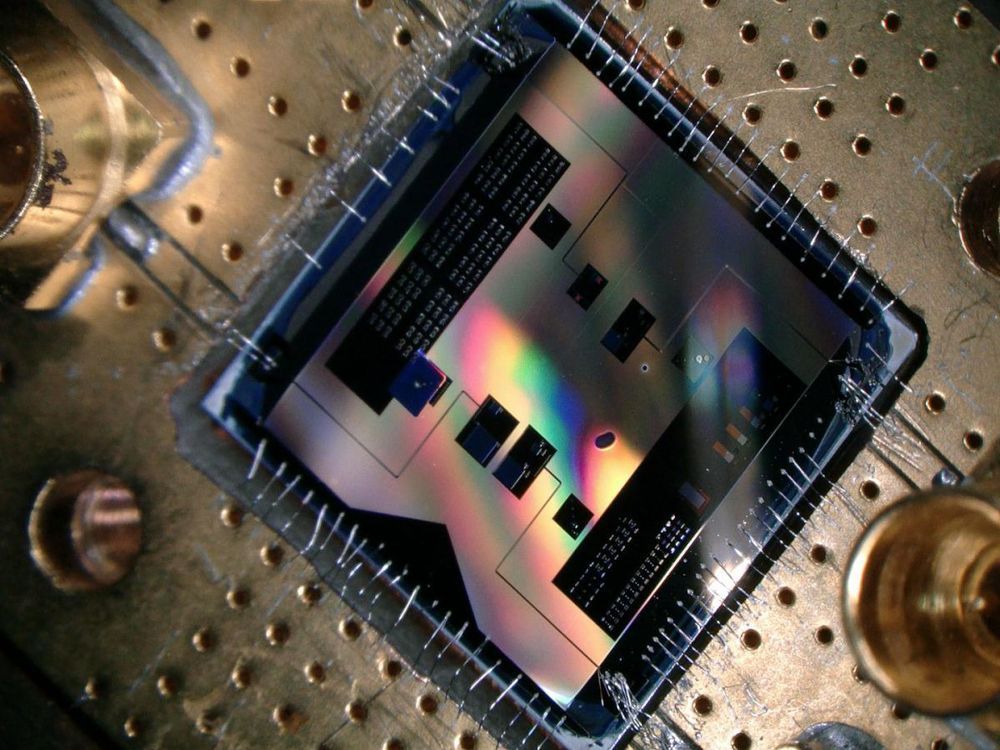
In the TU Wien design, quantum cascade heterostructures are arrayed within concentric ring-shaped waveguides (top; diameter of outer ring is 400 microns), and can act as both sources and detectors of light on the same chip. In the specific setup tested by the lab (bottom), one of the ring structures (on the right), acting in QCL mode, sends its light through a chamber containing the gas to be analyzed. The beam is reflected by a mirror (on the left) and sent back through the chamber, to be picked up by the other ring structure, acting in detector mode. [Image: TU Wien]

Quantum cascade lasers (QCL) excel as mid-infrared light sources, a characteristic that has made them a linchpin in many environmental and industrial gas-sensing applications. But though QCLs themselves can be quite small, actually setting up a sensor system requires other elements beyond the laser, which can make it tough to design compact devices ready for field use.

A team of scientists from the Vienna University of Technology (TU Wien), Austria, now offers a concept that the group believes could make designing handheld QCL-based sensors a lot easier. The key: a clever scheme that combines the laser and the detector on a single chip less than half a millimeter across (ACS Photon., doi: 10.1021/acsphotonics.6b00603).

Why the Many-Worlds Formulation of Quantum Mechanics Is Probably Correct

I have often talked about the Many-Worlds or Everett approach to quantum mechanics — here’s an explanatory video, an excerpt from From Eternity to Here, and slides from a talk. But I don’t think I’ve ever explained as persuasively as possible why I think it’s the right approach. So that’s what I’m going to try to do here. Although to be honest right off the bat, I’m actually going to tackle a slightly easier problem: explaining why the many-worlds approach is not completely insane, and indeed quite natural. The harder part is explaining why it actually works, which I’ll get to in another post.

Any discussion of Everettian quantum mechanics (“EQM”) comes with the baggage of pre-conceived notions. People have heard of it before, and have instinctive reactions to it, in a way that they don’t have to (for example) effective field theory. Hell, there is even an app, universe splitter, that lets you create new universes from your iPhone. (Seriously.) So we need to start by separating the silly objections to EQM from the serious worries.

The basic silly objection is that EQM postulates too many universes. In quantum mechanics, we can’t deterministically predict the outcomes of measurements. In EQM, that is dealt with by saying that every measurement outcome “happens,” but each in a different “universe” or “world.” Say we think of Schrödinger’s Cat: a sealed box inside of which we have a cat in a quantum superposition of “awake” and “asleep.” (No reason to kill the cat unnecessarily.) Textbook quantum mechanics says that opening the box and observing the cat “collapses the wave function” into one of two possible measurement outcomes, awake or asleep. Everett, by contrast, says that the universe splits in two: in one the cat is awake, and in the other the cat is asleep. Once split, the universes go their own ways, never to interact with each other again.

Quantum Liquid on Bismuth Crystal Could Lead to Faster Electronics

Luv this!


In Brief:

  • Researchers have demonstrated how electrons travel on different elliptical paths by using a quantum crystal kept at low temperatures.
  • The discovery could lead to a new class of microchips far beyond the capabilities of today’s silicon chips.

New developments from Princeton University and the University of Texas-Austin have revealed odd behavior in electrons that could lay the foundation for a new generation of faster microchips, according to a study published in Science.

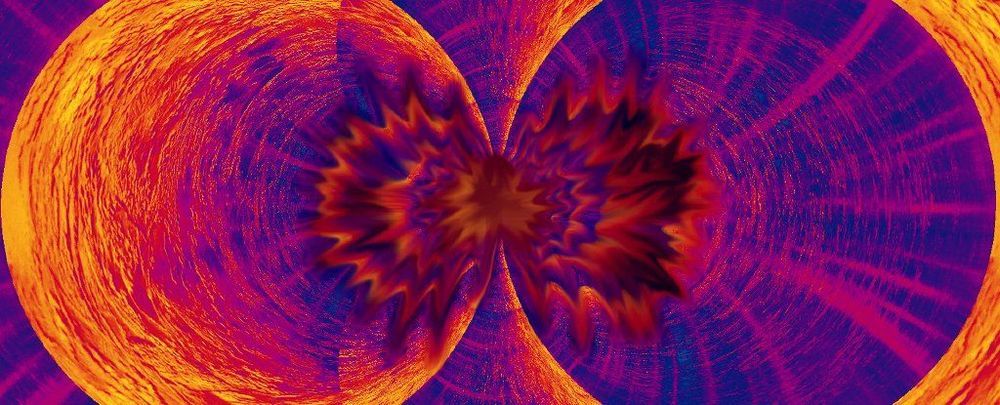
Electronic systems react in different ways depending on surfaces they’re exposed to, and the study demonstrated when electrons on crystal bismuth are kept at very low temperatures, they spontaneously travel in identical elliptical paths.

Quantum Teleportation Across The Dark Web

Get Ready Folks! Imagine a QC DarkNet as it will too come.


Quantum teleportation brings to mind Star Trek’s transporter, where crew members are disassembled in one location to be reassembled in another. Real quantum teleportation is a much more subtle effect where information is transferred between entangled quantum states. It’s a quantum trick that could give us the ultimate in secure communication. While quantum teleportation experiments have been performed countless times in the lab, doing it in the real world has proved a bit more challenging. But a recent experiment using a dark fibre portion of the internet has brought quantum teleportation one step closer to real world applications.

The backbone of the internet is a network of optical fibre. Everything from your bank transactions to pictures of your cat travel as beams of light through this fibre network. However there is much more fibre that has been laid than is currently used. This unused portion of the network is known as dark fibre. Other than not being currently used, the dark fiber network has the same properties as the web we currently use. This new experiment used a bit of this dark web in Calgary to teleport a photon state under real world conditions.

The basic process of quantum teleportation begins with two objects (in this case photons) that are quantumly entangled. This basically means the state of these two objects are connected in such a way that a measurement of one object affects the state of the other. For quantum teleportation, one of these entangled objects is measured in combination with the object to be “teleported” (another photon). The result of this measurement is then sent to the other location, where a similar combined measurement is made. Since the entangled objects are part of both measurements, quantum information can be “teleported.” This might seem like an awkward way to send information, but it makes for a great way to keep your messages secret. Using this method, Alice can basically encrypt a message using the entangled objects, send the encrypted message to Bob, who can then make his own measurement of the entangled state to decode the message.

How Smart Beta ETFs of the Future Will Use AI

Anyone who does not have QC as part of their 5+Yr Roadmap for IT are truly exposing their company as well as shareholders and customers. China, Russia, Cartels, DarkNet, etc. will use the technology to extort victims, destroy companies, economies, and complete countries where folks have not planned, budget, skilled up, and prep for full replacement of their infrastructure and Net access. Not to mention companies who have this infrastructure will provide better services/ CCE to svc. consumers.


In a recent article, we highlighted a smart beta ETF called the “Sprott BUZZ Social Media Insights ETF” that uses artificial intelligence (AI) to select and weight stocks. If we stop and think about that for a moment, that’s a pretty cool use of AI that seems well ahead of its time. Now we’re not saying that you should go out and buy this smart beta ETF right away. It uses social media data. We know that on social media, everyone’s an expert and many of the opinions that are stated are just that, opinions. However some of the signals may be legitimate. Someone who just bought Apple is likely to go on telling everyone how bullish they are on Apple shares. Bullish behavior is often accompanied by bullish rhetoric. And maybe that’s exactly the point, but the extent to which we’re actually using artificial intelligence here is not that meaningful. Simple scripting tools go out and scrape all this public data and then we use natural language processing (NLP) algorithms to determine if the data artifacts have a positive or negative sentiment. That’s not that intelligent, is it? This made us start to think about what it would take to create a truly “intelligent” smart beta ETF.

What is Smart Beta?

We have talked before about how people that work in finance love to obfuscate the simplicity of what they do with obscure acronyms and terminology. Complex nomenclature is suited for sophisticated scientific domains like synthetic biology or quantum computing but such language is hardly merited for use in the world of finance. We told you before what beta is. Smart beta is just another way of saying “rules based investing” which has in fact been around for centuries, but of course we act like it’s new and start publishing all kinds of research papers on it. In fact, a poll offered up by S&P Capital IQ shows that even 1 out of 4 finance professionals recognizes the term “smart beta” to be little more than a marketing gimmick:

The Nine Billion Names Of God

Quantum theory is strange and counterintuitive, but it’s very precise. Lots of analogies and broad concepts are presented in popular science trying to give an accurate description of quantum behavior, but if you really want to understand how quantum theory (or any other theory) works, you need to look at the mathematical details. It’s only the mathematics that shows us what’s truly going on.

Mathematically, a quantum object is described by a function of complex numbers governed by the Schrödinger equation. This function is known as the wavefunction, and it allows you to determine quantum behavior. The wavefunction represents the state of the system, which tells you the probability of various outcomes to a particular experiment (observation). To find the probability, you simply multiply the wavefunction by its complex conjugate. This is how quantum objects can have wavelike properties (the wavefunction) and particle properties (the probable outcome).

No, wait. Actually a quantum object is described by a mathematical quantity known as a matrix. As Werner Heisenberg showed, each type of quantity you could observe (position, momentum, energy) is represented by a matrix as well (known as an operator). By multiplying the operator and the quantum state matrix in a particular way, you get the probability of a particular outcome. The wavelike behavior is a result of the multiple connections between states within the matrix.

FUNCTION FOLLOWS FORM in the Quantum world, with a NEW splitting and pairing massless Black Hole

Perfect for Halloween — the big Pumpkin Star story.


According to Quantum FFF Theory, stars are formed between dual new physics black holes called Herbig Haro pressure cookers.

The dual black holes can have different sizes and different capacities to produce different sized stars.

They are assumed to produce most of the plasma dust and and Hydrogen gas to form the central baby star.

Super-Cool Quantum Research Lab Heads to Space

Just WOW!


PULLMAN, Wash., Oct. 26 — Washington State University and NASA scientists are set to begin an investigation into the strange world of quantum physics on the International Space Station.

WSU physicists Peter Engels and Maren Mossman are part of a team studying the behavior of atoms laser-cooled to temperatures just a few billionths of a degree above absolute zero, the point where they behave like one wave of discrete particles.

On Earth, the unavoidable presence of gravity makes it difficult to conduct unperturbed observations of this this super-cooled substance – called a Bose-Einstein condensate – and the laws of quantum physics that govern its wave-like behavior.

/* */