Toggle light / dark theme

Nanotechnology in Manufacturing: The Future is Now (Part 1)

The burgeoning field of nanotechnology promises an indefinite range of capabilities in medicine, optics, communications, and other facets of applied science and engineering. On that front, the U.S. Defense Advanced Research Projects Agency’s (DARPA) Atoms 2 Products program (A2P) is funding 10 companies, universities, and institutions to develop mass-manufacturing techniques and technologies for functional products made up of nanoscale constituents. The project demonstrates a mere slice of the contributions in the mass movement to make nanotechnology a part of our everyday lives.

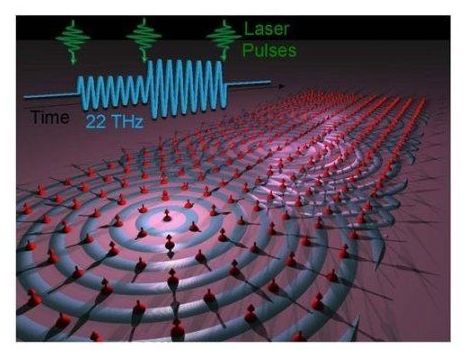
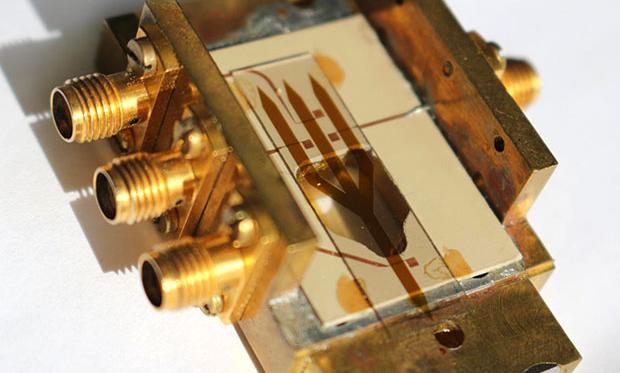
The following gallery highlights the work of five DARPA-funded projects in the program. The slides describe an atomic calligraphy technique for 2D atomic printing, a manufacturing method for producing high-frequency “Nanolitz” wires, the construction of pop-up sensors for laparoscopy, and a conjunct effort to use micro-robotics to build the assemblers of nanodevices.

Read more

Biotechnology, synthetic biology keys to humans colonizing other planets

Over the last 12,000 years or so, human civilization has noticeably reshaped the Earth’s surface. But changes on our own planet will likely pale in comparison when humans settle on other celestial bodies. While many of the changes on Earth over the centuries have been related to food production, by way of agriculture, changes on other worlds will result, not only from the need for on-site production of food, but also for all other consumables, including air.

As vital as synthetic biology will be to the early piloted missions to Mars and voyages of exploration, it will become indispensable to establish a long-term human presence off-Earth, namely colonization. That’s because we’ve evolved over billions of years to thrive specifically in the environments provides by our home planet.

Our physiology is well-suited to Earth’s gravity and its oxygen-rich atmosphere. We also depend on Earth’s magnetic field to shield us from intense space radiation in the form of charged particles. In comparison, Mars currently has no magnetic field to trap particle radiation and an atmosphere that is so thin that any shielding against other types of space radiation is negligible compared with the protection that Earth’s atmosphere affords. At the Martian surface, atmospheric pressure never gets above 7 millibars. That’s like Earth at an altitude of about 27,000 m (89,000 ft), which is almost the edge of space. And it’s not like the moon is a better option for us since it has no atmosphere at all.

Read more

Nuclear Fusion’s “Heat Loss” Problem May Have Been Solved

Scientists claim to have made yet another step towards the ultimate goal of achieving nuclear fusion, by partially solving an outstanding problem in the field: heat loss.

The research was led by scientists at MIT’s Plasma Science and Fusion Center, in collaboration with the University of California at San Diego, General Atomics, and the Princeton Plasma Physics Laboratory.

To make nuclear fusion work, atoms of deuterium need to be “stuck together” to form helium in a super-heated plasma at around 100 million degrees Celsius. Keeping the temperature this high is difficult, though, because turbulence stirs up the plasma, causing heat to dissipate – hence, heat loss.

Read more

Physicists Have Discovered Evidence Of A Gluino Particle, The Cousin Of The Higgs Boson

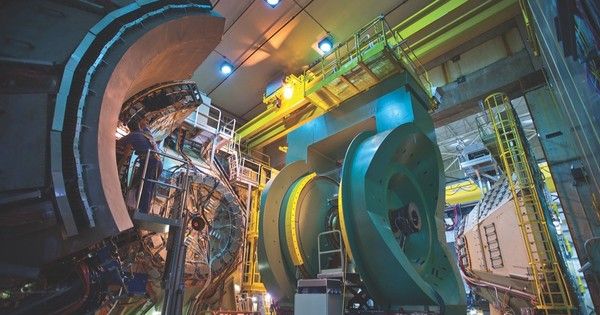
Scientists at the Large Hadron Collider at CERN have found evidence of a new particle called the gluino, which might be integral to the nature of our universe. (Photo : Mark Hillary | Flickr)

A team of scientists currently working at the Large Hadron Collier at the European Organization for Nuclear Research (CERN) announced that it has possibly discovered the existence of a particle integral to nature in a statement on Tuesday, Dec. 15, and again on Dec.16.

The two teams working in concert, named Atlas and CMS, presented their findings on the particle from the Large Hadron Collider’s second run (LHC Run 2). The results were based on what the scientists observed during the particle collisions. The previously-hypothesized particle, named the gluino, is theoretically the supersymmetric partner of the gluon (or glue particle, which is comprised entirely of nuclear force). This would mean that the gluino could be pair-produced by colliders like the LHC, and would more or less be described as a heavier version of the Higgs boson, a particle that essentially helps us understand why other particles contain mass and was identified at the LHC at CERN in 2012.

Read more

New worlds: Tapping particles of light

Interesting; no more rotten fruit. Researchers may actually found a new way to preserve perishable foods. Can you imagine the cost savings to consumers, plus being able to supply more people with fresh fruits and vegetables. World Bank and Health Organizations should be interested in this as well.

It does make me wonder how the research on life extension, etc. can learn from the findings of this experiment.


Researchers have managed to “pluck” a single photon – one particle of light – out of a pulse of light.”

Read more

ALPHA experiment shows antihydrogen charge is neutral

In a paper published in the journal Nature, researchers at CERN’s ALPHA experiment have shown – to the most accurate degree yet – that particles of antihydrogen have a neutral electrical charge.

According to the Standard Model, which explains how the basic building blocks of matter interact, all antimatter – such as antihydrogen – should have the exact opposite charge to its matter counterpart. For example, in a hydrogen atom a negatively charged electron combines with a positively charged proton to give a net charge of zero. In contrast, an antihydrogen atom should have a positively charged positron combining with a negatively charged antiproton to give a net charge of zero. The Standard Model also says that during the Big Bang equal amounts of antimatter and matter were created. But today this isn’t the case, there is much less antimatter in the universe than matter.

Since physicists know that hydrogen has a neutral charge, by studying the charge of antihydrogen, they hoped to see something different or surprising, which could help scientists to understand why nature has a preference for matter over antimatter. “It’s a very important question: is the universe neutral? Do all the positive charges and negative charges have exactly the opposite sign and to what level can you determine that?” explains Jeffrey Hangst, the spokesperson for the ALPHA experiment at CERN’s Antiproton Decelerator (AD) and the lead scientist on the study. “For normal matter that’s known very precisely: to about one part in 1021, that’s one and 21 zeros, that’s an enormous number, we really know that well. Now we have the first opportunity to study this with antiatoms, with antihydrogen, and that’s what we’re publishing now. We made the best possible study that we can make with trapped antihydrogen.”

Read more

Stephen Hawking: Black Holes Have ‘Hair’

Black holes may sport a luxurious head of “hair” made up of ghostly, zero-energy particles, says a new hypothesis proposed by Stephen Hawking and other physicists.

The new paper, which was published online Jan. 5 in the preprint journal arXiv, proposes that at least some of the information devoured by a black hole is stored in these electric hairs.

Still, the new proposal doesn’t prove that all the information that enters a black hole is preserved.

Read more

4 Cosmic Phenomena That Travel Faster Than The Speed Of Light

Hopefully one day soon we’ll be able to add a fifth cosmic phenomena that can travel faster than the speed of light to the list — humanity.


When Albert Einstein first predicted that light travels the same speed everywhere in our universe, he essentially stamped a speed limit on it: 670,616,629 miles per hour — fast enough to circle the entire Earth eight times every second.

But that’s not the entire story. In fact, it’s just the beginning.

Before Einstein, mass — the atoms that make up you, me, and everything we see — and energy were treated as separate entities. But in 1905, Einstein forever changed the way physicists view the universe.

Read more

New Quantum Record: Ball of Atoms Ends up in Two Spots at Once

Researchers have demonstrated the effects of superposition on the scale of everyday objects.

Of the weird implications of quantum mechanics, superposition may be the hardest for humans to wrap their minds around. In principle, superposition means that the same object can exist in more than one place at the same time.

Ordinarily, superposition is only relevant on the microscopic scale of subatomic particles. Effects on this scale are the key to some possibly groundbreaking technologies, like quantum computing. No one has ever demonstrated quantum effects on the scale of Schrödinger’s cat –the mythical unobserved cat in a box that is both alive and dead at the same time.

Read more

/* */