Toggle light / dark theme

Exploring the promise of the quantum realm

Nice work; understanding the quantum effects in nanomechanical systems is closer to reality in being achieved. Imagine a nanobot or microbot with quantum mechanic properties.


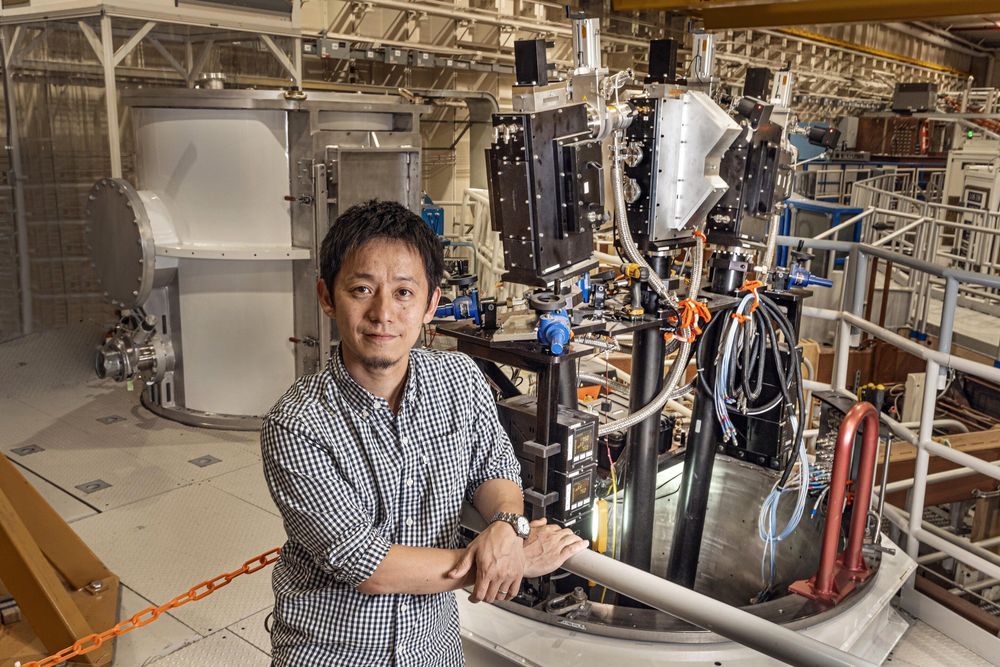
Rob Knobel is probing the ultimate limits of nanomechanical systems to develop and build tiny vapour sensors, which could be used as airport security tools to prevent terrorism or drug smuggling.

He and his students are using highly specialized equipment in the $5-million Kingston Nano Fabrication Laboratory (KNFL), which opened a year ago in Innovation Park, to fabricate nanosensors made from graphene, a form of carbon a single atom thick.

“Graphene is the strongest, lightest material yet discovered, and it has remarkable electrical and mechanical properties. We’re developing graphene chemical sensors that can detect vapours in parts per billion or trillion concentration. These could potentially be used for detecting explosives or biological agents,” says Dr. Knobel, an associate professor, the Chair of Engineering Physics and a Queen’s Engineering graduate himself.

New Evidence For a Fifth Fundamental Force of Nature Could Completely Change Our Understanding of The Universe

Recent findings indicating the possible discovery of a previously unknown subatomic particle may be evidence of a fifth fundamental force of nature, according to a paper published in the journal Physical Review Letters by theoretical physicists at the University of California, Irvine.

“If true, it’s revolutionary,” said Jonathan Feng, professor of physics & astronomy. “For decades, we’ve known of four fundamental forces: gravitation, electromagnetism, and the strong and weak nuclear forces. If confirmed by further experiments, this discovery of a possible fifth force would completely change our understanding of the universe, with consequences for the unification of forces and dark matter.”

The UCI researchers came upon a mid-2015 study by experimental nuclear physicists at the Hungarian Academy of Sciences who were searching for “dark photons,” particles that would signify unseen dark matter, which physicists say makes up about 85 percent of the universe’s mass. The Hungarians’ work uncovered a radioactive decay anomaly that points to the existence of a light particle just 30 times heavier than an electron.

China Launches New Space Race with World’s First Quantum Satellite –“Portal to a Whole New Universe”

At 1.40am this morning, China launched a new Space Race with the world’s first quantum satellite, recently named Micius after an ancient Chinese philosopher and engineer, who, more than 2,400 years ago, proposed that light always travelled in a straight line and that the physical world was made up by particles. Quantum teleportation technology would be able to eliminate the 20-minute time delay in communication between earth and Mars and would allow tiny spacecraft to send back images and videos of planets many light years away without the need to carry a huge antenna. It could even give us a glimpse of what’s inside a black hole.

Physicists confirm possible discovery of fifth force of nature

Recent findings indicating the possible discovery of a previously unknown subatomic particle may be evidence of a fifth fundamental force of nature, according to a paper published in the journal Physical Review Letters by theoretical physicists at the University of California, Irvine.

“If true, it’s revolutionary,” said Jonathan Feng, professor of physics & astronomy. “For decades, we’ve known of four fundamental forces: gravitation, electromagnetism, and the strong and weak nuclear forces. If confirmed by further experiments, this discovery of a possible fifth force would completely change our understanding of the universe, with consequences for the unification of forces and dark matter.”

The UCI researchers came upon a mid-2015 study by experimental nuclear physicists at the Hungarian Academy of Sciences who were searching for “dark photons,” that would signify unseen dark matter, which physicists say makes up about 85 percent of the universe’s mass. The Hungarians’ work uncovered a radioactive decay anomaly that points to the existence of a light particle just 30 times heavier than an electron.

How will quantum communication change life?

Although this another article that highlights again China’s planned launch; I wanted to share it because it does (in a pragmatic approach) highlight a couple of the key benefits for having QC.


The imminent launch of the world’s first quantum communication satellite is widely believed to herald a breakthrough in China’s development of quantum technology.

Mysterious and confusing, the study of minute particles smaller than atoms has been applied in fields as diverse as computer processing, lasers and nuclear technology.

How will quantum communication change our lives — especially in the age of cyber attacks, wiretapping and information leakage?

Consciousness Lives in Quantum State After Death Physicists Claim

Hmmm.


Testimonials from prominent physics researchers from institutions such as Cambridge University, Princeton University, and the Max Planck Institute for Physics in Munich claim that quantum mechanics predicts some version of “life after death.”

They assert that a person may possess a body-soul duality that is an extension of the wave-particle duality of subatomic particles.

Wave-particle duality, a fundamental concept of quantum mechanics, proposes that elementary particles, such as photons and electrons, possess the properties of both particles and waves. These physicists claim that they can possibly extend this theory to the soul-body dichotomy. If there is a quantum code for all things, living and dead, then there is an existence after death (speaking in purely physical terms). Dr. Hans-Peter Dürr, former head of the Max Planck Institute for Physics in Munich, posits that, just as a particle “writes” all of its information on its wave function, the brain is the tangible “floppy disk” on which we save our data, and this data is then “uploaded” into the spiritual quantum field. Continuing with this analogy, when we die the body, or the physical disk, is gone, but our consciousness, or the data on the computer, lives on.

Is Quantum the Future of High-Performance Analytics?

If you think quantum computing sounds like something out of science fiction, you’re not alone. It’s still more theory than practice, but it might be able to answer questions that are unsolvable by current computers. Earlier this year, IBM made a small quantum computer available via the cloud.

Quantum Mechanics and the Weirdness of Particles

To understand quantum computers, you must first know a little bit about quantum mechanics. In the briefest possible description, quantum mechanics is the branch of physics that models how particles behave at the smallest scales.

Meet the Reactors Accelerating Us Toward Fusion Energy

The old joke about fusion is that it is 30 years from becoming a reality — and that’s been the case for the last 50 years or more. It’s a joke that may quickly be reaching its sell-by date.

And a good thing too. The promise of fusion is near-unlimited energy that produces almost no waste.

Traditional nuclear reactors split atoms to create energy. These fission reactors run on processed uranium and leave behind radioactive waste. Fusion, on the other hand, is the same process that keeps the sun shining. Fusion reactors would run on abundant hydrogen isotopes and, in theory, create significantly more energy than fission with comparatively little waste.

NASA’s Fermi mission expands its search for dark matter

Dark matter, the mysterious substance that constitutes most of the material universe, remains as elusive as ever. Although experiments on the ground and in space have yet to find a trace of dark matter, the results are helping scientists rule out some of the many theoretical possibilities. Three studies published earlier this year, using six or more years of data from NASA’s Fermi Gamma-ray Space Telescope, have broadened the mission’s dark matter hunt using some novel approaches.

“We’ve looked for the usual suspects in the usual places and found no solid signals, so we’ve started searching in some creative new ways,” said Julie McEnery, Fermi project scientist at NASA’s Goddard Space Flight Center in Greenbelt, Maryland. “With these results, Fermi has excluded more candidates, has shown that dark matter can contribute to only a small part of the gamma-ray background beyond our galaxy, the Milky Way, and has produced strong limits for dark matter particles in the second-largest galaxy orbiting it.”

Dark matter neither emits nor absorbs light, primarily interacts with the rest of the universe through gravity, yet accounts for about 80 percent of the matter in the universe. Astronomers see its effects throughout the cosmos—in the rotation of galaxies, in the distortion of light passing through galaxy clusters, and in simulations of the early universe, which require the presence of dark matter to form galaxies at all.

LHC-style supercolliders are entering a make or break phase

As the Large Hadron Collider’s first sign of a superparticle melts away, physicists must contemplate their nightmare scenario, says Gavin Hesketh

By Gavin Hesketh

Particle physics finds itself in testing times. This branch of science aims to describe the universe by pulling it apart into its most fundamental building blocks, or particles, and putting them back together in a way that explains how everything works.

/* */